


Quick Answer: What Is a Xiao?
The xiao(箫,xiāo)is a Chinese end-blown flute, typically made from a single bamboo tube. The player holds it upright or slightly angled downward and directs a narrow stream of air against the edge at the top. Finger holes change the pitch.
A typical xiao tone combines an audible trace of breath with a clear pitch. Its sound suits solo playing and quiet duets. Some Chinese ensembles also use it, and different regional instruments vary in bore, blowing end and finger-hole layout.
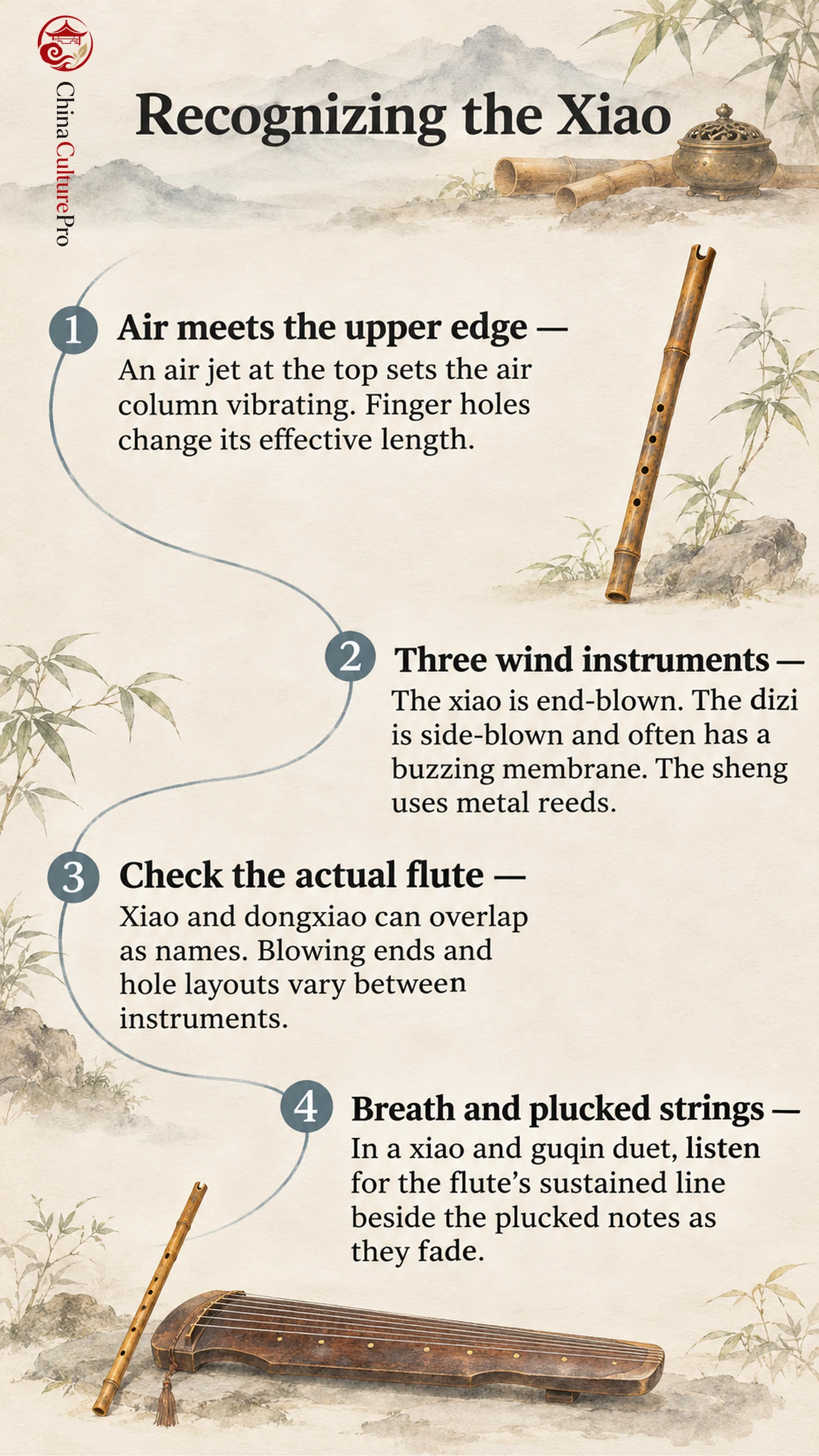
In a duet, a plucked note may begin sharply and fade while a flute tone continues beside it. That difference in how the two sounds unfold is a good way into xiao music. The flute’s outline also offers a clue. Look for one long bamboo tube, with the upper end brought to the lips.
How a Xiao Makes Sound
A player aims a stream of air across a sharp edge at the top of the tube. The air jet interacts with the air column inside the bamboo, which resonates at a pitch. A notch can give the player a defined edge to aim at. The tube points down from the mouth, and the fingers cover holes farther down the body.
Covering or opening a tone hole changes the effective length of the air column. The fingers select among pitches, and changes in breath and lip position can also bring out a higher register. A Yale example has a notch cut into a natural node at the upper end and five front finger holes plus one thumb hole.[1]
Six-hole layouts appear on traditional instruments, and eight-hole designs are also common. A hole for a tassel or a vent should be distinguished from a finger hole. Counting every opening can give a misleading impression of the fingering.[2]
Xiao, Dizi and Sheng Compared
Both the xiao and the dizi (笛子,dízi)are bamboo flutes. The useful visual difference is where the player blows. Many dizi also carry a thin membrane over a separate hole, which adds an audible buzz.[3] The sheng (笙,shēng)uses reeds and a shared chamber, giving it another sound mechanism entirely.[4]
| Instrument | What sets the air vibrating | What to watch for |
|---|---|---|
| Xiao | A jet of air against the edge at the upper end of a single tube. | A tube held down from the lips. |
| Dizi | A jet of air across a side blowing hole, often with a membrane that adds a buzz. | A tube held sideways across the face. |
| Sheng | Metal free reeds supplied with air from a shared wind chamber. | A bundle of pipes rising from a chamber with a mouthpiece. |
The table describes typical forms. Breath, register, instrument design and recording balance can all affect the timbre, so use the way the musician holds and blows into the instrument to confirm a visual identification.
What Names and Surviving Flutes Tell Us
Dongxiao(洞箫,dòngxiāo)is another name used for Chinese end-blown flutes. Catalogs may draw the boundary differently. One Metropolitan Museum record distinguishes a central Chinese example with a notch in a largely closed node from southeastern open-ended instruments it calls dongxiao. Yale also uses the label “Dong xiao” for its instrument with a notched node. Check the actual blowing end when you compare two instruments with the same name.[5]
The Met’s Yuping xiao from Guizhou dates to about 1890 and measures 65 centimeters long. The museum associates its soft tone and inscribed verse with instruments cultivated in scholarly settings. The museum describes this particular instrument as suitable for solo playing and duets. Its design and dimensions describe a surviving example and give no fixed specification for the whole family.[6]
Solo Music, Duets and Ensembles
A xiao can carry a melody by itself. In a duet with the guqin (古琴,gǔqín), a fretless plucked zither, the flute can hold a line across the spaces left by decaying string notes. The contrast leaves room for both instruments to be heard, even when each player leaves space between phrases.
The Smithsonian catalog identifies Meihua San Nong(梅花三弄,Méihuā Sānnòng), commonly translated as Three Variations on the Plum Blossom, as a recorded qin and xiao duet. Follow the start of a flute note and then the plucked strings around it. The breath-colored attack and the different ways the notes fade are easier to separate than in a larger group.[7]
Some Chinese orchestras also add an end-blown flute according to the repertory. Check the credits for the specific piece before assigning every soft wind line to the xiao.
FAQs About the Xiao
How many finger holes does a xiao have?
Six is a traditional layout, and eight-hole instruments also exist. Check the model rather than counting vent holes or openings for decoration.
Is xiao the same as dongxiao?
The terms can overlap. Some catalogs use dongxiao for a particular regional form, while other records use it for a broader range of end-blown flutes.
Does a xiao use a reed or membrane?
A typical xiao sounds through air directed against the edge at the top of the tube. Its normal sound comes from the vibrating air column.
Sources
[1] Yale School of Music. Dong Xiao, 3101.1973
[2] China Culture. Wind Instruments
[3] B.C. Chinese Music Association. Dizi and Flutes
[4] Hong Kong Chinese Orchestra. Wind Instruments
[5] Metropolitan Museum of Art. Xiao, 89.4.56
[6] Metropolitan Museum of Art. Yuping Xiao by Zhishan Zheng
[7] Smithsonian Institution. China, Sound Recording