

Quick Answer: What Is a Yangqin?
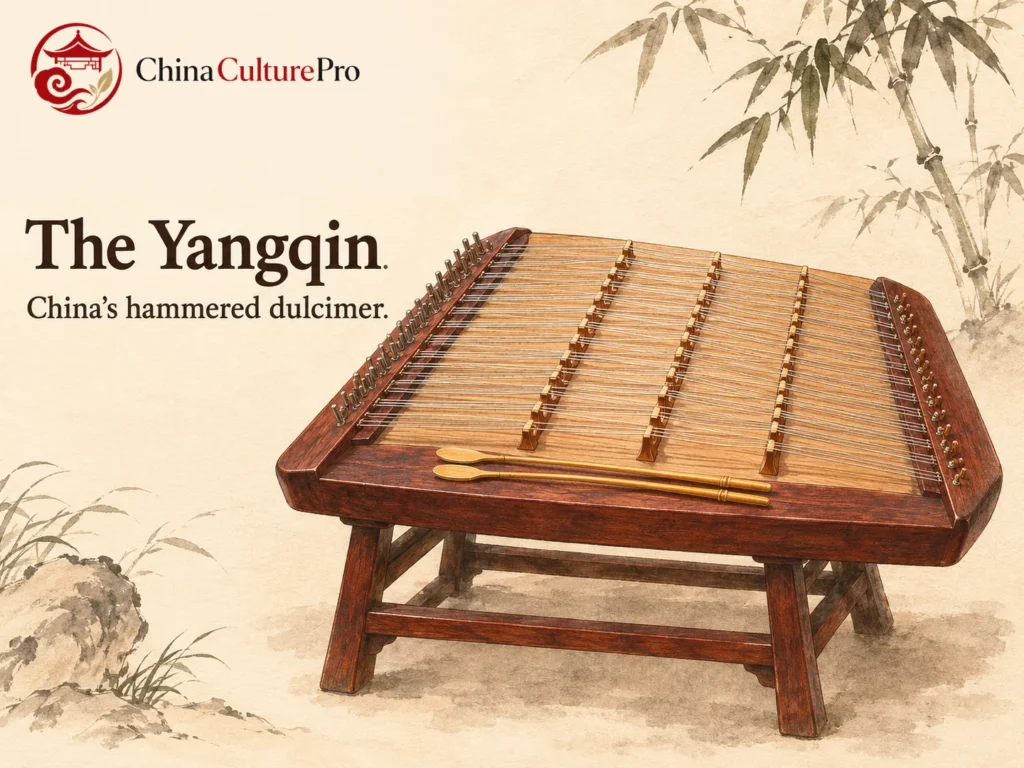
The yangqin(扬琴,yángqín)is a Chinese hammered dulcimer. It has a shallow wooden body and courses of metal strings stretched across bridges. The player holds two slender bamboo beaters and taps the strings to produce a bright attack followed by a ringing tone.
The instrument appears in solo music, regional opera and small ensembles. Modern Chinese orchestras may group it with plucked strings even though its player strikes the strings.
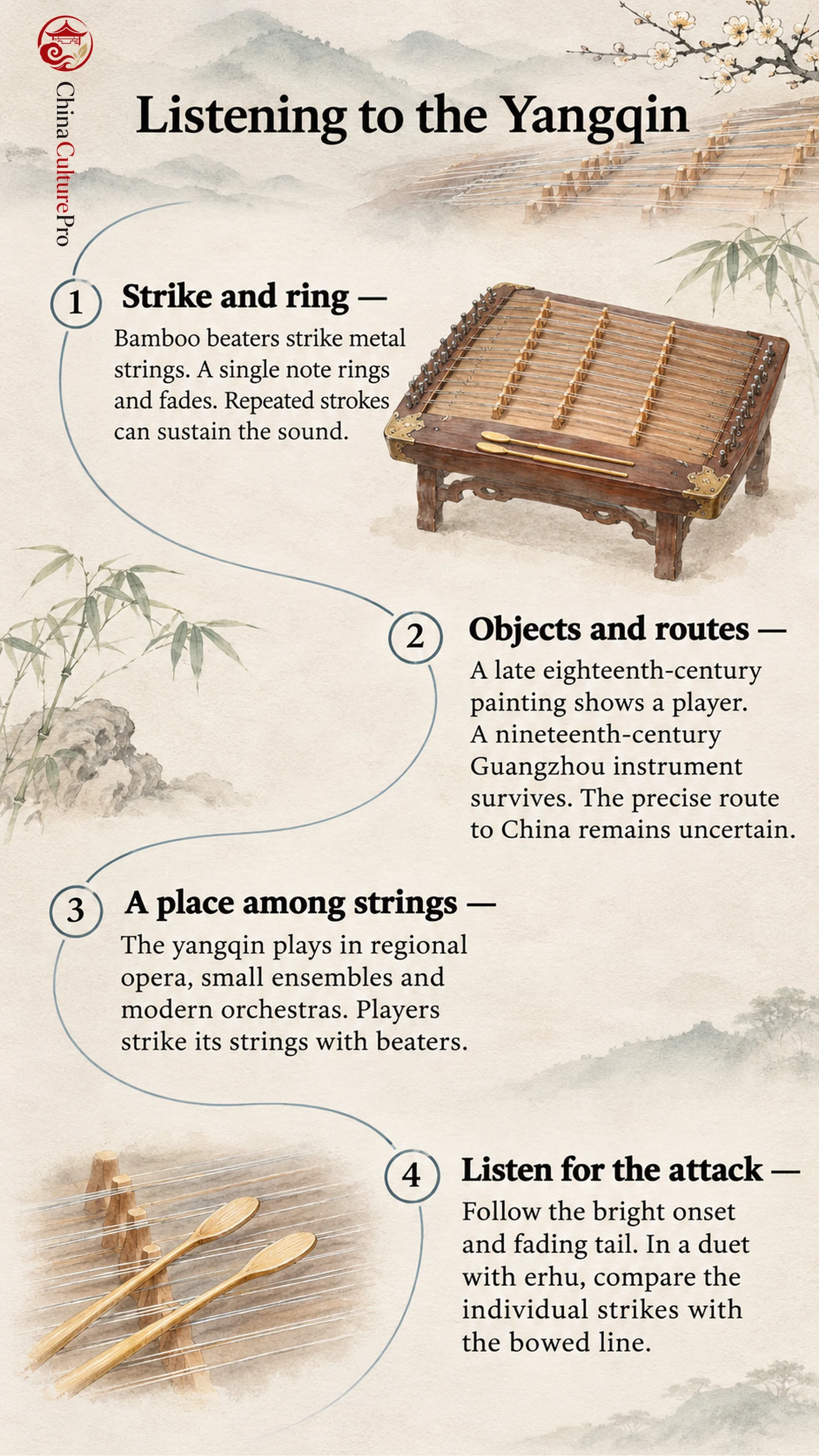
Two small beaters hover over the strings of a yangqin. A single stroke rings out, then several quick strokes make a longer phrase. The same shallow soundbox projects both sounds. Looking at how the strings are set up helps explain why the instrument can mark a pulse, double a tune or carry a solo.
How the Yangqin Makes Sound
The instrument lies horizontally in front of the player. Strings run across a soundboard and rest on bridges, which transfer vibration into the wooden body. Several closely spaced strings can form a course. A stroke from a flexible bamboo beater sets the chosen course vibrating, and the soundboard helps project that vibration into the room. A nineteenth-century Guangzhou instrument in the Metropolitan Museum of Art illustrates the wooden body and metal-string construction.[1]
A tap produces a clear beginning, then the note fades as the strings lose energy. Alternating the beaters rapidly on one course creates a roll, renewing the sound before the preceding strokes have faded. A roll and a single stroke can therefore give the same pitch very different shapes.
| Instrument | How a note starts | What to watch for |
|---|---|---|
| Yangqin | A bamboo beater strikes a course of metal strings. | Two hands above a shallow trapezoidal soundbox. |
| Zheng(筝,zhēng) | The player plucks strings stretched across a long body. | One hand plucks while the other can press strings to bend pitch. |
| Pipa(琵琶,pípa) | The player plucks a string on a fretted lute. | One hand fingers the neck while the other plucks near the body. |
The Hong Kong Chinese Orchestra groups the yangqin with its plucked-string section and identifies its technique as struck-string playing. Section membership describes where it sits in that orchestra. Its sound still comes from a string being struck.[2]
What the Historical Evidence Shows
A Chinese watercolor dated to the late eighteenth century depicts a yangqin player. The nineteenth-century instrument made by the Shop of Refined Tones in Guangzhou adds material evidence of local manufacture. The painting documents a depicted performance. The surviving instrument documents manufacture in Guangzhou. The date of first arrival remains uncertain.[3]
The older spelling(洋琴,yángqín)contains a character associated with things from overseas. The name is consistent with an imported connection, but cannot identify a carrier or route. One museum account suggests a maritime introduction through Guangdong in the Ming period. Another account points to European maritime traders in the eighteenth century and compares the traditional instrument’s shape, tuning and beaters with European dulcimers.[4]
The Persian santur and the yangqin share the broad principle of a struck zither. Similarity makes comparison worthwhile. The surviving Guangzhou object, the watercolor and the proposed routes provide different kinds of evidence, leaving the precise line of transmission open.
The Yangqin in Ensembles and Opera
In Cantonese regional performance, the instrument can reinforce a melody or add bright accents among bowed and plucked strings. Smaller groups can give its attacks more room to stand out. In Jiangnan sizhu (江南丝竹,Jiāngnán sīzhú), the silk-and-bamboo ensemble tradition associated with the lower Yangtze region, it can play within a texture of related melodic lines. Traditional instruments used in different regional styles may differ in tuning and range.[5]
Modern concert designs can extend the pitch range of smaller regional models. In a Chinese orchestra, the clear attack helps a line register among winds and bowed strings. The player can move between supporting notes, quick melodic figures and a solo part. An arrangement determines how prominently listeners hear each of those roles.
How to Hear the Yangqin
The Smithsonian’s recording of the Han Tang Ensemble from April 29, 2002 identifies Li Qun Li on yangqin. In a mixed ensemble recording, listen for short, bright attacks that continue to ring briefly after each stroke. A bowed instrument can maintain its sound through a moving bow. The yangqin’s individual attacks give its ringing notes a different outline.[6]
The concert program Qin: An Infinite Resonance offers two contrasting examples. Ye Yuzhao’s Summer Rain is a yangqin solo, while Tan Dun’s A Poem in Two Parts places the instrument beside the erhu(二胡,èrhú). In the solo, focus on the spaces between strokes and the tail of each note. In the duet, compare the struck sound with the bowed line.[7]
FAQs About the Yangqin
Is a yangqin a string or percussion instrument?
It is a struck string instrument, specifically a box zither. The beaters set the strings vibrating.
Is the yangqin the same as a santur?
They are distinct members of the hammered dulcimer family. Both use beaters on strings, while construction, tuning and playing traditions differ.
Can a yangqin sustain a note?
A single strike rings and decays. Rapid alternating strikes can maintain the impression of a continuous note.
Sources
[1] Metropolitan Museum of Art. Yangqin by the Shop of Refined Tones, Guangzhou
[2] Hong Kong Chinese Orchestra. Plucked-String Instruments
[3] Metropolitan Museum of Art. Watercolor of Musician Playing Yangqin
[4] Center for Traditional Music and Dance. Xiao Xiannian: New Sounds for Chinese Strings
[5] Qi Yi. An Instrumental Guide to the Chinese Orchestra
[6] Smithsonian National Museum of Asian Art. Traditional Chinese Music: The Han Tang Ensemble
[7] Hong Kong Chinese Orchestra. Qin: An Infinite Resonance