

Quick Answer: What Is a Dizi?
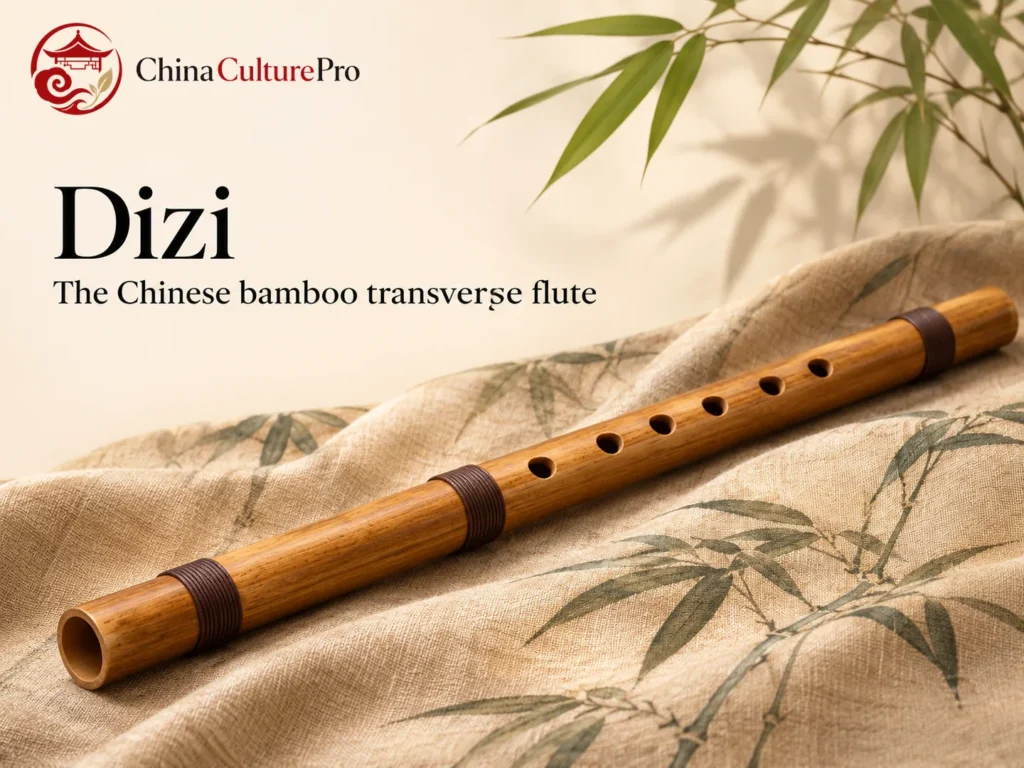
A dizi (笛子, dízi) is a Chinese flute usually made of bamboo and held sideways. A typical traditional model has an extra opening covered with a thin vibrating membrane, which adds a distinct buzz to the flute tone.
- Blowing hole: The player directs air across its edge to start a note.
- Membrane hole: A thin film covers this separate opening and vibrates while the flute sounds.
- Finger holes: Opening or closing them changes the sounding length of the air column.
Some related models omit the membrane. Look at how the flute is held and where the player blows before using the buzz as your only clue. [1][2][3][4]

A bamboo flute can sound clear and airy, then develop a bright buzz as the note settles. On a traditional dizi, that color comes from a film mounted on its own hole. The film has a different job from the player’s fingers or breath.
Blowing Hole, Membrane Hole and Finger Holes
A typical traditional dizi has a blowing hole near one end. Farther along the tube is the membrane hole, followed by a row of finger holes. The player keeps the flute across the face and directs air over the blowing hole. Fingering changes which pitches the tube can support. [1][2]
One measured bamboo flute had six finger holes and additional open vents farther down the tube. Some museum specimens have end vents too. Counting every visible opening would give the wrong number of finger holes because the openings serve different functions. [1][2]
How the Membrane Changes the Sound
The dimo (笛膜, dímó) is a thin film mounted over the membrane hole. The air column sounds when the player blows across the edge. As the film vibrates, it changes the tone and can add a bright, buzzing quality. In play, the film stays in place while the fingers move over other holes. [1][2]
The suona also has a distinctive edge to its sound, but its double reed sits at the mouthpiece and initiates the vibration. Both instruments belong among the winds in Chinese musical instruments. The flute’s membrane and the suona’s reed serve different purposes.
Bangdi, Qudi, Xindi and Xiao
The bangdi (梆笛, bāngdí) is typically a shorter, higher membrane flute. The qudi (曲笛, qǔdí) is generally longer and lower. Players may use several sizes and keys, so the two names describe types rather than single pitches. A xindi (新笛, xīndí) is a related side-blown flute without a membrane. [3][4]
A xiao (箫, xiāo) is an end-blown flute held down from the mouth. In a performance video, the easiest distinction is where the breath enters. A dizi player blows across the side of the tube, while a xiao player blows at the end. [1][3]
Where to Listen for the Dizi
A late nineteenth-century bamboo dizi carries lines from a poem by Wang Wei. Flutes of that kind were used in Kunqu opera, where the sound works alongside singing and action. The guide to Chinese performing arts puts that theatrical role in context. [2]
In a Jiangnan silk-and-bamboo recording, follow the flute as the bowed and plucked instruments shape the same tune. Then listen again for notes where the flute’s buzz stands out from the ensemble. See Chinese traditional music for more on that listening comparison. [5]
FAQs About Dizi
How Many Finger Holes Does a Dizi Have?
Six are common on traditional models. The blowing hole, membrane hole and any end vents are separate from the finger holes. Designs vary. [1][3][4]
Does Every Dizi Have a Membrane?
Traditional bangdi and qudi have membranes. The related side-blown xindi omits one. [4]
Is the Dizi a Reed Instrument?
It is an edge-blown flute. The membrane modifies the tone after the airstream sets the air column vibrating. [1][2]
Sources
[1] Xinyu Luan and colleagues. Acoustical Analysis of the Chinese Transverse Flute
[2] The Metropolitan Museum of Art. Dizi, accession 89.4.62
[3] Duke University Musical Instrument Collections. Dízi
[4] Hong Kong Chinese Orchestra. Instrumentation and Range Table
[5] Grinnell College Musical Instrument Collection. Sizhu Ensemble from China