

Quick Answer: How Can You Read China’s Cultural World Heritage Sites?
Read China’s cultural World Heritage sites by asking what each place preserves and what the physical evidence shows. A settlement can reveal how residents managed water, a tomb complex can record a court’s beliefs, and a port can show how goods and people moved. Cultural landscapes (文化景观, wénhuà jǐngguān) preserve relationships between people and their surroundings. [1][2]
- Landscapes and settlements: Follow cultivated ground, water systems and the layout of homes.
- Capitals and ritual sites: Read walls, halls, tombs and carvings for clues about rule and belief.
- Trade and exchange: Compare street plans, docks, workshops and places of worship.
These themes help you compare sites. Each UNESCO property has its own boundaries and reasons for inscription. [1][2]
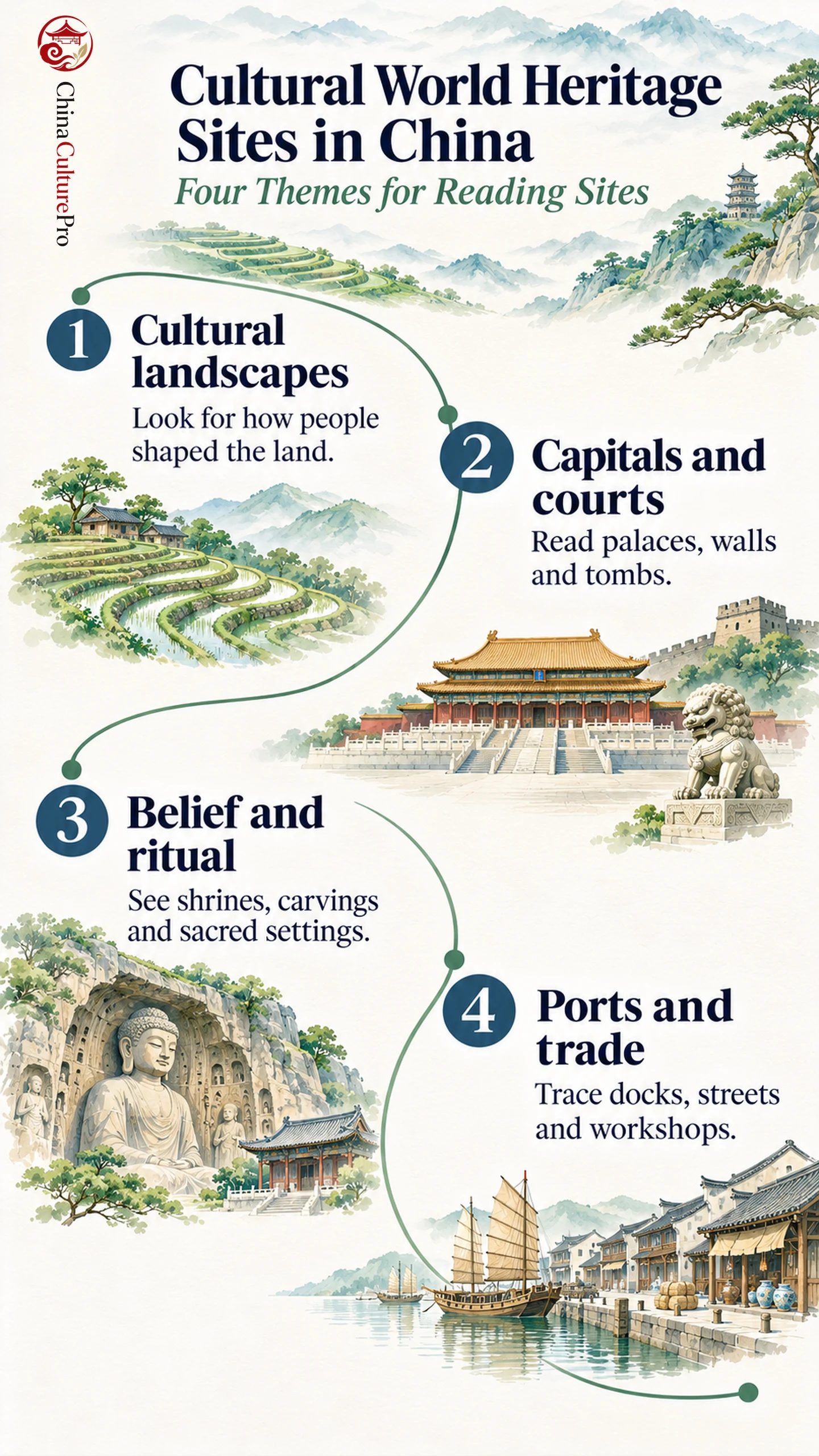
The easiest way to make sense of a long World Heritage list is to start with a question you can ask of more than one site. The examples below connect each question to features you can look for in plans and photographs.
Four Ways to Compare Cultural Sites
| Theme | Empiece aquí | Pruebas que conviene buscar |
|---|---|---|
| Cultural landscapes and settlements | Old tea forests of Jingmai Mountain | Old tea trees, forest cover and villages shaped by long-term cultivation |
| Capitals and political authority | Site of Xanadu | Walls and building remains from a seasonal capital |
| Belief and ritual | Zuojiang Huashan Rock Art Cultural Landscape | Painted figures and their placement on river cliffs |
| Ports and trade | Quanzhou in the Song and Yuan periods | Docks, religious buildings and production sites linked to maritime trade |
Landscapes and settlements
The tea forests of Jingmai Mountain preserve the imprint of Blang and Dai practices. In Xidi and Hongcun, houses and lanes reveal how Huizhou villages took shape. The waterways of the Old Town of Lijiang offer another way to read a settlement. Ask how people incorporated the local terrain and water into where they built and lived. [1][3]
Capitals and political authority
At the Site of Xanadu, walls and traces of buildings help locate the institutions of a seasonal capital. The Shenyang Imperial Palace preserves a different court setting and is inscribed alongside Beijing’s palace. The Koguryo capitals and tombs pair evidence of city building with paintings and structures from elite burials. [1][4]
Belief and ritual
With the Huashan cliff paintings, consider the figures and the river setting together. At Mount Qingcheng, temples and paths help show how a mountain became a sacred setting. In the mixed Mount Emei and Leshan property, the Leshan Giant Buddha is a cultural feature whose position at a river confluence matters to how it is seen. [1][5]
Ports and trade
Read Quanzhou through its docks, religious buildings and production sites. In the Historic Centre of Macao, Chinese temples, Christian churches, public buildings and streets show how a trading port brought different communities into the same streets. These contrasts connect the study of Chinese architecture with China’s cultural geography. [1][6][7]
How to Tell the UNESCO Programs Apart
The World Heritage List covers places and their designated components. UNESCO’s Intangible Cultural Heritage lists cover living practices such as the farmers’ dance of China’s Korean ethnic group and China’s traditional tea skills and customs. Jingmai’s tea forests are a World Heritage property in their own right. [1][3][8][9]
FAQs About China’s Cultural World Heritage Sites
What is a mixed World Heritage site?
It meets both cultural and natural criteria. The UNESCO country list shows mixed properties in their own category. [1][2]
Can a World Heritage property include several places?
Yes. A serial property links multiple components under one inscription. Quanzhou, for example, connects features that supported regional and international trade. [6]
Where can I check what an inscription actually includes?
Start with the property entry on the UNESCO World Heritage Centre website. Read its statement of Outstanding Universal Value and consult its maps when you need to check components or boundaries. [1][2]
Fuentes
[1] UNESCO World Heritage Centre. China’s World Heritage Properties
[2] UNESCO World Heritage Centre. The Criteria for Selection
[3] UNESCO World Heritage Centre. Cultural Landscape of Old Tea Forests of the Jingmai Mountain in Pu’er
[4] UNESCO World Heritage Committee. Decision on the Capital Cities and Tombs of the Ancient Koguryo Kingdom
[5] UNESCO World Heritage Centre. Zuojiang Huashan Rock Art Cultural Landscape
[6] UNESCO World Heritage Centre. Quanzhou: Emporium of the World in Song-Yuan China
[7] UNESCO World Heritage Centre. Historic Centre of Macao
[8] UNESCO Intangible Cultural Heritage. Farmers’ Dance of China’s Korean Ethnic Group
[9] UNESCO Intangible Cultural Heritage. Traditional Tea Processing Techniques and Associated Social Practices in China