
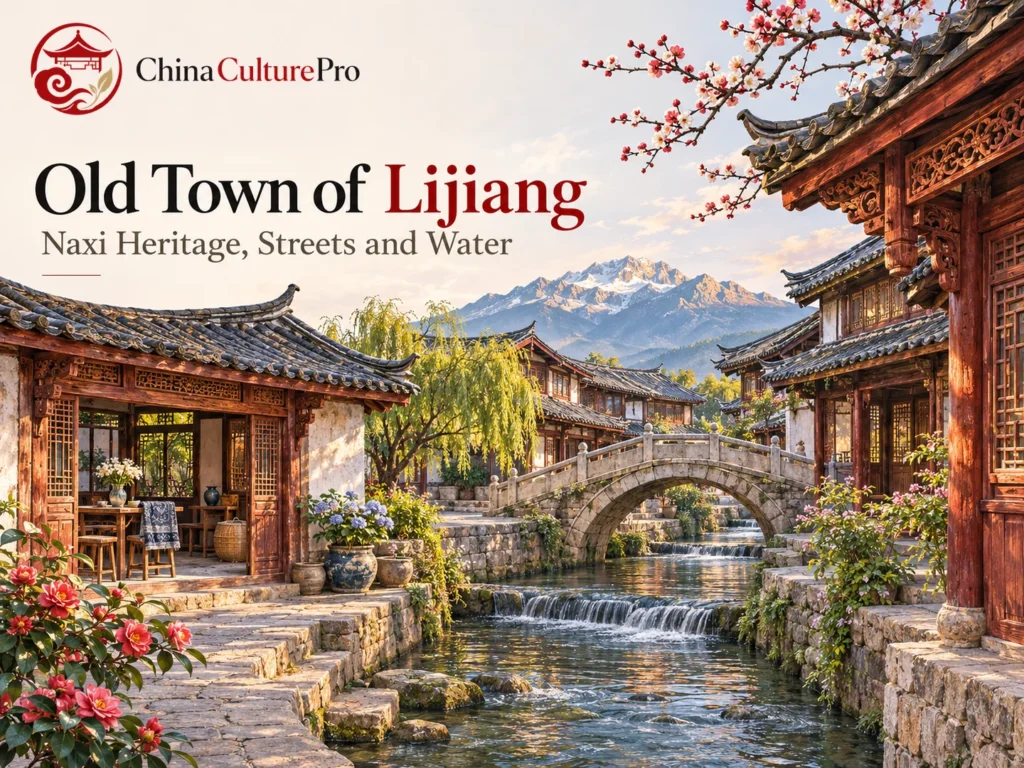

Quick Answer: What Is the Old Town of Lijiang?
The Old Town of Lijiang is a UNESCO World Heritage property in Yunnan. It includes Dayan (大研, Dàyán) with Black Dragon Pond, and the separate residential clusters of Baisha (白沙, Báishā) and Shuhe (束河, Shùhé). The three parts preserve how settlements responded to mountain-fed water, trade and the building traditions of several communities. [1][2]
- Water: Springs and streams reach Black Dragon Pond and feed channels that run through the old town. [1]
- Buildings: Timber houses, tile roofs, courtyard walls and carved work reflect Naxi building practices and exchanges with neighboring communities. [1][3]
- Trade: Lijiang developed as a center for exchange between Yunnan, Sichuan and Tibet. [1][3]
The UNESCO name covers more than the central streets often associated with Lijiang’s old town.
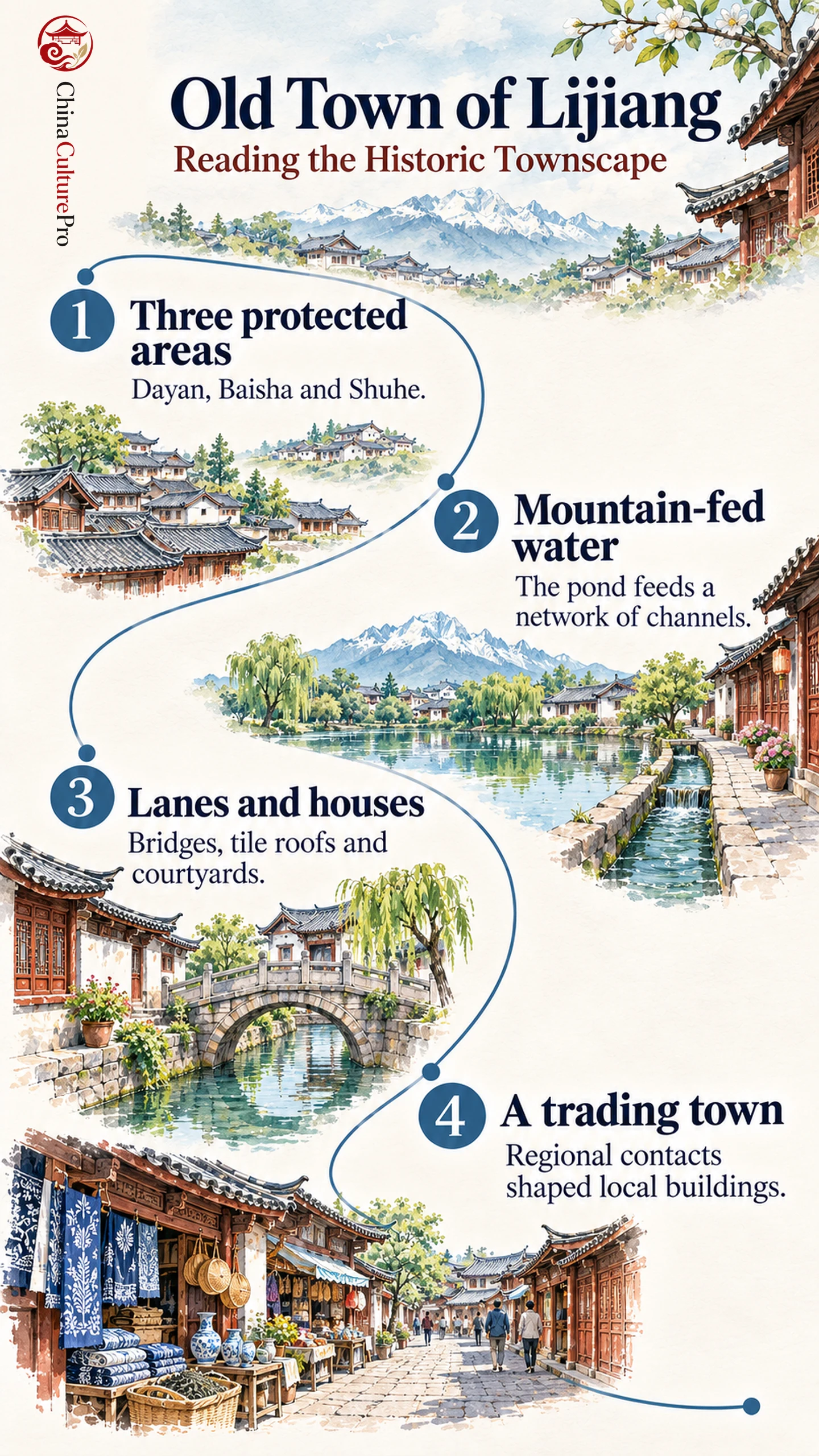
Look for a place where a bridge, a bend in a channel and the entrance to a house meet. That junction makes it possible to read the old town as a settlement with an organized water supply.
The Three Parts of the World Heritage Property
| Componente | What UNESCO includes | Qué buscar |
|---|---|---|
| Dayan Old Town | The main historic urban component, including Black Dragon Pond. [1][2] | Water crossings, lanes and houses along uneven ground. [1][3] |
| Baisha | A residential cluster separate from Dayan. [1][2] | Surviving village-scale buildings and the Baisha murals at a distinct historic center. [1] |
| Shuhe | Another residential cluster within the same property. [1][2] | A smaller settlement beside water with its own surviving street pattern. [1][2] |
Dayan is the most recognizable component for many visitors, but the protected property also includes two distinct residential clusters. UNESCO inscribed the Old Town of Lijiang in 1997. Its component maps show the distance between each of the three parts and their different boundaries. [1][2]
How Water Systems Shaped Streets and Homes
The mountain landscape feeds streams and springs on the Lijiang plain. Water from Black Dragon Pond moves through branches and smaller channels. Bridges allow people to cross the channels, and rows of homes follow the terrain beside them. The network joins the physical form of the town to the movement of everyday life. [1]
A World Bank heritage study describes wells with three openings traditionally used for drinking water, cleaning vegetables and washing. Thus, the openings served different household tasks. The historical arrangement shows how people assigned jobs to water in shared spaces. At Xidi and Hongcun, water and houses also meet, with village streams and ponds forming different patterns. [4]
How Trade and Naxi Building Traditions Meet
Lijiang’s position made it a place for goods and people moving between the regions around it. UNESCO describes gateways, screen walls, courtyards and carved roof beams among the features of its tile-roofed timber houses. Those features show architectural exchanges and ways builders adapted to local conditions. [1][3]
The old town gives a spatial view of Naxi heritage. Dongba writing provides different evidence for the community’s written and ritual traditions. The town’s commercial role also poses a different question from the administrative buildings at China’s Tusi sites, where structures help explain the authority of hereditary chieftains.
FAQs About the Old Town of Lijiang
Is Dayan the same as the Old Town of Lijiang property?
Dayan, including Black Dragon Pond, is one component. Baisha and Shuhe are included as separate residential clusters. [1][2]
Where do the historic channels get their water?
UNESCO describes springs and rivers from the mountain landscape that supply Black Dragon Pond and the town’s network of channels. [1]
Why does Lijiang preserve several building traditions?
Lijiang was a center of trade where different communities met over long periods. Its houses preserve forms associated with Naxi builders and features adapted from neighboring traditions. [1][3]
Fuentes
[1] UNESCO World Heritage Centre. Old Town of Lijiang
[2] UNESCO World Heritage Centre. Old Town of Lijiang Component Maps
[3] UNESCO World Heritage Centre. Old Town of Lijiang Periodic Reporting Section II
[4] World Bank. Lijiang Heritage and the Historic Water System