


Quick Answer: What Is Chinese Painting?
Traditional Chinese painting (国画, guóhuà) includes brushwork in ink or colored pigments, often on paper or silk. A work can be described by what it depicts, how the artist makes the marks and how the finished image is mounted or displayed.[1][2][3]
- Subject: Paintings can depict people, landscapes, birds, flowers and other motifs.
- Brushwork: Some forms rely on precise outlines, others on broad or abbreviated marks.
- Format: A scroll opens for viewing, while a mural is seen in place.
These descriptions answer separate questions. A single painting can fit several of them at once.
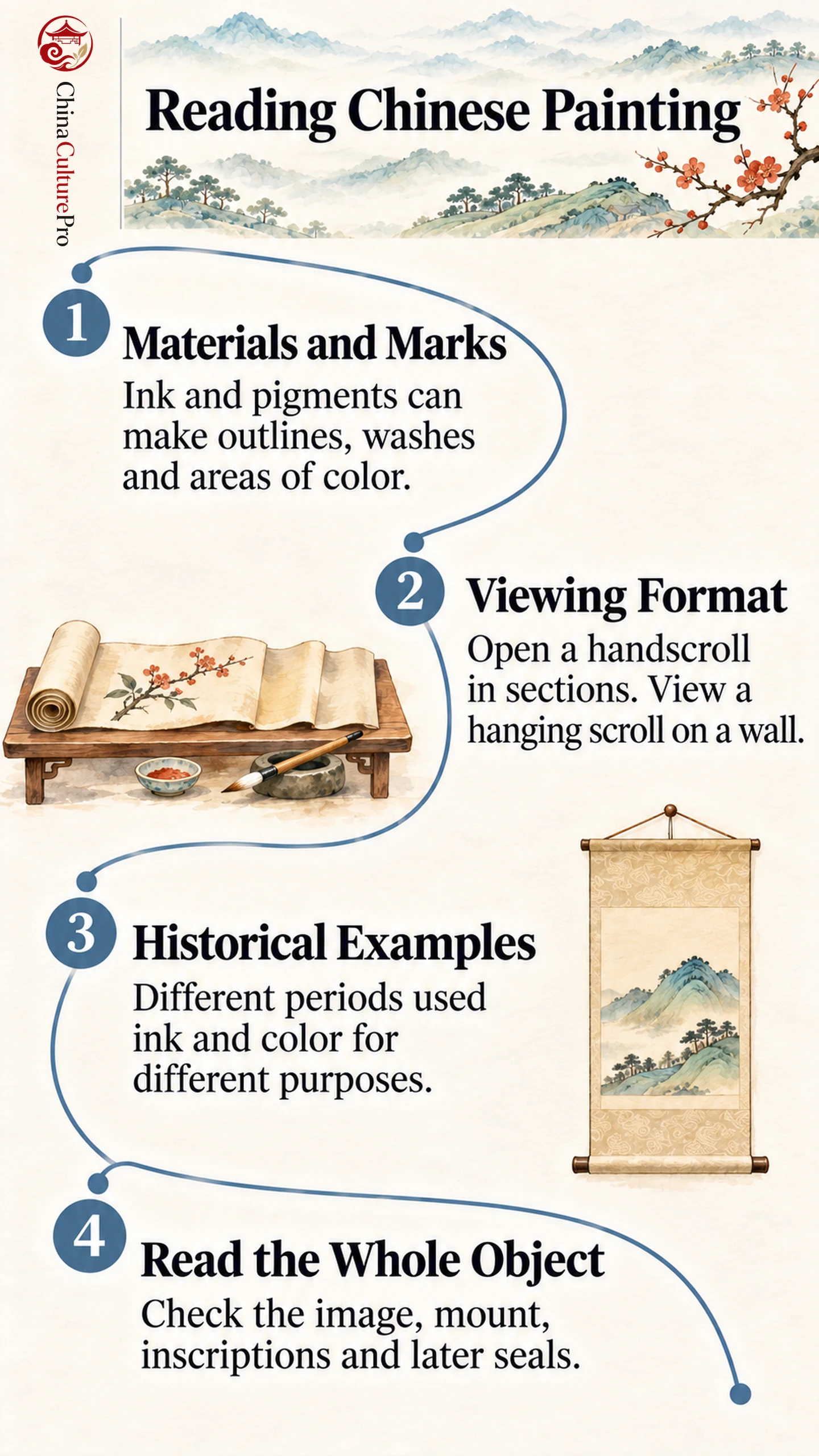
Read the medium line on a museum label, then step back to see how the painting is meant to open or hang. The paper, the brush marks and the mounting can tell different stories about the same object.
Materials, Subjects and Brushwork
Ink can supply a thin contour, a dark accent or a light wash. Colored pigments can define a form, tint an area or make color central to the design. Paper and silk take brush marks differently. A label such as “ink and color on silk” describes the materials. The guide to Chinese ink painting explains what artists can do with ink on those surfaces.[2][8]
Subject names are another layer. Landscape painting often organizes mountains, water and paths. Figure painting can depict people in portraits, narratives or religious scenes. Pintura de aves y flores can include plants, insects and animals. A long scroll may combine several kinds of subject.[1][5][6][8]
Gongbi (工笔, gōngbǐ) describes careful, precise brushwork. Xieyi (写意, xiěyì) emphasizes a freer handling of forms and expressive marks. Color often appears with gongbi, and ink is prominent in xieyi. Either approach can use color. The comparison of gongbi and xieyi shows why the terms refer chiefly to handling.[2]
How Format Changes the Way You Look
| Format | How it is encountered |
|---|---|
| Handscroll (手卷, shǒujuàn) | A horizontal work that is unrolled in sections, commonly from right to left. |
| Hanging scroll (立轴, lìzhóu) | An image mounted to hang for viewing, often vertically. |
| Album | Separate leaves that can be studied one opening at a time. |
| Abanico | A painted surface with the shape of a fan, sometimes remounted in an album or scroll. |
| Screen or wall painting | An image encountered in relation to a room or architectural surface. |
A screen painting can survive after being remounted. A fan may sit within a larger album leaf. The present mount can be newer than the painting it holds. The guide to Chinese scroll painting formats explains how mounting affects display and handling.[3]
Chinese Painting Across Historical Periods
Night-Shining White, Han Gan’s Tang horse painting in the Met, uses ink on paper. Its compact painted area became part of a much longer handscroll as comments, seals and mounting materials accumulated. By the Song, landscape had acquired particular prominence. Song collections also include finely observed birds and plants. The Met’s Finches and Bamboo, by Emperor Huizong, uses ink and color on silk. The same period therefore gives readers several different ways to study brushwork and subject.[1][4][5]
A Yuan example shows how color and scholar painting can overlap. The Met’s Pear Blossoms, dated to around 1280 and currently catalogued as the work of an unidentified artist after Qian Xuan, uses ink and pale color on paper. Its painted branch and poem belong to a tradition where image and writing can be read together.[6]
In the Ming, Shen Zhou’s Autumn Colors among Streams and Mountains explored brush methods associated with four Yuan painters. The title evokes autumn color. The catalogue lists ink on paper as the medium. The work demonstrates how literati painting could use earlier models to develop a new composition.[7]
The Qing court also commissioned large color paintings. The third scroll of the Kangxi Emperor’s Southern Inspection Tour, by Wang Hui and assistants, uses ink and color on silk to show a passage through Shandong to Mount Tai. Mountains, routes and towns give the imperial journey a visible setting. Individual paintings can share a subject while serving very different purposes.[8]
How to Read a Chinese Painting in a Museum
Start with the date, medium, support and format in the catalogue. Then look separately at the image area, its surrounding mount and any writing. An inscription can comment on the scene or record the circumstances of its making. Later owners or viewers can add their own seals and words.[1][3][4]
A seal can help trace authorship, ownership or appreciation, depending on whose seal it is and when it was added. The guide to inscriptions and seals in Chinese painting explains those different functions. Read the attribution field closely when it says “after,” “attributed to” or “unidentified.” Those words convey what the catalogue can establish about the maker.[1][4][6]
FAQs About Chinese Painting
Is Chinese painting always made with black ink?
Chinese paintings can use black ink alone or ink with pigments. The medium line in a collection record describes the combination on a specific work.
What is the difference between gongbi and xieyi?
Gongbi emphasizes careful, precise brushwork. Xieyi emphasizes freer handling and expressive marks. They describe approaches that can be used across subjects.
How is a handscroll viewed?
A handscroll is usually opened from right to left in sections. Each new passage appears as the previous part is rolled up.
What do the seals and writing mean?
The artist, a collector or a later viewer may have added writing and seals. Their function depends on the individual mark and the history of the work.
Fuentes
[1] The Metropolitan Museum of Art. Pintura china
[2] Asian Art Museum. A Visual Vocabulary of Brushstrokes
[3] Asian Art Museum. Formats of Chinese Painting
[4] The Metropolitan Museum of Art. Anatomy of a Masterpiece: How to Read Chinese Paintings
[5] Princeton University Art Museum. Chinese Landscape Painting during the Song Dynasty
[6] The Metropolitan Museum of Art. Pear Blossoms, After Qian Xuan, 1977.79
[7] The Metropolitan Museum of Art. Shen Zhou: Autumn Colors among Streams and Mountains
[8] The Metropolitan Museum of Art. Wang Hui and Assistants: Kangxi Emperor’s Southern Inspection Tour, Scroll Three