
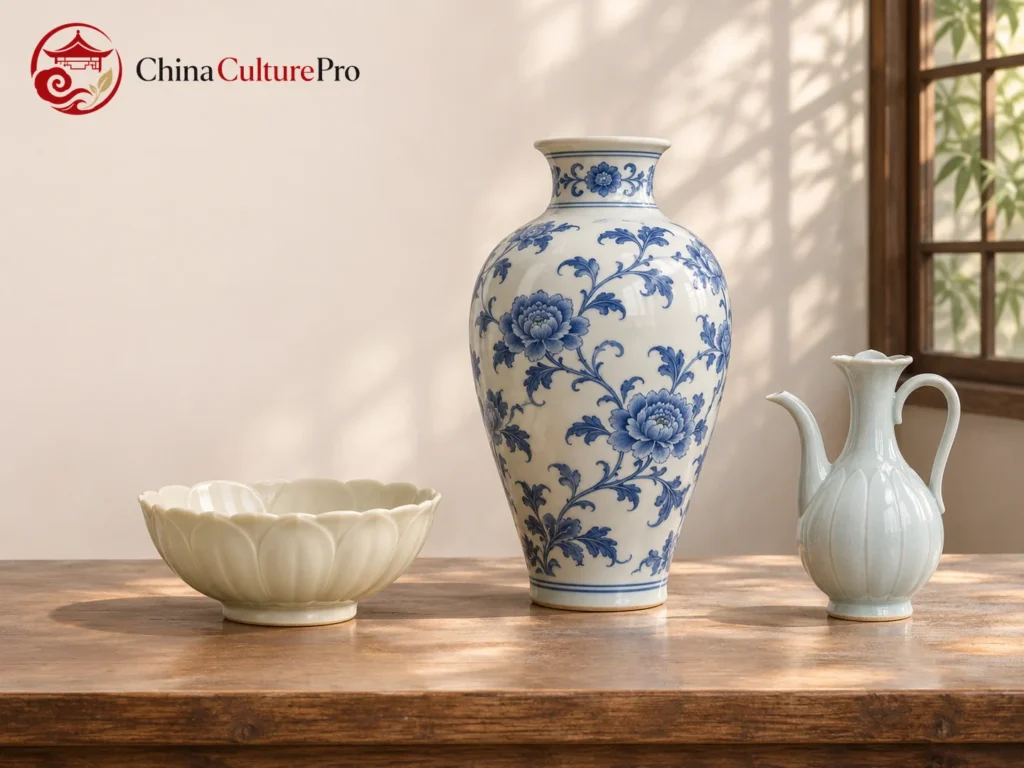

Quick Answer: What Is Chinese Porcelain?
Chinese porcelain (瓷器, cíqì) is a high-fired ceramic with a hard, dense body. Many examples have a pale body and transmit some light where the walls are thin. Chinese kilns made plain white pieces, wares with tinted glazes and vessels with decoration painted under or over a glaze. [1][2][3][4]
- The body and glaze tell you different things. A dense pale body can carry a clear glaze, a colored glaze or several layers of decoration. [1][5][4]
- Blue and white is one tradition. Ding ivory wares, Jingdezhen pale glazes and Dehua white figures show other ways to use the material. [5][6][7][8]
- A kiln’s products could go to several markets. At Jingdezhen, court orders, domestic trade and export all supported production. [5][9][10]
Read the body, the surface and the maker’s context as separate clues.
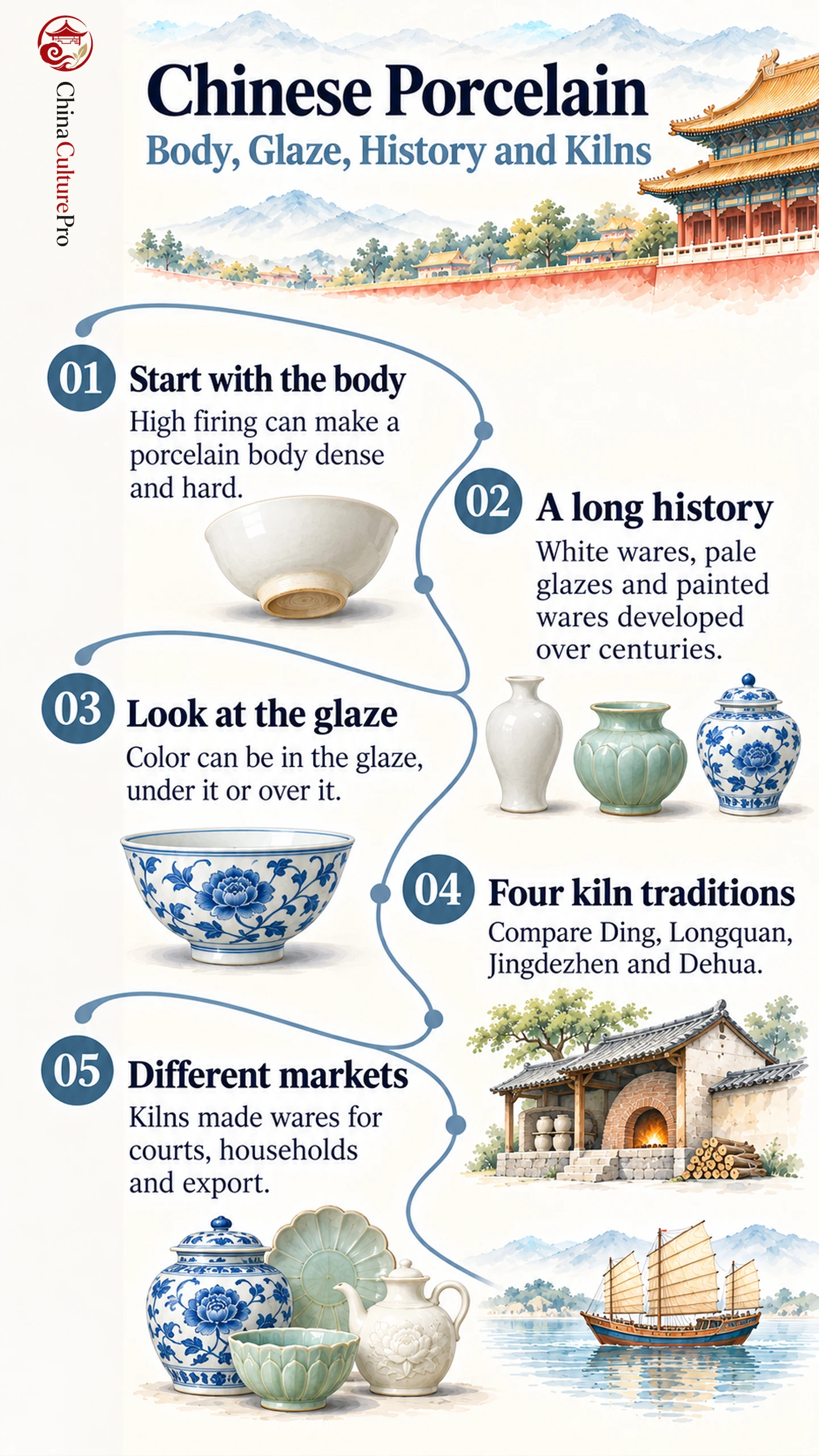
Start with a dish at a museum. Its glaze might be green, its body pale, and its base marked with writing. Each of those clues answers a different question about what the dish is, how it was made and where it may have come from.
What Makes a Ceramic Porcelain
The body is the fired material that gives a vessel its shape. The glaze is a glassy layer on the surface. At high firing temperatures, part of a porcelain body becomes glassy and binds the other material into a hard, dense form. Pale raw materials and the way a vessel is made can leave it white or slightly translucent, especially at a thin edge. [1][5][9]
Raw materials and recipes varied. At Jingdezhen, early potters worked with local porcelain stone. Kaolin later became an important ingredient. Together with preparation and firing, the choice of materials affects how white and dense a body can be. An unglazed part of the foot can show the body beneath the surface coating. [1][5][10]
The terms for pottery and porcelain depend partly on the context of the label. Chinese histories may group certain high-fired wares with porcelain, while English-language collections call some of the same wares stoneware. Body and surface descriptions make those labels easier to interpret. [2][3][11]
How Chinese Porcelain Developed
Chinese potters made high-fired precursors long before white porcelain became widespread. The Met’s Sui–Tang bowl is an example of early white porcelain. The museum notes that the material became more widely used for everyday goods and burial objects after the late sixth century. Northern kilns such as Xing became important producers of white ware. At the same time, makers continued producing other ceramics, including low-fired lead-glazed Tang sancai. [2][12][3]
During the Song period, kiln traditions included the ivory-toned Ding wares of the north and translucent pale glazes at Jingdezhen. Jingdezhen’s qingbai (青白, qīngbái) wares have a translucent glaze with a slight blue tint. A lighter body and a glaze that can look bluer where it gathers made it possible to bring out the fine contours of a bowl or ewer. Longquan became known for green glazes, with its own range of bodies and forms. [2][3][5][7][11][13]
In the Yuan period, Jingdezhen potters developed a substantial trade in porcelain painted with cobalt under the glaze. Ming porcelain includes blue-and-white, monochrome and multicolored wares. Qing potters continued earlier techniques and developed enamel palettes and forms for different users. Many of these techniques remained in use together. [3][5][6][4][9]
How to Read Color and Decoration
Color can come from the glaze or from painting applied at a different stage. A celadon glaze gets its color from iron and firing conditions. Qingbai is another tinted glaze tradition. A relief or cut design under a translucent glaze may show through the glaze or become more visible where the coating collects. [3][5][7][11]
For much blue-and-white porcelain, an artist painted with cobalt on the body, then a transparent glaze went over the painting before firing. Overglaze enamels go onto a glazed surface and require a further firing. Terms such as famille rose and famille verte describe groups of enamel colors used in particular traditions. Some objects combine underglaze and overglaze painting. [6][4]
Chinese celadon is a useful example of why a glaze term and a body term do different jobs. One Longquan dish can have a luminous green celadon glaze and a body a museum classifies as stoneware. Look for both descriptions when you read the label. [2][3][11]
Compare a twelfth-century qingbai vase in the Met’s collection with its early Ming Longquan plate. In the first, a pale bluish glaze coats a flower-shaped porcelain body. The Longquan piece presents an incised lotus under a greener coating on stoneware. Flowers are involved in both designs. In one, the overall shape supplies the motif. In the other, a design cut into the surface is part of what you see through the glaze. [11][14]
Four Kiln Traditions to Compare
| Kiln tradition | Ubicación | A distinctive example |
|---|---|---|
| Ding | Northern China, in present-day Hebei | Thin pale bowl or dish with an ivory-toned glaze |
| Longquan | Zhejiang | Green-glazed ware with incised or molded decoration |
| Jingdezhen | Jiangxi | Qingbai and later cobalt-painted or enameled porcelains |
| Dehua | Fujian | Lustrous white vessels and figures |
Kiln names are useful starting points. The Ding dish in the Met’s collection has a scalloped rim that echoes shapes used in metalwork. Its early Ming Longquan plate carries an incised lotus design. Dehua’s white wares also took a variety of forms, including figures and desk objects. Jingdezhen porcelain represents a network of workshops, material sources and markets. [5][7][11][8][10]
The Jingdezhen sites also preserve parts of the production system outside the kiln itself. UNESCO records raw material sources, wharves, roads, workshops and kiln remains. Looking at those sites together shows the work needed to bring prepared material, fuel and finished wares through the same district. [10]
Court, Household and Export Markets
A court commission could specify forms or decoration. At Longquan, early Ming court orders included green-glazed pieces with incised designs. Jingdezhen workshops served the court as well as domestic and overseas buyers. These markets could coexist in one production region. [5][9][11][10]
Trade brought Chinese wares to buyers across Asia and later in large quantities to Europe. Some forms and designs responded to orders from overseas. A museum label may call a vessel export porcelain because of the market it was made for. That description can sit alongside the technique and the place of manufacture. [5][6][9][8]
A vessel can carry evidence of more than one place in that trading history. The body might have been made in Jingdezhen, while the design was intended for a buyer in another region. The place of manufacture and the intended market answer separate questions. [5][9]
Base inscriptions offer another clue. Chinese porcelain marks can name a reign or contain other information. Later pieces could carry earlier reign names, sometimes as a reference to admired wares. Shape, body, glaze and recorded ownership help put an inscription in context. [3][4][15]
FAQs About Chinese Porcelain
Is all Chinese porcelain blue and white?
Chinese potters made ivory-toned and white wares, pale glazed pieces and porcelains with several enamel colors. Blue and white is one long-lived form of decoration. [3][6][4][7][8]
Is celadon always porcelain?
Celadon identifies a glaze tradition. Some celadon wares, including a number of Longquan pieces, have bodies described in English-language museums as stoneware. [2][3][11]
What makes Jingdezhen important in porcelain history?
Jingdezhen combined raw materials and specialized workshops with court, domestic and overseas demand. Its potters produced qingbai, blue-and-white and many other porcelain types over several centuries. [5][6][9][10]
Fuentes
[1] National Museum of Asian Art. Porcelana
[2] National Museum of China. Ancient Chinese Porcelain Art
[3] The Museum of Oriental Ceramics, Osaka. A Brief History of Chinese Ceramics
[4] The British Museum via Smarthistory. Chinese Porcelain: Decoration
[5] National Museum of Asian Art. Jingdezhen
[6] Victoria and Albert Museum. Chinese Blue-and-White Ceramics
[7] The Metropolitan Museum of Art. Dish with Scalloped Rim
[8] The Metropolitan Museum of Art. Bottle with Coiling Dragon
[9] The British Museum via Smarthistory. Chinese Porcelain: Production and Export
[10] UNESCO World Heritage Centre. Jingdezhen Handicraft Porcelain Industry Sites
[11] The Metropolitan Museum of Art. Foliated Plate with Lotus
[12] The Metropolitan Museum of Art. Sui–Tang Bowl
[13] The British Museum. Chinese Ceramics Gallery Guide
[14] The Metropolitan Museum of Art. Vase in the Shape of a Flower
[15] Christie’s. A Guide to Reign Marks on Chinese Ceramics