


Quick Answer: What Is Ming Porcelain?
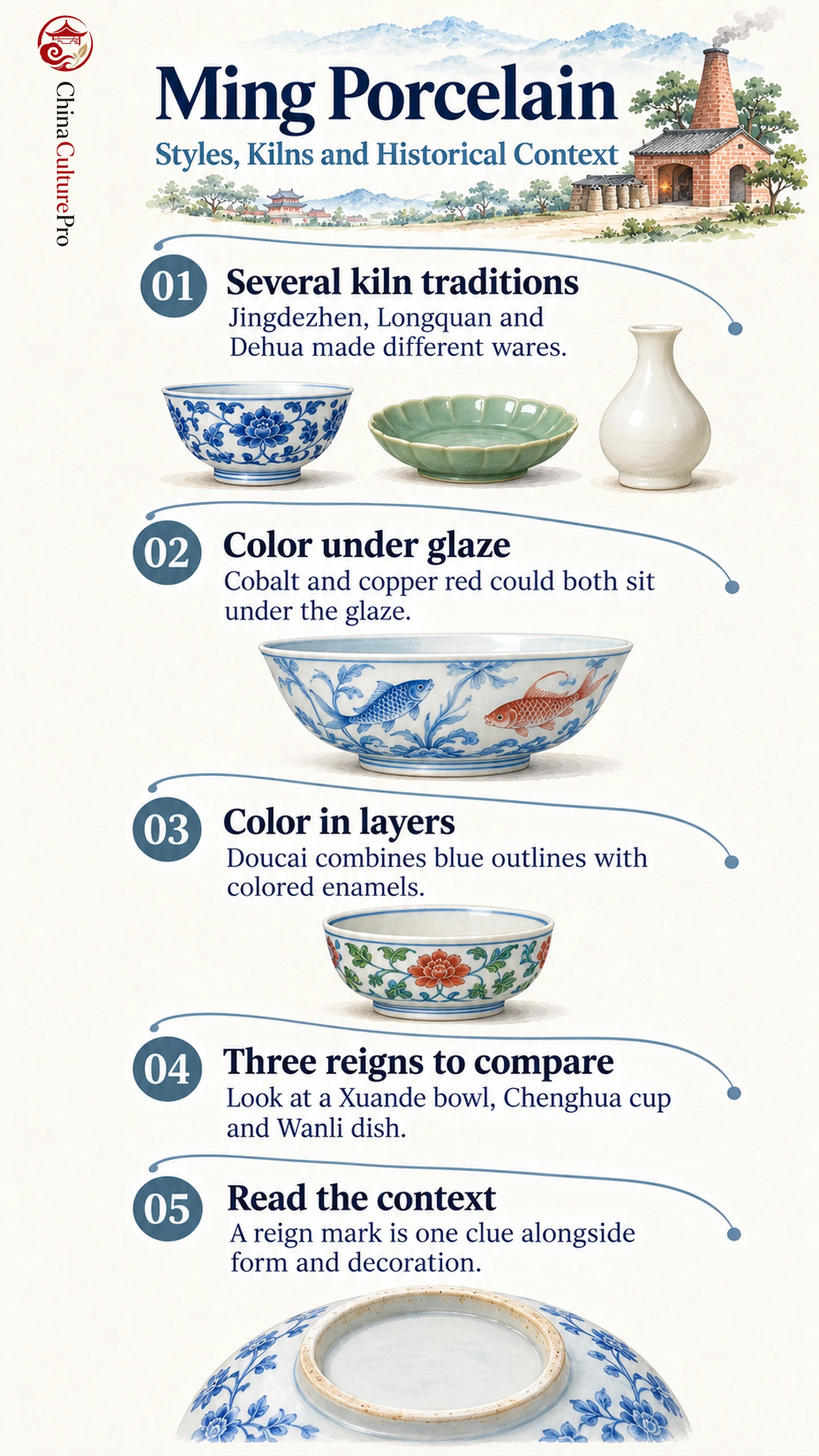
Ming porcelain was made during the Ming dynasty, from 1368 to 1644. Jingdezhen was a major center, but its workshops and those elsewhere made very different wares. A piece might carry cobalt under the glaze, colored enamels on top of it, or a single glaze color. [1][2][3][4][5]
- Blue and white was one important style. Ming potters also made copper-red wares, colored enamels, white porcelain and green-glazed ceramics. [1][3][4][6][7]
- The layers help distinguish painted styles. In doucai (斗彩, dòucǎi), underglaze blue outlines can be filled with color in overglaze enamel. [5][8]
- A reign name needs context. A later object may repeat an earlier Ming mark, while a catalogued period piece can carry both a contemporary mark and evidence of its date. [6][9][10]
Read the period, place and decoration as separate descriptions of the same object.
The word Ming identifies a period, but it does not tell you how the color went onto a bowl or who ordered it. A blue line under glaze and a yellow patch over glaze tell different parts of the object’s story.
Jingdezhen and Other Ming Kilns
Jingdezhen in Jiangxi was one of the most important places for Chinese porcelain. Workshops there used local materials and specialized production to meet different demands. Some supplied the Ming court, while private kilns made goods for buyers in China and abroad. Calling something Jingdezhen porcelain identifies a production center and leaves questions about technique and intended use open. [1][2][11]
Other regions developed distinctive high-fired wares. In Zhejiang, Longquan kilns made green-glazed celadon, including pieces ordered for the early Ming court. English-language museums classify some of those pieces as stoneware. At Dehua in Fujian, pale and lustrous white porcelains included religious figures, vessels and objects for a desk. [1][3][4]
Early Ming Blue and White and Copper Red
By the Ming period, painting with cobalt under a transparent glaze was well established. The Met’s Xuande bowl with pomegranates, lotus scrolls and chrysanthemum petals shows how different bands of decoration can fit one rounded vessel. The bowl’s catalog dates it to the Xuande reign and identifies its decoration as cobalt under the glaze. [12][6]
Ming makers also used copper red. A different Xuande bowl in the Met’s collection shows fish painted in copper red together with cobalt blue, both beneath the glaze. The example helps distinguish underglaze color from enamel added after the glaze firing. The pigment and its place in the layers both matter when you compare it with blue-and-white porcelain. [1][6][7]
A copper-red glaze and copper-red painting are two different uses of copper. The British Museum’s gallery guide describes an early Ming dish covered with red glaze and a Hongwu-period ewer with decoration painted in underglaze red. The red coating on the dish can partly obscure the molded design. The ewer uses red as a pigment to draw the design. A label that specifies the technique helps separate these effects. [5]
Chenghua Doucai and Later Wucai
The British Museum describes how doucai potters first outlined a design in cobalt and fired it under a clear glaze. They then filled parts of the design with colored enamels and fired the vessel again. The technique is especially associated with the Chenghua reign. On the Met’s small chicken cup, chickens and plants form a low band around the vessel. The museum identifies both underglaze cobalt and overglaze enamel. The small cup lets the viewer follow the design by turning it in the hand. [5][8]
Wucai (五彩, wǔcǎi), often translated as five colors, can describe multicolored wares in which enamels form substantial areas of the image. A potter could paint a selected motif in cobalt before glazing and complete other motifs with red, yellow or green enamel after the first firing. On a Wanli dish with dragon and phoenix in the Met, the museum identifies both layers. Look at which parts of the image the cobalt and the enamels create. The name refers to a multicolored style. [1][5][9]
Later Qing enamel palettes developed other ways to work with color. Labels for those palettes can help describe later pieces and should be kept distinct from the Ming terms used for the examples here. [1][5]
Three Ming Objects Compared
| Ejemplo | Period identified by the Met | What to notice |
|---|---|---|
| Xuande pomegranate bowl | Xuande mark and period, 1426–1435 | Cobalt blue beneath the glaze and bands of floral and fruit motifs |
| Chenghua chicken cup | Chenghua mark and period, 1465–1487 | Small scale and painted birds with a combination of glaze layers |
| Wanli dragon and phoenix dish | Wanli mark and period, 1573–1620 | Blue under transparent glaze and colored enamels on top |
Compare where the color sits in relation to the transparent glaze. Then look at how far the design extends across the surface. The plate offers a wide central field. The small cup distributes its scene around the outside. [5][6][8][9]
Court Orders, Export and Reign Marks
A court commission could specify shape or design. The Met’s early Ming Longquan plate with an incised lotus gives a court example outside Jingdezhen. Overseas orders could call for different shapes and patterns, and private workshops also made wares for buyers within China. In late Ming trade with Europe, Kraak export dishes commonly used repeated decorative panels around a central subject. [2][3][11][12]
Ming wares could also move between forms associated with different materials. The British Museum describes a white porcelain ritual vessel of the jue form, a shape with bronze precedents, ordered during the Hongwu period. It shows how court requirements could shape a vessel even when its surface was left white. [5]
A museum description that reads “mark and period” identifies an object judged to have been made in the reign named in the mark. A later piece might use an earlier name as a reference to admired wares. Reign marks make better sense alongside material, decoration and recorded context. [5][6][9][10]
FAQs About Ming Porcelain
Is all Ming porcelain blue and white?
Ming makers also produced plain white porcelains, monochrome glazes and different kinds of multicolored decoration. Blue and white was one prominent tradition. [1][4][12][5]
How are doucai and wucai different?
Doucai typically uses blue lines beneath the glaze to outline areas filled with overglaze enamels. In many wucai pieces, painted enamels form broader parts of the design, sometimes in combination with underglaze cobalt. [1][5][8][9]
Does a Ming reign mark prove the piece is from the Ming dynasty?
Later makers also used earlier reign names. The inscription has to be read with the object’s material, shape, decoration and recorded context. [5][6][10]
Fuentes
[1] The Museum of Oriental Ceramics, Osaka. A Brief History of Chinese Ceramics
[2] National Museum of Asian Art. Jingdezhen
[3] The Metropolitan Museum of Art. Foliated Plate with Lotus
[4] The Metropolitan Museum of Art. Bottle with Coiling Dragon
[5] The British Museum. Chinese Ceramics Gallery Guide
[6] The Metropolitan Museum of Art. Bowl with Pomegranates, Lotus Scrolls, and Chrysanthemum Petals
[7] The Metropolitan Museum of Art. Bowl with Fish
[8] The Metropolitan Museum of Art. Chicken Cup
[9] The Metropolitan Museum of Art. Dish with Dragon and Phoenix
[10] Christie’s. A Guide to Reign Marks on Chinese Ceramics
[11] The British Museum via Smarthistory. Chinese Porcelain: Production and Export
[12] Victoria and Albert Museum. Chinese Blue-and-White Ceramics