


Quick Answer: What Happens at a Chinese Wedding?
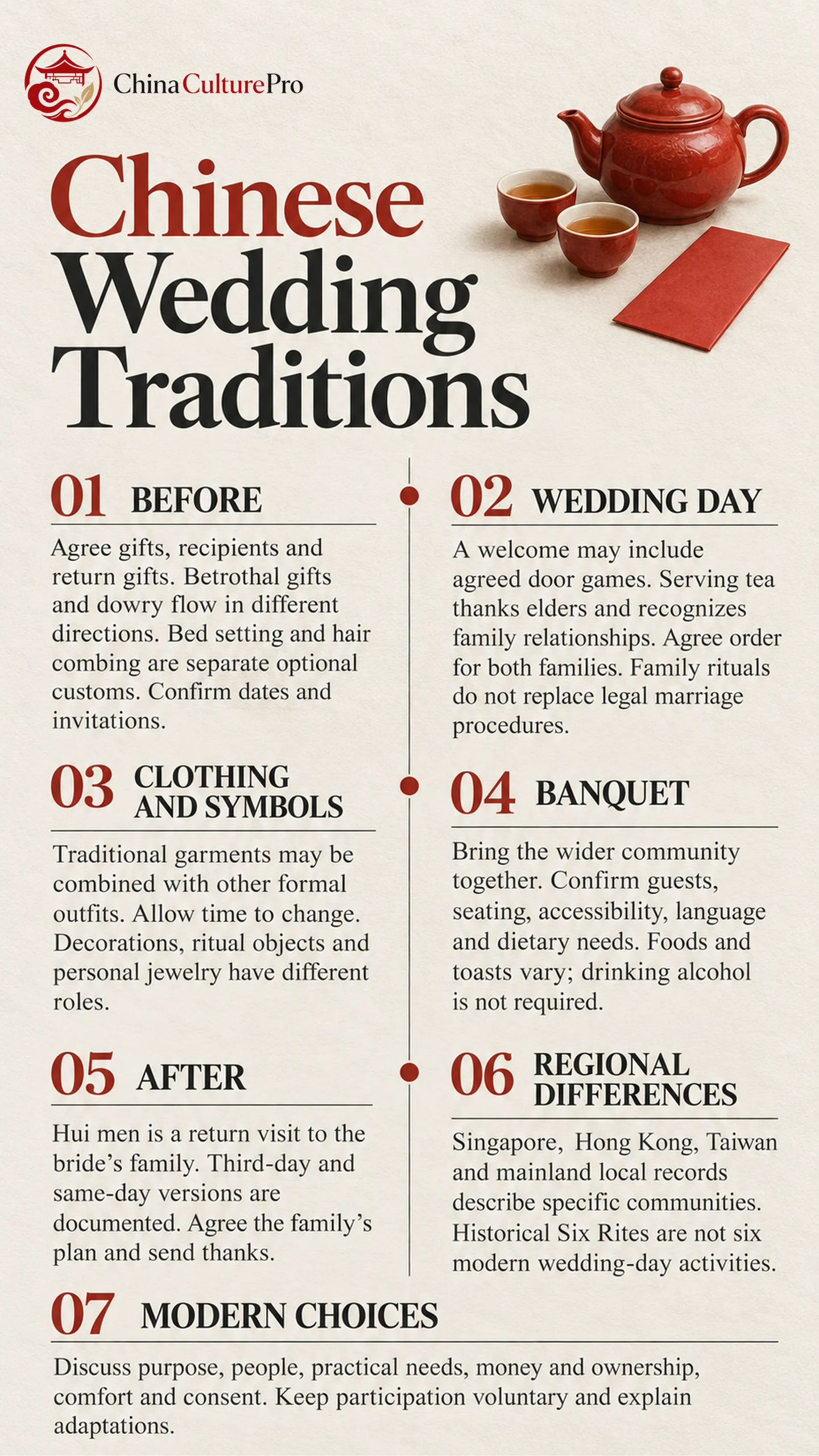
Chinese wedding traditions connect a couple’s marriage with recognition by relatives and a wider circle of guests. A wedding may include gift exchanges, family rituals, a shared meal and a return visit, but the selection and order depend on region, community and family. [1][2][3]
- Before: Families discuss arrangements, exchange agreed gifts and prepare people, clothing and spaces.
- During: The couple may welcome each other, honor elders, celebrate a ceremony and host a banquet.
- After: Visits and thanks continue the relationship between the two families.
Use the sequence as a way to understand the occasion, rather than a compulsory checklist for every Chinese couple.
A Chinese wedding can mean a day in a hotel ballroom, several visits between homes, or a smaller celebration combining family customs with a civil or religious ceremony. The most useful question is what each event does for the people involved. Gift exchanges make agreements visible; family rituals acknowledge relationships; the banquet shares the celebration. Within Chinese family traditions, these functions matter more than copying every object from another wedding.
Before the Wedding: Agreements, Gifts and Preparation
Guo da li (过大礼, guò dà lǐ) is a formal presentation of gifts associated with betrothal. In documented Singapore and Hong Kong practices, the exchange can take place weeks before the wedding, with items and return gifts agreed between families. The specific timing and contents are local practices, not a national shopping list. [1]
Betrothal gifts (聘礼, pìnlǐ) and dowry (嫁妆, jiàzhuang) describe different directions of giving. The former are associated with the groom’s side presenting gifts; the latter concerns what the bride’s side provides for her marriage or new household. English accounts sometimes call everything dowry, which hides who gives what and to whom. Historical records also reflect unequal family structures that should not be treated as instructions for contemporary couples. [3][6]
For planning, separate the ceremonial exchange from the couple’s actual finances. Decide who receives a gift, whether any part is returned, whether it belongs to the couple or a relative, and what everyone can comfortably afford. A symbolic basket and a substantial cash transfer should not remain ambiguous simply because both appear in the same ceremony. The betrothal traditions guide covers the exchange; dowry and bride price require their own distinctions.
Other preparations can include an chuang (安床, ān chuáng), setting the matrimonial bed, and shang tou (上头, shàng tóu), a hair-combing ritual associated with a transition into married adult life. Their objects, timing and participants differ. They are separate customs, even when performed close together. [1]
Couples who retain these customs can use the dedicated bed-setting and hair-combing guides to discuss the family’s version. Choose participants respectfully rather than assuming a relative’s marital history makes them unsuitable to celebrate with you.
Dates and invitations also belong in the early conversation. Some families choose auspicious dates as a cultural preference; venues, travel and relatives’ availability create practical limits. Give invitees a clear location, date, time and description of which events they are invited to. The invitation wording should communicate the actual plan, while the wedding timeline connects the chosen events realistically.
The Wedding Day: Welcome, Tea and Family Recognition
In many documented practices, the groom goes to meet the bride before the couple continues to family rituals or a ceremony. Door games can turn the welcome into a playful negotiation with friends. They are a social activity, not proof that embarrassment, unsafe challenges or unwanted physical contact are necessary parts of tradition. Agree the games and a stopping point beforehand. [1][2]
A tea ceremony (敬茶, jìng chá) gives the couple a direct way to thank parents and elders and receive their recognition. The ritual may take place at homes, a hotel or another suitable venue. Families may hold separate sessions or bring relatives together. The order of parents and older generations should be agreed with the people concerned; even documented accounts describe more than one approach. [2]
The tea ceremony guide explains the meaning and order. A separate tea ceremony script helps with names and spoken invitations. For the welcome itself, door games should fit the couple’s comfort and the day’s available time.
A family ritual and the legal creation of a marriage have different functions. Do not assume that serving tea, exchanging gifts or hosting a banquet replaces the official marriage requirements of the place where the couple marries. Hong Kong, for example, has a distinct official registration and celebration procedure. Check the relevant jurisdiction’s current official instructions. [5]
Clothing and Symbols Carry Different Jobs
Wedding clothing identifies the occasion and can express a regional or family connection. A couple may wear traditional garments for family rituals and change into other formal clothing for a ceremony or dinner. A Hong Kong practitioner account explicitly describes modern combinations and changes of outfit rather than one costume for the whole day. [2]
The wedding dress guide distinguishes the garments themselves. That is more useful than treating every red bridal outfit as the same dress. When planning changes, allow time for assistance, travel, photographs and a comfortable place to change.
Double Happiness (囍, shuāngxǐ) is a recognizable wedding motif that may appear in decorations and objects. [7] Its visual role differs from the function of a tea set, gift container or ceremonial garment. Likewise, a piece of wedding jewelry may be a personal gift as well as part of the outfit. Ask about the object’s role before assuming every item is simply decoration.
A modern wedding can preserve a meaningful Double Happiness symbol without copying an entire historical room. Avoid adding objects solely to make the event look more traditionally Chinese when nobody involved recognizes or wants their meaning.
The Banquet Brings the Wider Community Together
The banquet makes the celebration visible to relatives, friends and colleagues beyond the smaller family rituals. A documented Singapore sequence places it after the day’s other events, commonly in a restaurant, hotel ballroom or event hall. Other communities and families organize their meals differently. [1]
For hosts, the important questions are concrete: who is invited to which meal, how guests find their tables, who needs help with mobility or language, and what dietary needs must reach the kitchen. Symbolic foods can add meaning, but their exact selection depends on cuisine, budget and the people eating them. The wedding banquet guide owns dish choices, seating and toasts.
Guests should use the invitation and the couple’s instructions rather than guessing from another wedding. Clothing, gift arrangements and arrival times may differ even between events in the same city. Guest etiquette and wedding gifts answer those practical questions separately. A toast can express goodwill without requiring every guest to drink alcohol.
After the Wedding: Return Visits and Thanks
Hui men (回门, huímén) is a return visit associated with the bride visiting her family after marriage, often with the groom. Traditional accounts frequently mention a third-day visit, but local records also document same-day visits and other arrangements. The name describes the relationship being acknowledged; it does not establish one universal date. [2][4]
The distinction is visible even within Shandong, where different places recorded different timing. A modern Hong Kong account also describes adapting the return visit to the wedding day’s movements. Use those examples to recognize variation rather than combine their details into a new compulsory ceremony. [2][4]
For a contemporary couple, thank-you messages, returning borrowed items and checking that older relatives got home comfortably can continue the same attention to relationships. Those are practical suggestions, not claims that every historical community performed identical follow-up tasks.
Why Regional and Family Versions Differ
A heritage account from Singapore, a Hong Kong practitioner’s explanation and a Taiwan museum display document different communities and settings. Each can be accurate without representing every Chinese wedding. Dialect background, migration, religion, household structure and personal choices influence what people retain. [1][2][3]
Historical descriptions require another boundary. The Three Letters and Six Rites (三书六礼, sān shū liù lǐ) provide a framework for discussing earlier marriage institutions and ritual stages. They should not be confused with a modern list of six wedding-day activities. The Six Rites guide explains that historical framework. [3][6]
A useful response to a difference is to ask which family practice is meant and why it matters. The regional customs guide helps keep that question specific. Similarly, wedding taboos are reported beliefs and expectations, not evidence that an accidental breach causes misfortune.
Choosing Traditions for a Modern Wedding
Start with what the couple and families want the event to express. These five decisions prevent many disagreements before they become last-minute problems.
- Purpose: Identify the relationship or value each custom recognizes. Keep the activity connected to that purpose.
- People: Confirm who is included, who will guide the activity and how different family structures will be acknowledged.
- Practical needs: Allow space, time, accessible seating, translation and help for anyone who needs it.
- Money and ownership: Agree gifts, costs, recipients and any returns clearly before the exchange.
- Comfort and consent: Make participation voluntary, adapt kneeling or standing when needed, and set boundaries for games and teasing.
A smaller, well-understood ceremony can carry more meaning than a rushed set of unexplained gestures. Keep a shared written plan with names, locations and responsibilities, and tell helpers which details are important to the family. Leave room for warmth and conversation rather than turning every moment into a test of correctness.
FAQs About Chinese Wedding Traditions
Must every Chinese wedding include all these customs?
No. Weddings vary by community and family. Couples can retain, simplify or omit customs while communicating their choices to relatives.
Does a tea ceremony legally register a marriage?
Do not assume so. Family rituals and legal marriage procedures have different functions. Follow the official requirements of the jurisdiction where the marriage takes place.
Who pays for a Chinese wedding?
There is no single useful rule for every family. Agree who pays for each event and who receives each gift instead of relying on a general cultural stereotype.
Can a multicultural couple adapt the rituals?
Yes. Explain the purpose, agree wording and participants, and make the ceremony understandable and comfortable for both families.
Fuentes
[1] National Heritage Board, Singapore. Chinese Weddings
[2] Hong Kong Family and Women Portal. Dai Kam Jie Explains the Contemporary Take on Traditional Weddings: A Rich Blend of Heritage and Heartfelt Blessings
[3] National Museum of History, Taiwan. 婚俗的簡化
[4] Shandong Provincial Gazetteer. 六、回门
[5] Hong Kong Immigration Department. Registration of a Marriage
[6] Chinese Historical and Cultural Project. Tradiciones de boda chinas
[7] National Museum of History, Taiwan. 喜字變成囍事