

Quick Answer: What Is the Shang Tou Ceremony?
Shang tou (上头, shàng tóu) is a wedding hair-combing ceremony observed in Cantonese and some other Chinese family traditions. A chosen relative or ceremonial helper combs the bride’s or groom’s hair while offering wishes for married life, often on the night before the wedding.[1][3]
- It marks a family transition into marriage and expresses hopes such as harmony and growing old together.
- The person, objects, timing and blessing words depend on the family’s version.
- Three- and four-combing accounts both exist; agree on the version rather than assuming one national rule.
These are symbolic blessings, not guarantees about marriage, children or fortune. The practical sequence below is an adaptation to discuss with your family.
A comb, a familiar voice and a few words can make this one of the quieter moments around a wedding. Its significance comes from the relationship between the people taking part, as well as the wishes they choose to express.
This guide explains the ritual within Chinese wedding traditions, including why accounts differ and what to settle before preparing it.
Meaning and the Person Who Combs the Hair
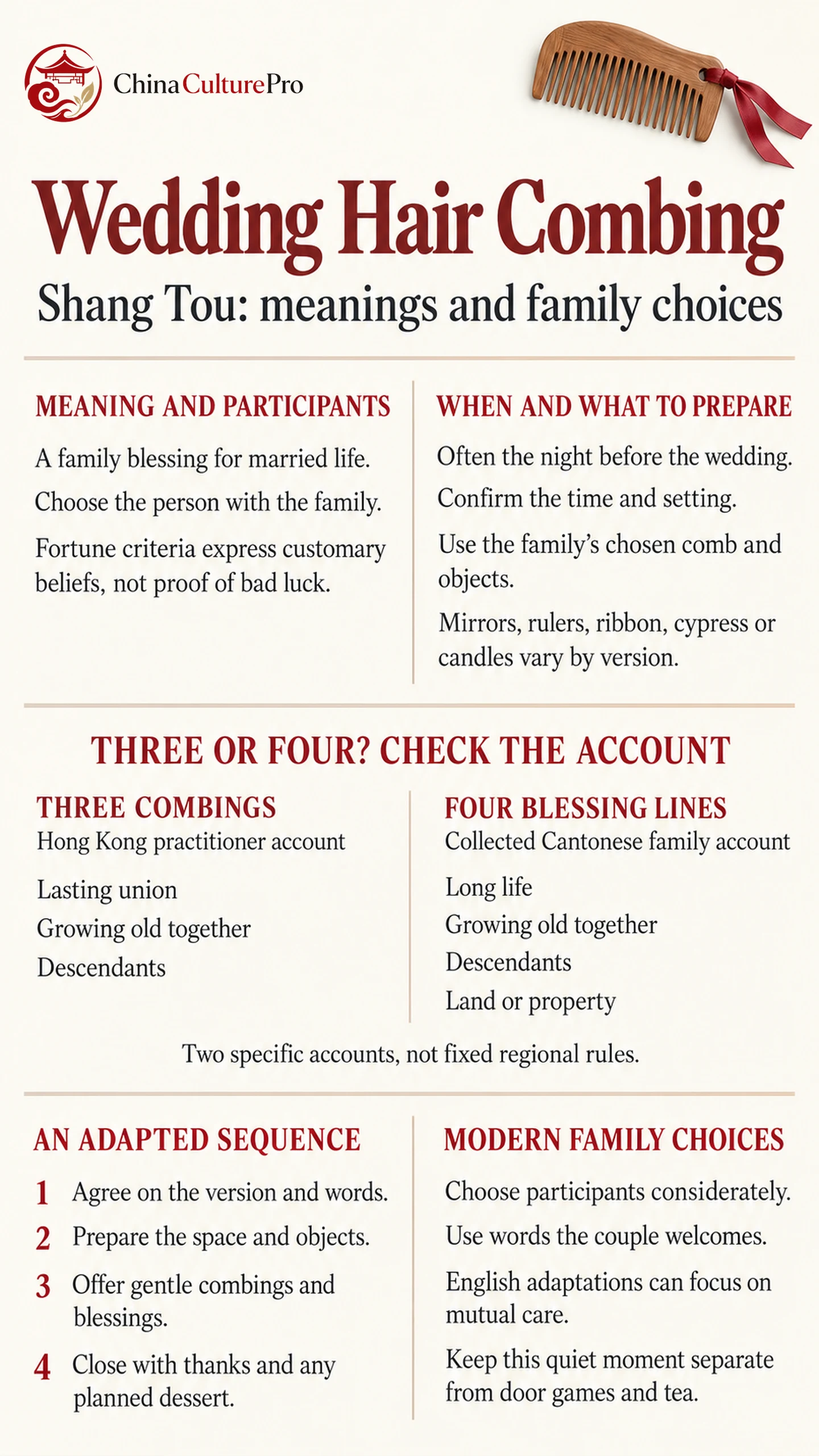
The ceremony expresses readiness to enter married life and the hope that the couple will grow old together.[1] Combing is part of a blessing offered by an older generation or another person the family regards as suitable. It is not simply a bridal hair appointment.
Traditional accounts often select someone considered fortunate through a harmonious marriage and family life. A Hong Kong practitioner account describes criteria including living spouses and children; a collected Cantonese family account describes an older sister whose own marriage and household were considered happy.[1][2] These criteria belong to particular customs and beliefs, not to evidence that another person’s bereavement or circumstances can harm a marriage.
Ask whom the family would like to involve and why. A parent, relative or ceremonial helper may fill the role in different accounts.[1][3] If traditional criteria would exclude someone important to you, discuss an adapted arrangement privately. The wedding taboos and family expectations guide helps put such conversations in context.
When to Hold It and What to Prepare
The night before the wedding is a common setting, traditionally with the bride and groom at their respective homes. Some families select a preferred auspicious time and include new clothes or pajamas.[1] Confirm the actual time with the people involved and place it on the wedding timeline; do not assume every family requires the same hour or interval between ceremonies.
A preparation list can be modest. Use the family’s chosen objects rather than treating a commercial set as compulsory.
| Item or arrangement | Its practical or symbolic role |
|---|---|
| Comb and comfortable seat | Enable the chosen person to perform the combing gently |
| Mirror and ruler, where used | Associated with reflection and measured conduct in one Singapore account |
| Red ribbon and cypress, where used | Carry wishes connected with vitality and lasting marriage |
| Candles or other ceremonial objects, if chosen | Belong to particular family setups rather than every modern version |
| A readable blessing sheet | Keeps the agreed words and number of combings clear |
The mirror, ruler, ribbon and cypress meanings come from a Singapore community account; the Hong Kong account gives a somewhat different collection of objects.[1][3] Check which items your family uses and how it understands them. If the setting does not permit candles or incense, discuss an unlit or other agreed substitute rather than introducing a flame without permission.
Some families finish with tangyuan (汤圆, tāngyuán), glutinous rice balls associated with a sweet, harmonious marriage in the Hong Kong account.[1] The separate tangyuan guide explains the food and its wider family associations.
Three or Four Combings: Understanding the Blessings
The number and wording should be checked together. Two documented examples show why a short online formula should not be treated as universal:
| Relato | Combing and blessing pattern |
|---|---|
| Hong Kong practitioner explanation | A simplified three-combing form, with wishes connected with lasting union, growing old together and descendants |
| A Cantonese family account collected in 2013 | Four lines, associated with long life, growing old together, descendants and land or property |
These are two specific accounts, not a rule that every Hong Kong family uses three and every other Cantonese family uses four.[1][2] A difference in the final blessing is not proof that one ceremony has been performed incorrectly.
If the family wants traditional wording, ask a fluent relative or the chosen helper for its exact words and pronunciation. A translated summary cannot replace a Cantonese or other home-language recitation. Do not copy unverified Chinese characters from a decorative image.
For an adapted English ceremony, you could use the following original wishes. They are modern examples, not literal translations of the traditional lines:
- “May you care for each other through every stage of life.”
- “May your home be kind and peaceful.”
- “May family and friends continue to support you.”
- “May you meet the future with steadiness and hope.”
Choose the lines together, including whether wishes about children or property are welcome. Do not assume that every couple shares the family plans implied by older verses.
An Adaptable Hair Combing Sequence
Use this practical sequence after the family has chosen the form. It describes an arrangement to discuss, not a universal ceremonial requirement.
- Agree on the version: Confirm the time, place, participants, number of combings and blessing words with the family.
- Prepare the space: Set out the agreed comb and objects, check the seating and keep any written words easy to read.
- Offer the combings and blessings: The chosen person gently combs the hair while speaking the agreed wish for each combing.
- Close with thanks: Thank the person taking part and share any planned dessert or quiet family moment.
Arrange hair and clothing so the gesture is comfortable. Avoid tugging or forcing a comb through a snag merely to reproduce a description of an uninterrupted stroke. If a symbolic gesture suits the person better, agree on it beforehand. The ritual should fit the participant rather than require an elaborate hairstyle.
Keep the room calm and confirm whether photographs are wanted. A small audience may suit the private family moment better than a staged performance for every wedding guest. If the bride and groom hold separate ceremonies, give each household its own contact and clear instructions.
Keeping the Meaning in a Modern Family
Decide which part is meaningful to you: a parent’s blessing, continuity with grandparents, the spoken wishes or a quiet pause before a busy day. That decision can guide a simpler setup and a considerate choice of participants.
Be clear about adaptations. You can ask for different words, a smaller gathering or a different person, while acknowledging that the arrangement reflects your family’s present choices. There is no need to claim a new version is an unchanged ancient formula.
Keep this event distinct from the next day’s door games and tea ceremony. Each has its own participants and purpose; adding all three does not mean they must share one long script or audience.
FAQs About the Chinese Wedding Hair Combing Ceremony
Is the hair combing ceremony only for the bride?
No. Accounts describe ceremonies for both bride and groom, often in their respective family homes. Confirm which version your families wish to observe.
Must a parent perform the ceremony?
Not necessarily. Different accounts include parents, other relatives and ceremonial helpers. Agree on the person and any customary criteria before the event.
Do I need a gold comb or elaborate hairstyle?
An expensive comb or elaborate hairstyle is not the purpose of the ceremony. Choose the family’s agreed objects and a comfortable way to perform the gesture.
Can we leave out blessings about children?
Discuss the wording with the person offering the blessing. An adapted ceremony can use wishes for mutual care and a happy shared life without assuming the couple’s plans for children.
Fuentes
[1] Hong Kong Family and Women Information Portal. Dai Kam Jie (Bride’s Chaperone) Explains the Contemporary Take on Traditional Weddings: A Rich Blend of Heritage and Heartfelt Blessings
[2] USC Digital Folklore Archives. Cantonese Wedding Comb Tradition
[3] Singapore Federation of Chinese Clan Associations. Traditional Wedding Rituals