

Quick Answer: What Are the Three Letters and Six Rites?
The phrase three letters and six rites (三书六礼, sān shū liù lǐ) combines customary marriage documents with a six-stage framework of formal marriage rituals. The documents record arrangements and gifts; the rites describe a sequence from proposal negotiations to welcoming the bride.[1][2]
- The three letters are conventionally explained as a betrothal letter (聘书, pìnshū), gift letter (礼书, lǐshū) and wedding letter (迎书, yíngshū).
- The six rites have distinct names and purposes, with most stages concerning preparations and negotiations.
- Their forms changed across periods and communities; modern weddings may retain only selected elements.
This is a historical and cultural framework, not a single unchanged checklist followed by every Chinese family.
A list of ancient names can make the framework sound like nine ceremonies. The distinction is simpler: some names refer to written documents, while others refer to actions through which families arranged and acknowledged a marriage.
Understanding that distinction also makes modern Chinese wedding traditions easier to interpret. A betrothal gift exchange or the groom’s arrival can echo an older ritual idea without reproducing the entire historical system.
A Framework for Families, Documents and Ceremony
The Book of Etiquette and Ceremonial (《仪礼》, Yílǐ) and the Book of Rites (《礼记》, Lǐjì) provide classical foundations for the marriage-rite framework. Their ritual descriptions place marriage within relations between families, ancestral observance and household continuity.[1]
Read these texts as prescriptions for proper ritual in particular social settings, rather than a record showing what every person actually did. A later village ceremony, an elite family manual and a contemporary wedding can share vocabulary while differing in sequence, objects and expectations.
Written marriage arrangements also have their own history. The familiar three-document summary should not be projected unchanged into the earliest classical six-rite model. Commentary on a late Qing wedding list explicitly distinguishes the later grouping of three letters from the Zhou ritual framework.[5]
For the wider institutional background, see Chinese marriage history. Here the focus is what the names help a reader recognize, including the role of family relationships in the exchange.
The Three Letters: What Each Document Does
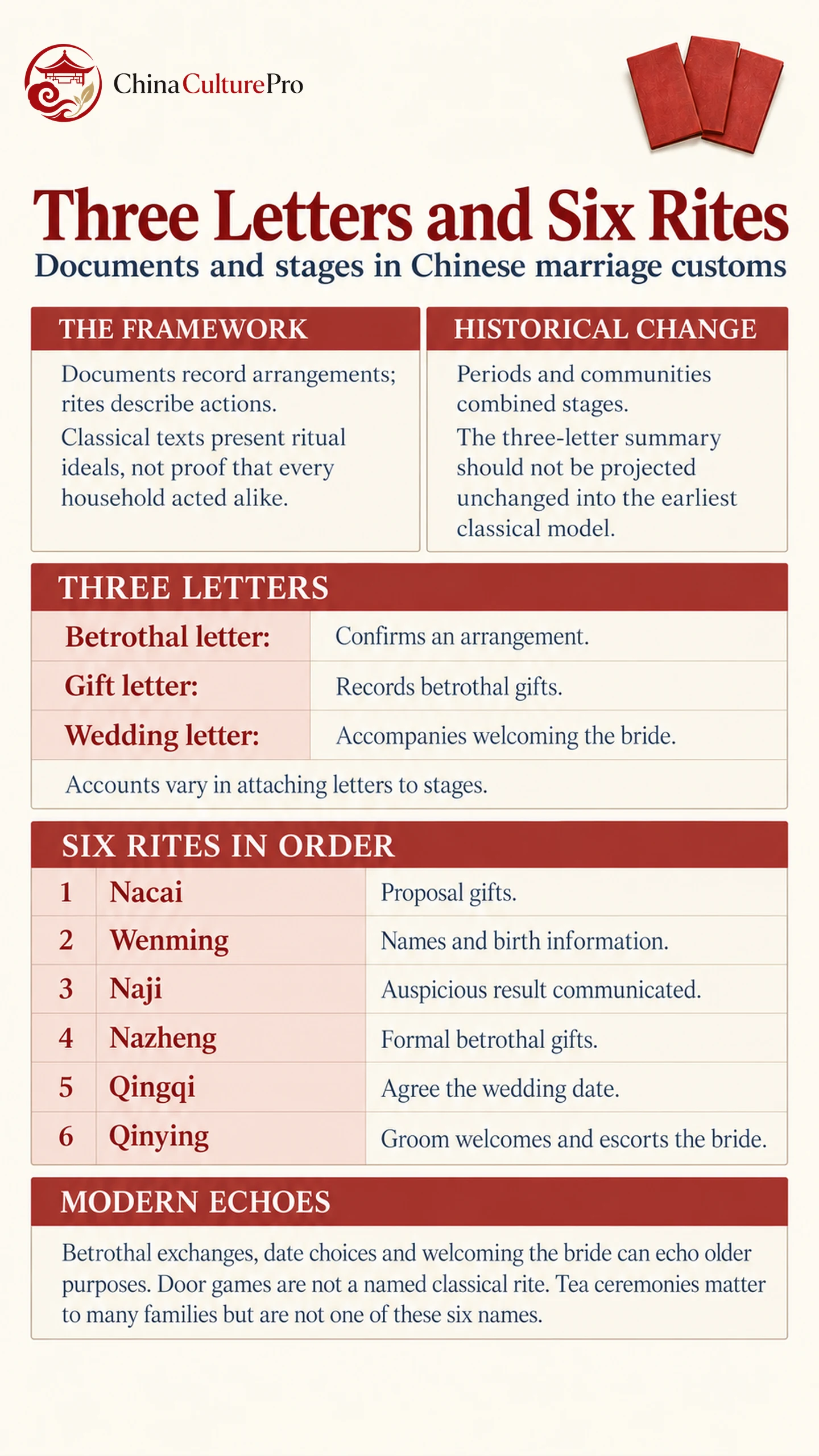
The conventional explanation distinguishes three kinds of document:[2][3]
| Document | Función principal |
|---|---|
| Betrothal letter (聘书, pìnshū) | A document confirming the proposed marriage arrangement |
| Gift letter (礼书, lǐshū) | A written record of the betrothal gifts |
| Wedding letter (迎书, yíngshū) | A document associated with welcoming the bride |
These labels summarize functions, not three universally identical forms. The gift record can clarify the items being presented; the wedding document belongs to the welcoming stage rather than the ordinary invitation sent to banquet guests.
Accounts also differ in exactly where they attach the betrothal document within the earlier stages. One scholarly explanation connects it with the opening proposal rite, while another historical account places it at the auspicious confirmation stage.[2][3] It is more accurate to explain that variation than to impose a single document-to-rite chart on every period.
A modern wedding invitation therefore should not be called one of the three letters simply because it announces a wedding. Its immediate job is to invite specified guests and communicate attendance details.
The Six Rites in Order
The following is the conventional six-part sequence. The English descriptions explain each stage’s main job; they are not instructions for a couple to perform today.[1][2][4]
| Rite | Main job in the framework |
|---|---|
| 1. Nacai (纳采, nàcǎi) | Proposal gifts initiating formal negotiations |
| 2. Wenming (问名, wènmíng) | Inquiry about names and birth information |
| 3. Naji (纳吉, nàjí) | Communication of an auspicious divination result |
| 4. Nazheng (纳征, nàzhēng) | Presentation of the formal betrothal gifts |
| 5. Qingqi (请期, qǐngqī) | Agreement on the wedding date |
| 6. Qinying (亲迎, qīnyíng) | The groom personally welcoming and escorting the bride |
The first and fourth stages both involve gifts, but they do different work. The opening presentation begins a formal approach; the later betrothal presentation marks a more developed commitment after intervening inquiries and confirmation. Translating both simply as “giving gifts” hides that distinction.
Similarly, asking for names and communicating an auspicious result are separate steps. Birth information belonged to historical divination and family negotiation; describing that belief does not establish that it predicts a couple’s compatibility.
The final rite is specifically the groom’s personal welcoming and escort of the bride. It should not be translated so broadly as “the entire wedding day,” since that erases the action that distinguishes it from the earlier stages.
Why the Historical Framework Changed
Ritual systems are not preserved only by repeating every step separately. Later manuals and local practices could combine stages while retaining their underlying purposes. Historical analysis discusses how the simplified family-ritual tradition associated with Zhu Xi (朱熹, Zhū Xī) brought the auspicious confirmation into the proposal stage.[4]
Even the question of when a historical betrothal became fully established has prompted debate. Interpretations emphasize the auspicious confirmation, the substantial gift presentation, or their relationship.[4] That disagreement is a reason to avoid claiming that one named act always had the same legal effect throughout Chinese history.
An actual document can be more revealing than a neat universal chart. A late Qing wedding list preserves local wording and gift arrangements that do not reproduce the simplified three-letter summary mechanically.[5] Its value lies partly in showing how broad ritual language met a particular household’s circumstances.
Do not turn such examples into a new rule for all families in the same province. Period, social position and local practice belong to the explanation, as do the different traditions found in the regional wedding guide.
What Modern Wedding Customs Still Echo
Several familiar practices can be understood against the older framework, without treating them as exact equivalents:
- A formal betrothal presentation: Guo da li (过大礼, guò dà lǐ) is a living gift-exchange custom whose name and arrangements vary by community. Compare the actual betrothal exchange before equating it with a whole classical rite.
- Agreement over gifts and money: Discussions may concern jewelry, returns or dowry and betrothal money. Their modern recipients and purposes need clarification rather than assumptions drawn from a historical term.
- Choosing a date: Family preferences may influence the wedding schedule, but this does not mean every household conducts a separate formal date-request ceremony.
- Welcoming or fetching the bride: The groom’s arrival can be accompanied by contemporary door games. Those games are not themselves one of the six named classical stages.
The tea ceremony is also important in many living wedding traditions, but it is not one of the six names in this sequence. Its absence from the list does not diminish its significance to a particular family.
For a modern celebration, ask which gestures the couple and families want to retain and why. A useful discussion of family expectations distinguishes symbolic meaning from a demand that everyone reproduce a historical model.
FAQs About the Three Letters and Six Rites
Are the three letters and six rites nine separate ceremonies?
No. The letters are types of document, while the rites are stages in a ritual framework. Documents can accompany stages rather than add three more ceremonies.
Do Chinese weddings still perform all six rites?
Some celebrations retain or reconstruct several stages, while others combine or omit them. A contemporary wedding should be understood through the family’s actual practice rather than judged against an unchanged six-step checklist.
Is the gift letter a wedding invitation?
No. The gift letter records betrothal gifts; an invitation tells guests which celebration to attend and provides its practical details.
Is the tea ceremony one of the six rites?
It is not one of the six named stages in the conventional sequence. It can nevertheless be a central part of a family’s wedding customs.
Fuentes
[1] National Museum of History, Taiwan. Traditional Wedding Customs — The Six Rites
[2] David K. Jordan, University of California San Diego. Chinese Matchmakers of Tianjin and Taoyuan
[3] Chongqing Local Chronicles Office. The Historical Imprint Carried by Marriage Documents
[4] Chinese Academy of Social Sciences. Debating the Betrothal-Establishment Stage Within the Six Rites
[5] Tsinghua University School of Law. Fa Yuan, Issue 70 — Commentary on a Late Qing Wedding List