

Quick Answer: What Is Guo Da Li?
Guo da li (过大礼, guò dà lǐ) is a formal betrothal gift presentation observed in many southern Chinese and diaspora communities. The groom’s family traditionally presents gifts to the bride’s family, which responds with hui li (回礼, huí lǐ), return gifts expressing acceptance and goodwill.[1]
- The exchange is arranged before the wedding, with the date and participants agreed by the families.
- Gifts can include money, pastries, fruit, ceremonial items and jewellery, depending on the community.
- What is kept, returned or substituted should be discussed before anything is bought.
Guo da li is not a single shopping list followed by every Chinese family. Regional heritage, household practice and the couple’s preferences shape the arrangement.
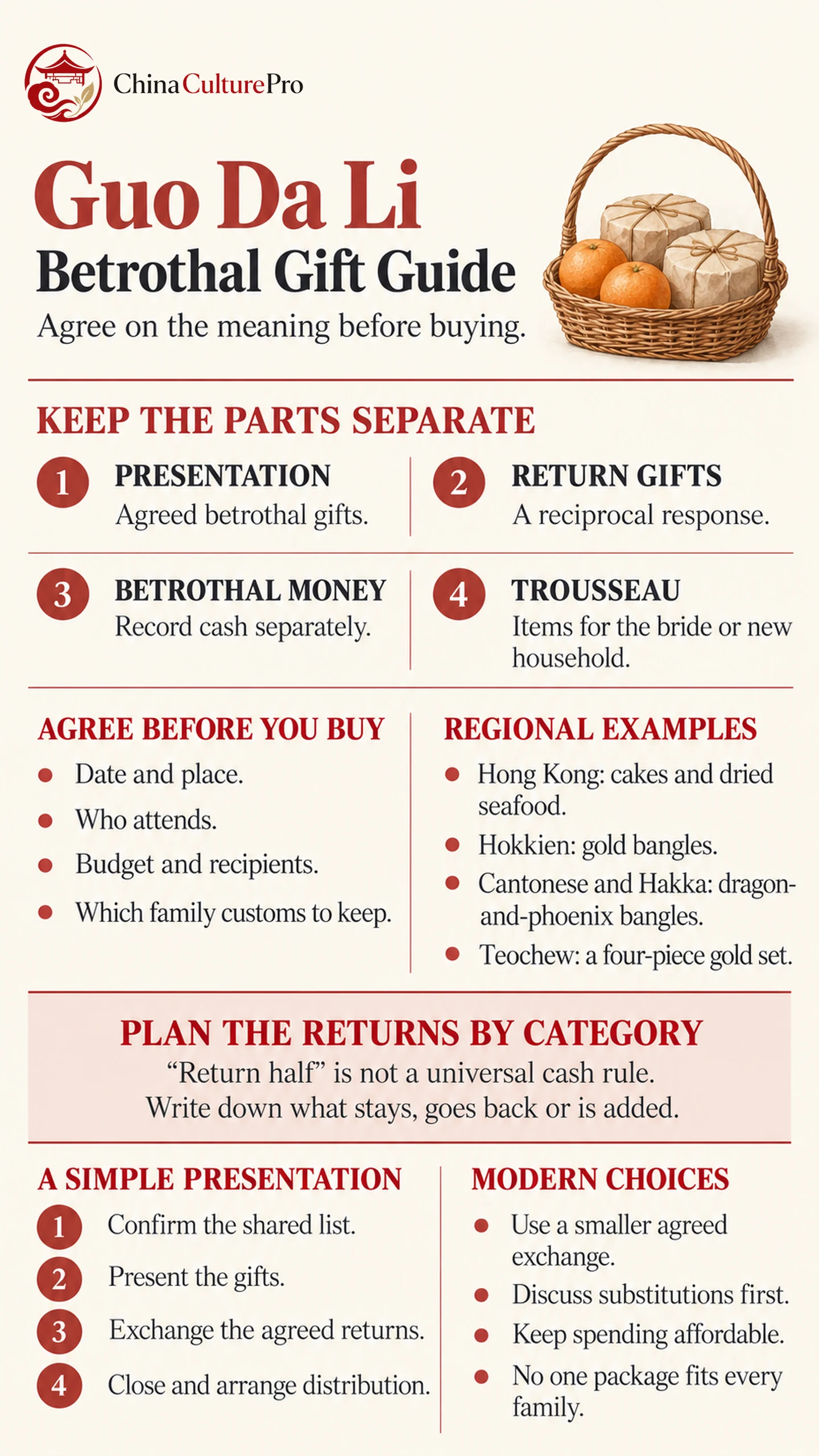
The most useful preparation is a shared conversation, not an expensive basket bought before anyone agrees on its contents. Two families may use the same phrase for betrothal while expecting different foods, representatives or return gifts.
Within the wider Chinese wedding traditions, this exchange gives families a way to acknowledge the planned union. Understanding its separate parts makes it easier to preserve that meaning without confusing symbolism with a spending requirement.
Keep the Gift Terms Separate
Pin jin (聘金, pìn jīn) refers to betrothal money. Jia zhuang (嫁妆, jiàzhuang) refers to a trousseau or dowry, associated with what the bride’s family prepares for her or the new household. These are related to the wedding but are not interchangeable with the whole gift-presentation event.[1][3]
| Término | What it refers to |
|---|---|
| Guo da li | The formal presentation of agreed betrothal gifts |
| Hui li | Return gifts exchanged in response to the presentation |
| Pin jin | Betrothal money within the agreed family exchange |
| Jia zhuang | A trousseau or dowry prepared for the bride or new household |
An ordinary friend’s reception envelope belongs to a different context; see the wedding gift guide. For the historical and contemporary distinctions around money and property, use the separate dowry and bride-price guide.
Modern guo da li also should not be treated as a complete reproduction of every stage described in the historical marriage rites. The living practice has its own regional forms and family adaptations.
Agree on Timing, People and Expectations
The presentation commonly happens some weeks before the wedding, but the date is arranged rather than nationally fixed. A Singapore heritage account describes two to four weeks; a Hong Kong practitioner account describes fifteen to thirty days.[1][2] Treat those as examples, not deadlines that every family must meet.
Ask who should attend. Some Singapore descriptions include the groom and a female relative, while a Hong Kong account records an older convention in which the prospective couple did not participate.[1][2] This difference is a reason to confirm the household’s expectations, not to declare one family’s custom incorrect.
Set the place, representatives, budget and gift recipients together. If the families have different traditions, write down which elements each wants to retain. Confirm whether any religious offering, preferred date or ceremonial role is included and whether everyone taking part agrees to it.
Put the event on the wedding timeline early enough to arrange transport and later distribution of pastries or invitations. Do not select a date solely from a generic online checklist.
What Goes Into the Betrothal Gifts?
A useful list separates consumable gifts, money, jewellery and ceremonial objects. Examples include wedding pastries, fruit, tea or liquor, candles and symbolic foods. The names and quantities vary; some gifts are shared with relatives after the presentation.[2][3]
Regional examples make the differences clearer:
| Community context | Documented examples | Practical implication |
|---|---|---|
| Hong Kong practitioner account | Wedding cakes, tea, dried seafood, fruit and paired ceremonial items | Agree on the particular goods and what will be returned |
| Hokkien families in Singapore | Gold bangles and community-specific pastries or foods | A generic Cantonese package may omit the family’s expected items |
| Cantonese and Hakka families in Singapore | Dragon-and-phoenix bangles and distinctive pastries | Check both jewellery and food preferences rather than the label alone |
| Teochew families in Singapore | A tiered gift basket, food gifts and si dian jin (四点金, sì diǎn jīn), a four-piece gold set | Confirm the actual set and presentation with the family |
These examples come from specific community accounts, not an exhaustive classification of Chinese weddings.[2][3][4] For gold, use the wedding jewellery guide to discuss recipients, pieces and timing. Four-piece gold sets also show why a blanket instruction to avoid every quantity of four would misrepresent the tradition.
Ask what each selected object means to your family. A symbolic food or candle expresses a wish; it does not guarantee fertility, wealth or a successful marriage. Only buy quantities that the families have agreed they can use, distribute or keep.
Hui Li Is More Than Returning Half
The return exchange acknowledges the presentation and shares goodwill between the families. It may include a portion of the received goods and additional gifts chosen for the groom or his family.[1][2] Its purpose should be clear before anyone starts unpacking baskets.
“Return half” is a common shorthand, but it should not be applied mechanically to every category. The Hong Kong account distinguishes ordinary goods from money and wedding cakes, for which a smaller portion may be returned. A Teochew account also describes specific returns and a cash arrangement set by consensus.[2][4]
Make two columns on the shared list: what stays and what goes back. Record cash separately from objects. If clothing, a wallet or another personal gift is planned for the groom, confirm the preference directly rather than buying it only because a shop bundle includes it. Agree on the return before the visit so it does not become a public negotiation.
A Simple Presentation Sequence to Adapt
This is a practical sequence for an agreed exchange, not a claim that every family follows four identical ritual steps.
- Confirm the shared list: Both families approve the items, quantities, money arrangements, recipients and return gifts before the visit.
- Present the gifts: The agreed representatives bring and explain the gifts at the chosen place and time.
- Exchange the returns: The receiving family sets aside what it will keep and presents the return gifts according to the shared list.
- Close and distribute: Share congratulations, confirm transport of the gifts and arrange any planned cake or invitation distribution.
Keep names and delivery details on a private checklist. Assign someone to handle fragile objects and someone to track the gifts that must travel back. If pastries are being distributed, arrange recipients and storage in advance rather than leaving boxes at the wrong home.
Where invitations follow the exchange, check the invitation wording and guest information before printing or sending them. That sequence is a family arrangement, not a requirement to withhold all invitations until a particular ceremony has occurred.
Modern Choices Without a One-Size-Fits-All Package
Some families simplify physical gifts or use agreed cash substitutions, a change documented in contemporary accounts.[2][4] A smaller exchange can still communicate respect when its meaning is understood by the people involved.
Separate symbolic choices from spending decisions. Agree on an affordable budget, keep money discussions private and ask which objects matter most to the family. If an item is unsuitable for dietary, religious, transport or household reasons, discuss a replacement before ordering it.
A retailer can help source the items after the families have agreed on their list. If jewellery will be presented later at the tea ceremony, record that choice so the same gift is not mistakenly expected at both events.
FAQs About Chinese Betrothal Traditions
Is guo da li the same as a proposal or engagement ring?
No. It is a family gift presentation connected with betrothal. A personal proposal, engagement ring and family exchange may be related, but they are separate decisions.
Must the groom deliver the gifts himself?
Ask the families. Community accounts differ on whether the prospective couple attends and which relatives represent them; there is no reliable universal attendance rule.
Do both families have to follow the same dialect tradition?
They can agree on a combination. Specify the meaningful items, recipients and returns rather than assuming one family’s label settles every detail.
Is there a fixed amount of betrothal money?
No single amount applies across these communities. Agree on the arrangement privately and within your means; a symbolic number or shop package does not establish a compulsory sum.
Fuentes
[1] National Heritage Board, Singapore. Chinese Weddings
[2] Hong Kong Family and Women Information Portal. 摩登大妗姐講解傳統婚禮現代版 傳承文化感受滿滿祝福
[3] Singapore Federation of Chinese Clan Associations. Traditional Wedding Rituals
[4] Teochew Federation (Singapore). Teochew Traditions