


Quick Answer: What Jewelry Is Given at a Chinese Wedding?
Chinese wedding jewelry can include gold bangles, necklaces, earrings and rings given by relatives as wedding or betrothal gifts. Si dian jin (四点金, sì diǎn jīn), a four-piece gold set, is particularly associated with Teochew tradition; other communities have different gift patterns.[1]
- Confirm the family’s exact pieces rather than assume every bride receives the same set.
- Agree who gives each gift and whether it is presented at betrothal, the tea ceremony or another moment.
- Include the wearer in choices about fit, style and what will actually be worn.
A meaningful family gift does not require a universal weight, price or number of pieces for every Chinese wedding.
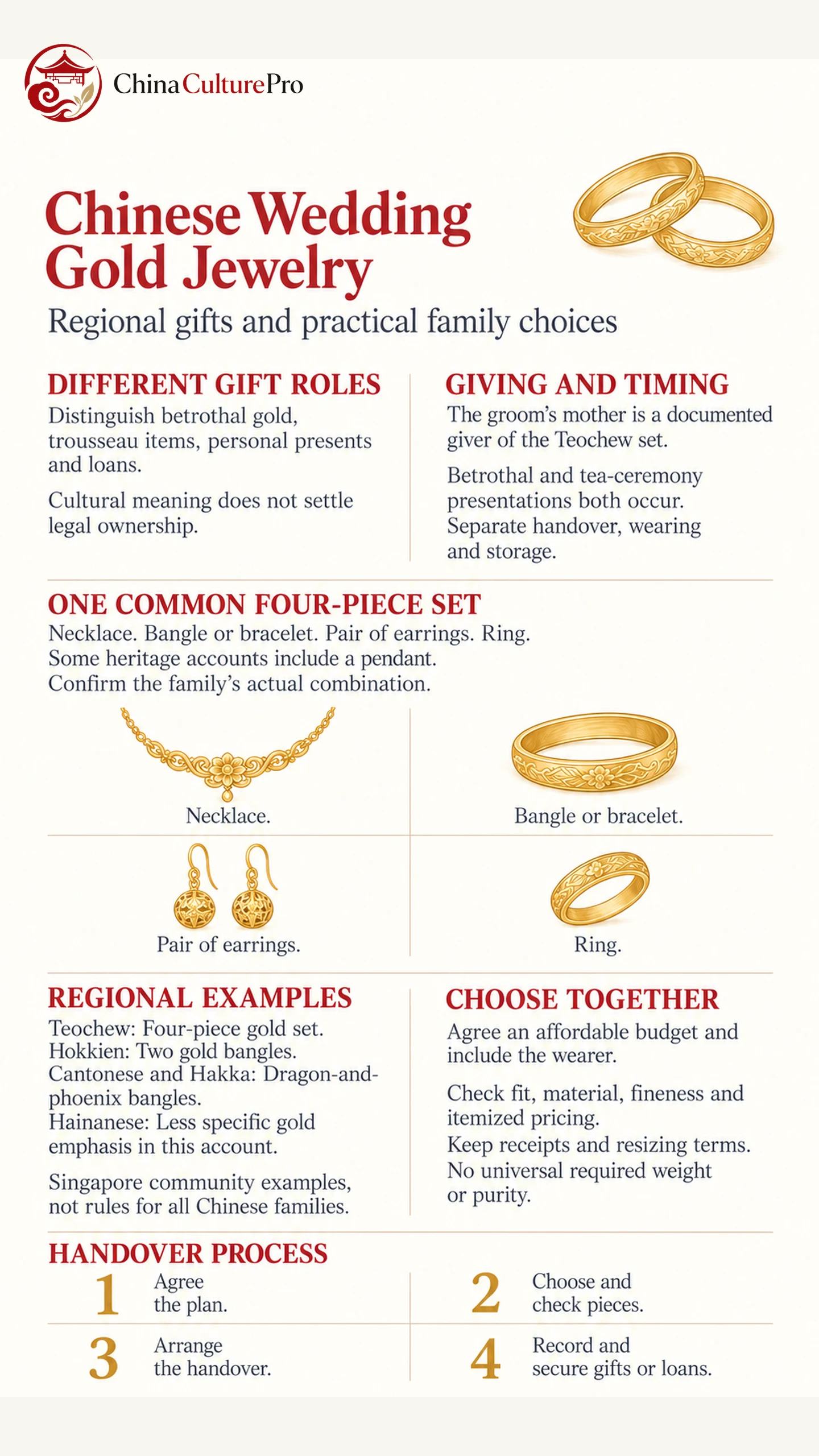
Wedding gold is easier to understand when its role is clear. A pair of bangles from an elder, a four-piece betrothal set and an engagement ring can all appear at the same celebration without being interchangeable gifts.
This guide explains the jewelry within Chinese wedding traditions, with concrete community examples and practical questions for the giver and wearer to settle together.
Gold Gifts Have Different Roles
Jewelry can express welcome, affection and blessings for married life. Accounts of wedding gold describe it as a family gift and, in some households, an heirloom passed to another generation.[3] These meanings do not guarantee prosperity or determine the legal ownership of every piece.
Separate a betrothal gift from jewelry included in the bride’s trousseau, an elder’s personal present and a ring exchanged by the couple. The dowry and bride-price guide explains why the direction and purpose of marriage gifts matter.
Likewise, a borrowed family bangle worn for photographs is not automatically a permanent gift. Agree whether an heirloom is being given, lent or simply displayed before someone else packs it away. Ordinary guests do not need to reproduce a family gold-gifting arrangement; their wedding presents belong to a different context.
Si Dian Jin: Four Pieces, With Family Variations
One commonly documented four-piece wedding gold set contains the following items:[1]
| Piece | Practical detail to agree |
|---|---|
| Necklace | Length, fastening and how it sits with the neckline |
| Bangle or bracelet | Fit, comfort and ease of putting it on |
| Pair of earrings | Whether the wearer has pierced ears and can wear the chosen style |
| Ring | Size and its intended role within the set |
This is a useful example, not the only legitimate composition. A Teochew heritage handbook also records combinations including a pendant, with a ring or necklace among the other components.[2] Differences between accounts are a reason to confirm the family’s intended set before buying anything.
The customary name refers to the four-part gift arrangement; it should not be replaced by a blanket warning that all groups of four are inauspicious. Number associations depend on context, as the wedding taboo guide explains.
If a family wants to adapt the set, discuss the change with the giver early. A smaller number of pieces, an existing heirloom or a different style should be a shared decision rather than a surprise at the presentation.
Regional Examples Beyond One Gold Set
A Singapore community account distinguishes several traditions:[1]
| Community context | Documented jewelry example |
|---|---|
| Teochew | A four-piece gold gift associated with si dian jin |
| Hokkien | Two gold bangles |
| Cantonese and Hakka | Dragon-and-phoenix bangles (龙凤镯, lóng fèng zhuó) |
| Hainanese | Less specific emphasis on a prescribed gold arrangement in this account |
The dragon and phoenix motifs give these bangles their name; the jewelry form does not establish a gift requirement for every Chinese family.
These examples concern communities in Singapore, not a complete map of all mainland Chinese, Hong Kong, Taiwanese or overseas practices. Migration, intermarriage and household preferences can bring traditions together. Use the regional wedding guide for the wider context, then ask the actual families what they observe.
Who Gives the Jewelry, and When?
For the Teochew four-piece set, a documented convention is a gift to the bride from the groom’s mother. Other elders may give their own jewelry gifts; these should not be confused with that particular set.[1][3]
Guo da li (过大礼, guò dà lǐ), the formal betrothal gift presentation, is one occasion for handing over wedding gold. Some families instead present pieces during the tea ceremony, when elders offer blessings and gifts.[3] Neither timing should be imposed on a household using the other arrangement.
Confirm three separate moments: when the pieces are given, when they are first worn and who stores them between events. A set presented at betrothal can be worn later on the wedding day without needing to be ceremonially gifted twice.
Add any fitting, collection and presentation to the wedding timeline. Let the tea helper know whether an elder plans to put a necklace or bangle on the wearer, and confirm that the wearer is comfortable with this.
Choose Pieces by Agreement, Fit and Clear Pricing
Start with the giver’s comfortable budget and the wearer’s preferences. Ask which features carry family meaning: a particular motif, a complete set, an inherited piece or simply a gift of gold. Do not assume a heavier piece expresses greater affection.
Check how jewelry works with the chosen wedding outfit. Necklines, sleeves, hair ornaments and ear piercings affect what can be worn comfortably. Try the pieces where possible instead of judging fit from a photograph.
There is no single price for wedding gold. Ask for an itemized explanation of material, fineness, weight, workmanship or design charges and any other components. The color of an object does not by itself establish its gold content, and a ceremonial preference is not proof of purity.
For example, Hong Kong retail rules require fineness marking and specified invoice details for gold and gold-alloy articles. The invoice includes the supplier, price, date, description and fineness; a weight requirement applies where the whole article falls within the specified pure-gold category.[4] Requirements elsewhere can differ, so check the terms applicable where you buy.
Do not assume every family requires 24-karat gold, or that gold-alloy jewelry is “not real” simply because a wedding guide says so. Confirm the actual material and family preference separately. Keep written return, resizing and repair terms with the receipt.
A Simple Presentation and Safekeeping Process
Use a short process to keep the exchange clear without turning the ceremony into an inventory exercise:
- Agree the gift plan. Confirm the giver, recipient, intended pieces, budget and presentation time.
- Choose and check the pieces. Include the wearer in checking fit, comfort, material descriptions and the itemized price.
- Arrange the handover. Tell the helper which gift is presented when and whether it should be worn immediately.
- Record and secure the gifts. Keep the receipts and an agreed record of gifts or loans, then place the pieces in secure storage.
Choose one trusted person for temporary storage during outfit changes. Keep labeled boxes or photographs so a borrowed piece is returned to the correct person. The purpose is a considerate handover, not a public comparison of the value of different relatives’ gifts.
FAQs About Chinese Wedding Jewelry
Does every bride need si dian jin?
No. It is especially associated with Teochew tradition and is not a universal requirement for Chinese weddings. Confirm what the particular families want to observe.
Is the ring in a gold set the engagement ring?
Not automatically. A ring within a family gold set and an engagement ring can have different givers and purposes. Clarify whether one piece is intended to serve both roles.
Must Chinese wedding jewelry be 24-karat gold?
There is no universal family rule. Some traditions favor high-fineness gold, while individual families may agree other materials or styles. Check the material description and the giver’s expectations separately.
Can heirloom jewelry be used?
Yes, if the people involved agree. Confirm fit and condition, and make clear whether the piece is a permanent gift or a loan that must be returned.
Fuentes
[1] Singapore Federation of Chinese Clan Associations. Culture — Rituals
[2] Teochew Federation (Singapore). Teochew Traditions
[3] Arthesdam Jewellery. What is Si Dian Jin?
[4] Hong Kong Customs and Excise Department. Trade Descriptions — Gold and Gold Alloy