

Quick Answer: How Should a Guest Attend a Chinese Funeral?
Confirm the family’s wishes, choose quiet clothing, offer a brief condolence and follow the guidance of the people organizing the visit. Chinese funerals vary by religion, region and household, so an invitation is more useful than a universal ritual checklist.
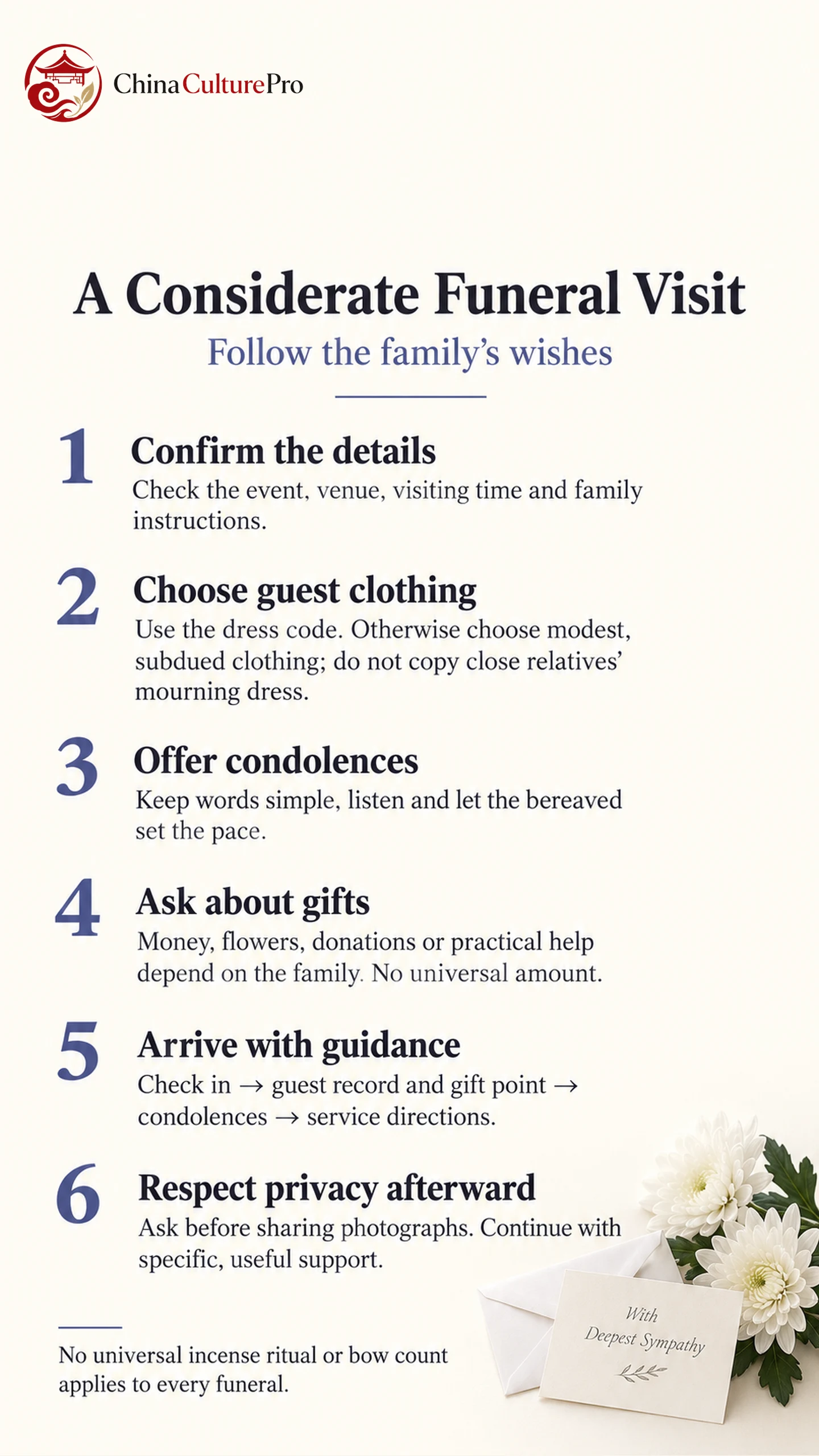
- Before you go: Check the venue, visiting time, service details and any instructions about gifts or donations.
- Clothing: Use the stated dress code; otherwise choose modest, subdued clothing and avoid a festive appearance.
- Condolences: Acknowledge the loss in simple words and allow the bereaved to speak or remain quiet.
- Gifts: Ask whether the family welcomes condolence money, flowers, a donation or practical help.
- At the service: Follow a family helper’s directions and clarify unfamiliar religious actions before joining them.
Guests do not need to copy a close relative’s mourning clothes or claim beliefs they do not hold. A considerate presence matters more than performing an unfamiliar ceremony perfectly.
Attending a friend’s or colleague’s family funeral can feel unfamiliar, especially when you do not know the household’s religion or language. A few questions asked discreetly beforehand can remove much of that uncertainty.
“Chinese funeral” describes a broad cultural setting rather than one service format. The guide to Chinese funeral traditions explains the wider practices; this page focuses on the decisions a guest needs to make.
Confirm the Invitation and the Family’s Wishes
First establish which event you are attending. A wake visit, a formal funeral service, a procession and a later memorial gathering can have different schedules and expectations. Do not assume that an open visiting period means every subsequent ceremony is open to all visitors.
Read the notice carefully. If details are missing, ask the designated organizer, a mutual friend or the funeral provider. A useful question is: “Is there anything the family would like visitors to know about clothing, gifts or the service?” This keeps several practical questions together without asking the bereaved to teach a full set of customs.
Research on Chinese funeral practices in Singapore identifies differences associated with dialect background, religious affiliation and changing spaces for wakes. That research is a reminder to identify the actual family setting before borrowing a ceremony from a general guide.[1]
If you plan to bring a child or someone who needs assistance, confirm seating, access and the nature of the event in advance. The organizer can explain what is possible without making assumptions about who should attend.
Choose Guest Clothing Rather Than Copying Mourning Dress
The family’s instructions come first. Without a stated code, choose clean, modest clothing in quiet colors and leave conspicuously festive accessories aside. This is a practical default rather than a rule that one color is correct in every Chinese community.
Singapore practitioner guidance, for example, lists white, black and other muted colors for guests. The range itself matters: “Chinese funerals use white” does not mean every guest must arrive dressed entirely in white.[2]
Close relatives may wear special garments, cloth markers or other items connected with their relationship to the deceased. These are different from ordinary guest clothing. Do not buy or copy them simply because you saw them in a photograph. The separate article on Chinese mourning clothing explains that historical and family context.
Comfort also matters. Choose clothing and footwear that suit the venue, weather and any standing or walking you have been told to expect. If you are unsure about a particular outfit, a quick description to the organizer is more reliable than a general color chart.
Offer Simple Condolences and Listen
Diaoyan (吊唁, diàoyàn) includes paying respects to the deceased and consoling the bereaved.[7] You do not need a Chinese phrase to express care. “Please accept my condolences” or “I’m sorry to hear about your father” is enough. If you knew the person, a short, kind memory may be welcome, but let the bereaved set the pace.
Cruse Bereavement Support emphasizes listening and avoiding pressure to feel better. Its guidance is general bereavement advice rather than a Chinese ritual rule, and it is useful here because uncertainty about etiquette can distract from the person who is grieving.[4]
Avoid demanding an account of the death, comparing losses or insisting that someone should be strong. Do not assume a belief about an afterlife when choosing reassuring words. A quiet acknowledgment can be more appropriate than an explanation of why the death happened.
If the family is receiving many visitors, keep the initial greeting brief. A person who says little is not necessarily rejecting your support. They may be tired, occupied with arrangements or simply unable to talk at that moment.
Ask About Condolence Money, Flowers and Other Gifts
Condolence money is familiar in several Chinese communities, but it is not a universal admission fee. A Singapore professional guide describes it as common while explicitly noting that it is not obligatory.[3]
Where condolence money is customary, a plain white envelope is a recognizable form. Ask about local practice before choosing the envelope or amount, and follow any donation instructions in the notice. Currency, relationship and family preference vary too much for one online figure to work everywhere. Avoid choosing a red wedding-style packet without checking the family’s practice.
| Possible offering | What to confirm |
|---|---|
| Condolence money | Whether it is welcomed and where it should be given |
| Flowers or a wreath | Whether the family accepts them and what wording or delivery details to use |
| A memorial donation | The organization and instructions named by the family |
| Food or practical help | What would be useful and when it would be convenient |
Ask before ordering a large wreath or sending a delivery to a busy household. If a family requests a charitable donation instead of flowers, honor that request. There is no need to bring both money and an elaborate gift to demonstrate respect.
When a reception point is provided, use it rather than placing an envelope on a ritual table or giving it to whichever mourner happens to be nearest. Let the organizer explain how names and gifts are recorded.
How to Arrive and Pay Respects
This is a flexible arrival sequence, not a script for a particular religion. The family’s directions can change the order.
- Check in: Approach the reception point or a family helper and confirm where visitors should go.
- Handle the guest record and gift: Use the guest book or designated gift point if provided, following the helper’s instructions.
- Offer condolences: Greet the bereaved briefly and let them decide whether to talk further.
- Follow the service guidance: Ask where to stand or sit and choose an appropriate way to pay respects.
A bow, incense, prayers or quiet standing can carry different meanings in different services. Ask before assuming an action is required. If an unfamiliar act conflicts with your beliefs, explain this gently to the helper and ask whether you can remain respectfully present in another way.
Do not move offerings, touch ritual objects or photograph the deceased without permission. Silence your phone and avoid interrupting a service to obtain a photograph or greeting. Understanding ancestor remembrance can provide background, but it does not tell you what this particular family expects from guests.
After the Visit: Privacy and Continuing Support
Some households observe return or cleansing customs after a funeral. Singapore’s research repository records flower baths and other interview-based examples. Such records describe local practices; they do not require every visitor to repeat them or establish that a guest carries misfortune away from the event.[6]
Ask before sharing photographs, funeral details or the family’s story online. Attending does not give a guest permission to make private mourning public.
Support can continue after the visitors have gone. Cruse recommends offering concrete help and maintaining contact rather than expecting grief to finish on a schedule. A message offering a specific errand or a convenient meal can be easier to answer than a broad request to invent a task for you.[5]
As in other Chinese family traditions, respect is expressed through the relationship as well as the ceremony. Following the family’s lead and remaining considerate afterward are useful ways to take part.
FAQs About Chinese Funeral Guest Etiquette
Should every guest wear white?
No. Guest clothing and close relatives’ mourning dress can differ. Follow the family’s instructions; without them, modest and subdued clothing is a useful starting point.
Is condolence money compulsory?
No. It is common in some communities, but the family may prefer another form of support or no gift. Confirm local expectations rather than assuming a fixed amount.
Must a guest burn incense or bow a set number of times?
No universal action or count applies to every service. Ask the organizer, and discuss a respectful alternative if an action conflicts with your beliefs.
Is it acceptable to send a message if I cannot attend?
Yes. A brief condolence and a considerate offer of support can acknowledge the loss. Use the family’s preferred contact method and do not demand an immediate reply.
Fuentes
[1] Chinese Funeral Practices in Singapore research team. About the Project
[2] 1 Stop Buddhist Funeral Services. Do’s and Don’ts for Guests Attending a Chinese Funeral
[3] Direct Funeral Services. How to prepare and give condolence money
[4] Cruse Bereavement Support. What to say when someone dies
[5] Cruse Bereavement Support. How to support someone who is grieving
[6] Chinese Funeral Practices in Singapore research team. Post-funeral: Flower bath
[7] Singapore Federation of Chinese Clan Associations. Culture: Rituals, offering condolences