

Quick Answer: What Did Historical Adoption Mean?
Historical Chinese adoption included arrangements for continuing a family line, forming household relationships and, in some settings, preparing for marriage. These purposes overlapped, but they were not identical.
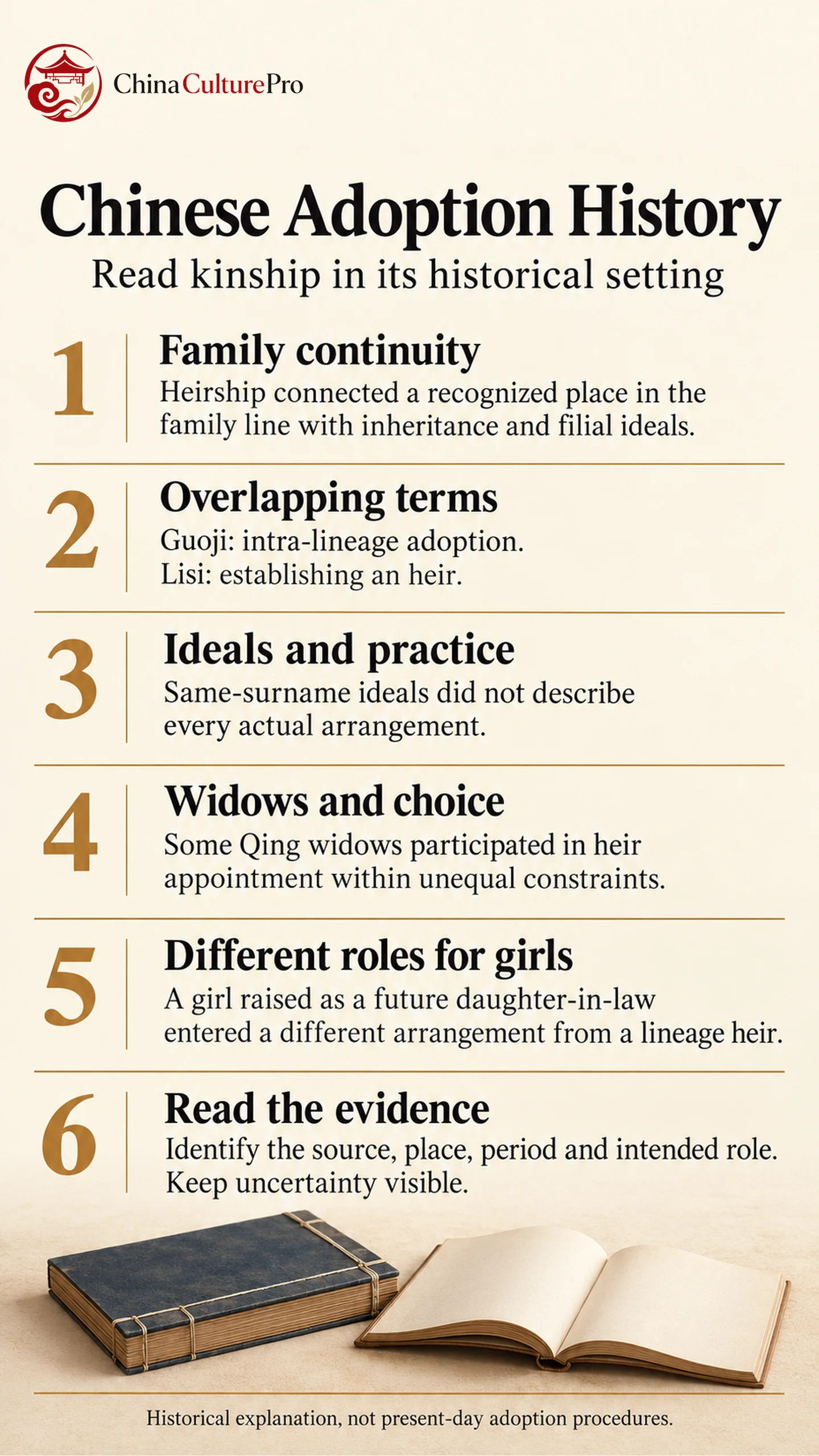
- Succession: An heir could carry forward a recognized place in the family line.
- Several arrangements: The English word “adoption” can conceal different expectations and relationships.
- Women’s roles: Widows and other women could participate in family decisions within unequal social structures.
- Historical context: Period, locality and the type of evidence matter more than a single national rule.
This is a guide to historical culture, especially late imperial China and a documented Taiwanese case, rather than present-day adoption procedures.
Reading that someone was “adopted” in a Chinese family history raises several questions. Who recognized the relationship? Was the main concern succession, care, marriage or some combination? What changed in the person’s position within the family?
A historical arrangement becomes clearer when those questions replace assumptions drawn from a modern adoption process. This guide explains the distinctions without treating inherited family hierarchies as instructions for families today. The broader Chinese family traditions guide introduces the surrounding kinship context.
Why Continuing a Family Line Mattered
In a patrilineal system, descent is organized through the male line. Securing a recognized successor could therefore matter beyond the immediate relationship between a parent and a child.
Ann Waltner’s study of adoption in the late Ming and early Qing periods connects the demand for heirs with inheritance and ideas of filiality. Its range of sources includes ritual and medical texts, legal codes, biographies, local gazetteers and fiction. Adoption emerges as a problem discussed across different kinds of writing, rather than a single unchanging practice.[1]
“Continuity” is a useful starting point, but it does not explain every person’s motives. A family’s wish to preserve its line and an individual’s experience within that arrangement are different subjects. A formal account of succession may say little about affection, daily care or conflict.
Keep three questions separate: who belonged to the household, who occupied a place in the lineage and who received property. A record may answer one while leaving the others uncertain. Related discussions of ancestor worship and family genealogy help explain why recognized relationships mattered to later descendants.
Heir Succession and Adoption Are Overlapping Ideas
Guoji (过继, guòjì) refers here to intra-lineage adoption associated with continuing a family line. Lisi (立嗣, lìsì) means establishing an heir for succession. The first points to a kinship arrangement; the second emphasizes the appointment of a successor.
| Término | Significado en esta guía | Precaución al interpretar |
|---|---|---|
| Guoji | Intra-lineage adoption associated with continuing a family line | Do not apply the term to every historical adoption |
| Lisi | Establishing an heir for succession | An heir’s status does not by itself describe everyday household life |
A City University of Hong Kong research abstract identifies intra-lineage adoption as one mechanism for addressing a lack of legitimate heirs. Kuanqing Lü’s Qing study examines heir appointment through the decisions and disputes of widows.[2][3] Together, these examples show why “adoption” and “succession” need to be distinguished even when they intersect.
The terms are guides to reading, not a complete classification of all Chinese kinship practices. If a translated document uses only “adopted son,” preserve the original expression where available before assigning it a more precise historical meaning.
Surname Ideals and Actual Family Choices
A rule in a ritual or legal text is evidence of an ideal. It does not automatically establish what every household did.
Waltner’s book description highlights this tension: same-surname adoption had ritual and legal approval, while adoption across surname lines was nevertheless relatively common in the period she studies. Her analysis identifies arguments against such arrangements as well as a discourse that justified them.[1] The important distinction is between the normative framework and the relationships people actually constructed.
This does not mean that surname identity was irrelevant, or that a shared surname proves a particular biological connection. It means the researcher must identify what the source is claiming. A prescription, a disputed case and a family’s commemorative narrative serve different purposes.
Avoid turning an ideal into a neat historical checklist. Ask instead whether the account describes an approved model, an exception, a conflict or an arrangement that relatives accepted in practice. The same word may appear in each kind of source while doing a different job.
Widows Could Participate in Choosing an Heir
A male-centered descent system did not make women absent from decisions about succession. Their room to act could be real while remaining constrained.
Lü’s study describes Qing widows who did not remarry as potential participants in adopting an heir. It distinguishes forms translated as adoption “by order” and “by affection,” notes some different-surname heirs and discusses economic compensation. Patriarchal authority, lineage institutions and convention limited widows’ choices, yet women could also use legal proceedings to protect their interests.[3]
This is more complicated than either “women had no say” or “widows could choose freely.” A dispute over a successor could involve both family authority and material security. The study’s account should not be stretched into a guarantee about every widow’s experience.
Chia-Lan Chang’s research on Qing and Republican Quanzhou likewise examines women using family status, legal powers and community connections. It also discusses mother-daughter bonds formed between religious instructors and disciples.[5] Such relationships broaden the history of kinship, but a social bond should not automatically be labeled a formal adoption.
Girls and Marriage Arrangements Need Separate Context
A history centered only on male heirs would miss other uses of adoption. Girls described as adopted could be entering relationships with quite different expectations.
Arthur P. Wolf and Chieh-shan Huang’s study covers nine districts in northern Taiwan between 1845 and 1945. As summarized by eHRAF, it examines arrangements in which adopted daughters were raised as sons’ future wives, alongside other marriage forms. The study relates these choices to interacting demographic, economic and psychological forces, rather than uniformly held ideals.[4]
A girl raised as a future daughter-in-law occupied a different intended role from a boy appointed to continue a lineage. Neither category alone establishes that a child was orphaned or explains the circumstances of placement. The historian needs to ask about the person’s age, expected role, household relationships and ability to influence the arrangement.
Keep this evidence within its documented setting. A northern Taiwanese study covering a particular century cannot establish how every girl, family or Chinese community experienced adoption. Nor does describing a historical practice endorse the power relations it involved.
How to Read Adoption in a Family History
Begin with what the document actually records, then make the unanswered questions visible. The following prompts help keep interpretation precise.
- Identify the source: Is it a genealogy, household record, legal dispute, biography or later family recollection?
- Locate the arrangement: What period, locality and family branch does the account concern?
- Clarify the role: Does the wording establish heirship, household membership, a marriage expectation or another relationship?
- Separate evidence from inference: Which relationships are explicit, and which have been reconstructed by a later reader?
- Look for other voices: Does another record preserve the perspective of women, the adopted person or relatives involved in a dispute?
A gap is not proof of secrecy, and a formal entry is not a complete account of family life. Keep uncertain connections marked as uncertain. Grave inscriptions may supply another account of a person’s relationships, but they too are commemorative sources with their own purposes.
Historical adoption is most useful to understand as kinship being made and recognized under particular conditions. Preserving those conditions gives descendants a more accurate history than forcing every arrangement into one familiar label.
FAQs About Chinese Adoption History
Was historical adoption only about orphaned children?
No. The historical studies discussed here include succession and marriage-related arrangements. An adoption label alone does not establish that a person was orphaned or explain why the relationship was formed.
Did an adopted heir always share the family surname?
No. Waltner’s study distinguishes the same-surname ideal from the existence of different-surname adoption in late Ming and early Qing practice. A stated rule and an actual family arrangement are different kinds of evidence.
Could a widow help choose an heir?
Yes, in the Qing cases examined by Lü, widows who did not remarry could participate in heir adoption. Their choices remained subject to family and social constraints; the study does not imply unlimited freedom.
Were all children described as adopted being prepared for the same role?
No. Lineage succession and being raised as a future spouse involved different expectations. Read the original terminology and local context before assuming that two records describe the same arrangement.
Fuentes
[1] Ann Waltner, University of Hawai‘i Press. Getting an Heir: Adoption and the Construction of Kinship in Late Imperial China, book description
[2] Shukai Liu, City University of Hong Kong. From Intra-lineage adoption (guoji) to Surrogacy: Lineage Continuation and Institutional Change in Chinese Legal History, conference abstract
[3] Kuanqing Lü, Frontiers of History in China. Adopting an heir: Widows’ heir adoption and related legal and social issues in the Qing Dynasty, abstract
[4] Arthur P. Wolf and Chieh-shan Huang, Stanford University Press. Marriage and Adoption in China, 1845–1945, eHRAF publication information and abstract
[5] Chia-Lan Chang, University of Southern California. Family matters: Women’s negotiation with Confucian family ethics in Qing and Republican China, dissertation abstract