

Quick Answer: What Is Mahjong?
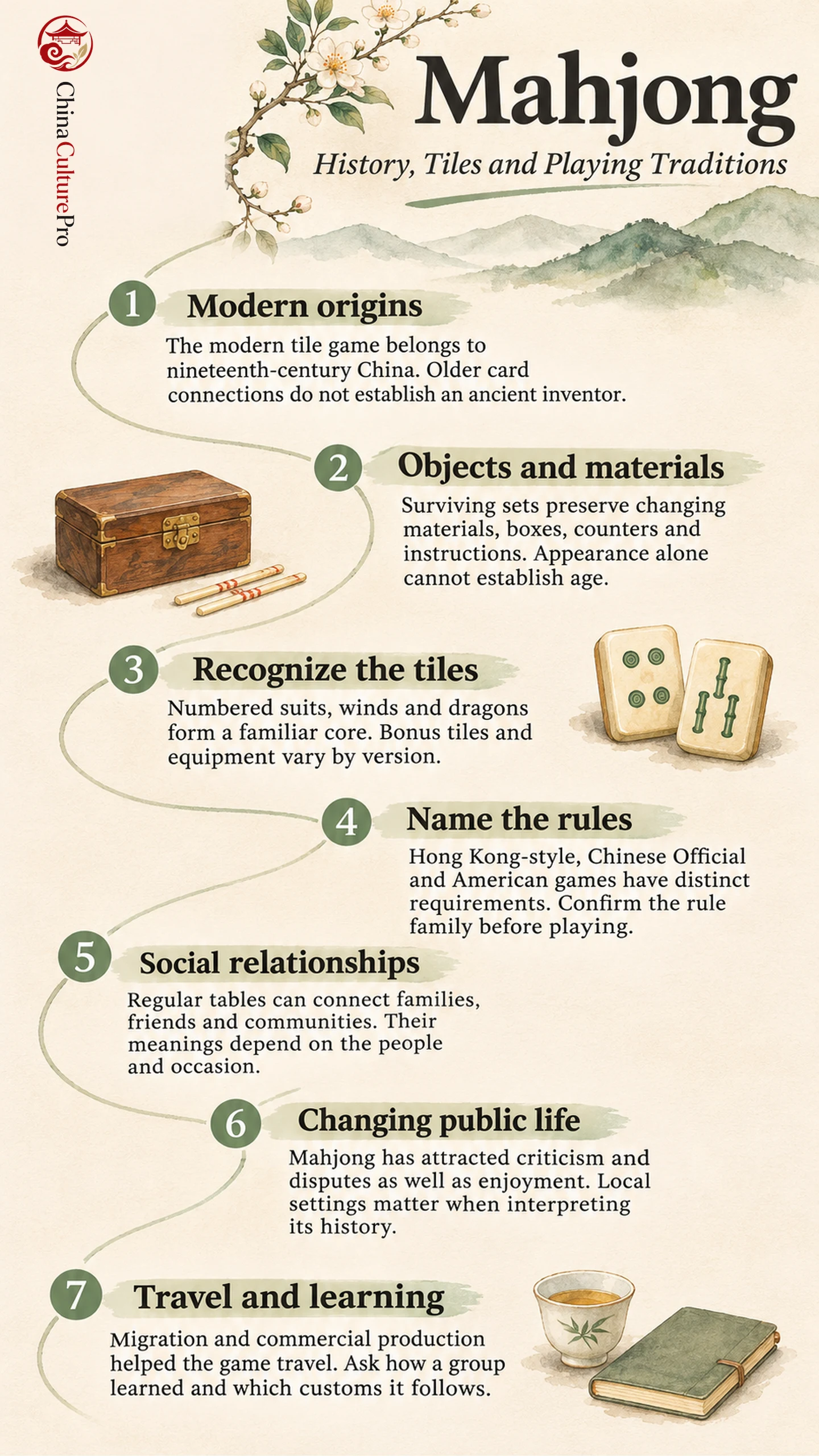
Mahjong (麻将, májiàng) is a Chinese tile game best understood as a family of playing traditions. Four players commonly draw, discard and build combinations, but regional rules and social settings differ. Its documented modern history belongs to nineteenth-century China, rather than to a securely established ancient inventor.[1][2]
- Equipment: numbered suits, winds and dragons make the tiles recognizable across many versions.
- History: surviving objects, printed materials and scholarship reveal a game that developed and traveled.
- Culture: regular tables can connect friends, relatives and communities, while local expectations shape play.
Recognizing the tiles does not tell you which rules a particular group follows.
The sound of shuffled tiles is often the first thing a visitor notices. The more revealing questions come next: who gathers around the table, how they learned, which version they play and what the occasion means to them. Those questions connect the game with histories of leisure, migration and everyday relationships.
A Nineteenth-Century Game with Older Connections
The modern tile game emerged in the late Qing period. A British Museum exhibition label describes a nineteenth-century set donated in 1908, made from bone, wood and bamboo. Its 140 surviving tiles form an incomplete set, accompanied by counting sticks, printed cards, dice and a round/dealer marker. This is tangible evidence of a developed playing culture, not proof of a single inventor.[1]
Mahjong also has connections with older Chinese card games. Historian Maggie Greene discusses madiao (马吊, mǎdiào) as a predecessor while treating mahjong’s precise origins as uncertain. A resemblance between earlier cards and later tiles is different from evidence that the modern game existed unchanged for centuries.[3]
Stories crediting Confucius or a particular legendary founder are appealing explanations of prestige. They should not replace the nineteenth-century material and textual record. A cautious origin account can still explain the game’s Chinese roots without supplying a founder whom the evidence cannot establish.
What the Tiles and Equipment Reveal
The familiar core set has three numbered suits, usually called dots, bamboo and characters, plus winds and dragons. Four copies of each core tile type give 136 tiles. Eight flowers and seasons bring a set to 144; other versions use different equipment or additional tiles.[2]
- Suited tiles provide numbered ranks that players can combine in patterns permitted by the rules.
- Honors are the winds and dragons, distinguished from the numbered suits.
- Bonus tiles, when used, have a different role from ordinary hand-building tiles.
Tile names and pictures help organize play, but their designs also reveal production and adaptation. A Smithsonian set combines bamboo with laminated celluloid tops and a wooden box. Compared with the earlier bone-and-bamboo example, it demonstrates that the game’s material culture includes changing manufactured materials.[4]
Do not date a set from its “traditional” appearance alone. The container, maker’s marks, instructions and documented history may be more informative than an aged-looking surface. For identification, use the separate mahjong tiles guide rather than assuming every decorative set has the same contents.
One Game, Several Rule Traditions
Mahjong’s recognizable equipment can conceal substantial differences in play. A platform offering several versions lists Hong Kong, Chinese Official, Taiwanese, Japanese riichi and American games separately. The choice is practical: a familiar-looking table may use an unfamiliar scoring system.[5]
| Rule family | A useful identifying feature | What a newcomer should ask |
|---|---|---|
| Hong Kong-style | Faan (番, fān in Mandarin) scoring with table conventions | Which scoring sheet and minimum apply? |
| Chinese Official or MCR | A standardized competition code | Are Mahjong Competition Rules being used? |
| American | Published card-based hand requirements | Which organization’s rules and card apply? |
The National Mah Jongg League’s own account dates its founding to 1937, when enthusiasts met in New York to standardize hands and rules. Its changing annual requirements show how a named organization can sustain a particular form of the game.[6]
Regional traditions such as Sichuan mahjong deserve their own explanations. For your first lesson, choose one version: our mahjong rules guide introduces a Hong Kong-style framework, while mahjong scoring systems explains why charts cannot simply be combined.
The Social Life Around the Table
Repeated meetings can matter as much as individual wins. Historian Annelise Heinz’s research describes long-standing groups whose members shared major changes in their lives. Her work places Chinese American and Jewish American tables in distinct community settings, rather than treating every group as a generic example of the same custom.[7]
That perspective also changes how to observe play in China. A family game, a neighborhood table, an organized club and a tournament need not share the same purpose or pace. Ask what the participants are doing instead of deciding from the presence of tiles alone.
Learning can be a form of relationship-building: someone explains a tile, corrects a call or introduces a visitor to the group’s conventions. The etiquette of that particular table—when to speak, how to confirm a win and whether to photograph—belongs to the social setting as well as the rule sheet.
Heinz’s examples include Chinese American apartment life in 1930s San Francisco and Jewish American homes in 1950s Brooklyn. Those specific settings help explain how regular play acquired different meanings across communities.[7]
Criticism, Regulation and Changing Public Life
Mahjong has not always been celebrated. Greene’s study traces criticism by late Qing and Republican-era reformers who associated the pastime with wasted time or social decline. Its popularity nevertheless crossed class and gender boundaries. The argument over leisure is itself part of the game’s cultural history.[3]
Later urban life brought other tensions. Di Wang’s study of post-Mao Chengdu examines neighbor disputes, community institutions, official media and city image through mahjong. Its local cases show how recreation could become a question about shared space, individual choices and collective interests.[8]
Across these studies, ordinary recreation makes larger issues visible: reformers’ ideas about productive time, neighbors’ competing uses of shared space and officials’ visions of a modern city. The cultural meaning of mahjong changed with the people and institutions surrounding it.[3][8]
This history also helps explain why mahjong should not be reduced either to gambling or to a timeless symbol of harmony. People have used the same game in different ways and judged it through changing social expectations.
How Mahjong Traveled Overseas
The early 1920s brought a major mahjong craze in the United States and Europe. The Strong National Museum of Play connects that expansion with commercial rule publications and game manufacturing, and preserves a Parker Brothers set from about 1923. Products and teaching materials traveled with the game.[9]
Overseas communities then made their own enduring traditions. Heinz’s book follows the game across American social settings, including Chinese American heritage and Jewish American women’s culture. Its history concerns both connections across groups and the distinct identities that groups formed around play.[10]
The Strong’s Mahjong Oral History Collection preserves recordings gathered during that research. Personal recollections add something an old box cannot: how people learned, whom they played with and what regular games meant in their lives.[9]
The comparison between Chinese and American mahjong is therefore a story of adaptation as well as a rules comparison.
Approaching Your First Game
Start by asking which version the group plays and whether someone can explain its basic hand structure and scoring. Watch a hand before assuming that a rule learned online applies. Hong Kong mahjong is one possible starting point, not a default for every Chinese table.
If you are interested in the cultural setting, ask a player how they learned and whether their group has its own customs. That often produces a more useful conversation than asking for the one “authentic” way to play.
Mahjong sits alongside board games, outdoor play and other forms of Chinese traditional games. Its particular strength as a cultural subject is that objects, rules and people can all be studied together.
FAQs About Mahjong
Was mahjong invented by Confucius?
There is no sound historical basis for treating that story as the game’s origin. The modern tile game belongs to the nineteenth-century record; older connections do not establish an ancient founder.
Why do some sets have 136 tiles and others 144?
The common core contains 136 tiles. Adding four flowers and four seasons produces 144. Different versions may require other equipment, so identify the rules before judging a set’s completeness.
Is there one official Chinese mahjong game?
Mahjong Competition Rules provide a standardized competition code, but they do not replace all Chinese regional and household traditions. “Official” identifies a particular code, not every group’s practice.
Is mahjong the same as tile-matching solitaire?
No. The multiplayer game involves drawing, discarding and competing to form qualifying combinations. Tile-matching solitaire uses similar-looking pieces for a different task.[11]
Fuentes
[1] British Museum. China’s Hidden Century: Large Print Exhibition Text, Mahjong Set
[2] World Mahjong Organization. Mahjong Competition Rules
[3] Maggie Greene. The Game People Played: Mahjong in Modern Chinese Society and Culture
[4] National Museum of American History. Mah Jong Set, 2006.0098.1475
[5] Mahjong Time. Mahjong Game Info
[6] National Mah Jongg League. The League
[7] Stanford University, Department of History. From China to U.S., the game of mahjong shaped modern America, says Stanford scholar
[8] Di Wang, International Journal of Asian Studies. Mahjong and Urban Life: Individual Rights, Collective Interests, and City Image in Post-Mao China
[9] Julia Novakovic, The Strong National Museum of Play. Chow, Pong, and Kong: Mahjong!
[10] Annelise Heinz. Mahjong: A Chinese Game and the Making of Modern American Culture
[11] Shanghai city government portal. Unmasking a tiled tradition: Mahjong from its origins to today