


Quick Answer: How Does Dou Dizhu Work?
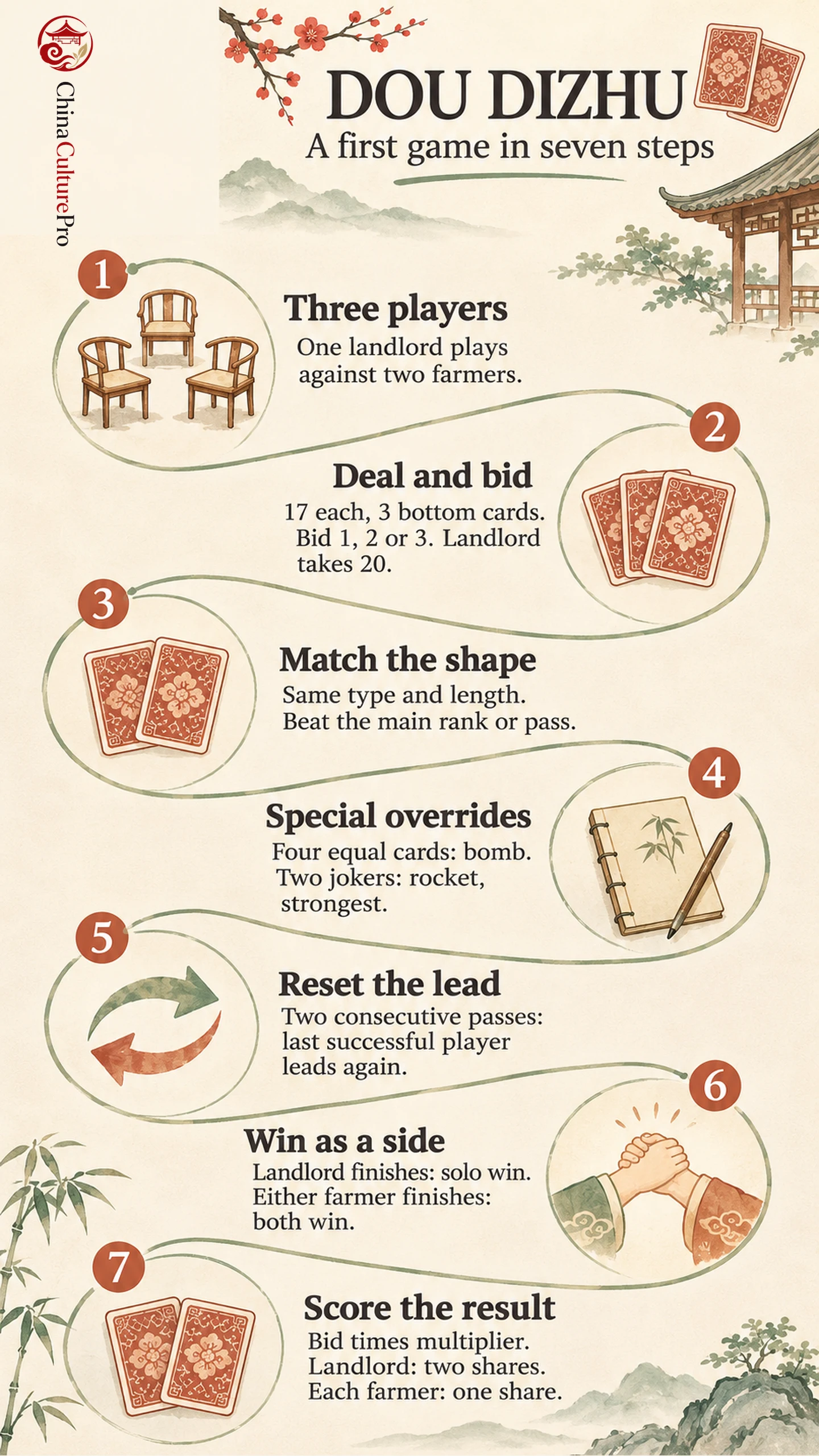
Dou Dizhu (斗地主, dòudìzhǔ), often translated as “Fight the Landlord,” is a three-player shedding game. One landlord (地主, dìzhǔ) plays alone against two cooperating farmers (农民, nóngmín); the first player to empty a hand wins for that side.[6]
- Use a 54-card pack: 52 ordinary cards and two different jokers.
- Deal 17 cards to each player; the eventual landlord takes the remaining three and holds 20.
- Follow a play with a higher combination of the same type and length, or pass.[6]
This guide uses a 1–2–3 points auction, exposed bottom cards and the practice settings described below. Fix those settings before the first deal.[2]
The changing teams make the game more than a race to discard high cards. A farmer’s best result may come from leaving a partner’s winning play alone, while the landlord must manage two opposing hands. This asymmetry gives Dou Dizhu a distinctive place among Chinese traditional games.
Deal 54 Cards and Bid for the Landlord
For a first practice game, use this opening:
- Shuffle the 54-card pack and deal 17 cards to each player. Leave three bottom cards face down in the center.
- Choose a first bidder at random. Moving anticlockwise, each player has one chance to pass or bid 1, 2 or 3; a positive bid must exceed the previous highest bid.
- A bid of 3 ends the auction immediately. Otherwise, the highest bidder becomes landlord after the bidding round. If everyone passes, shuffle and deal again.
- Reveal the three bottom cards to everyone and add them to the landlord’s hand. The landlord leads any legal combination with 20 cards; each farmer retains 17.
Use no optional player doubling or redoubling for this practice game. Those settings are separate from the score multipliers for combinations actually played.
Published versions differ. One operator’s rules assign the first bidder as landlord when everybody passes, whereas the opening above redeals. Do not switch between those procedures midway through a session.[1][2]
Know the Rank Order and Legal Combinations
From strongest to weakest, single-card ranks are: higher joker, lower joker, 2, A, K, Q, J, 10, 9, 8, 7, 6, 5, 4, 3. Identify the two jokers’ order before play; suits do not break ties. Chains run only from 3 through Ace, with no twos or jokers in their consecutive core.[3]
The following table groups the legal shapes without treating every attachment variation as the same response.[1]
| Familia | Forma | Simple example |
|---|---|---|
| Basic groups | A single; a same-rank pair; or a same-rank triple | 7;7–7;7–7–7 |
| Triple with attachment (三带一, sāndàiyī) | A triple plus one other single or one pair | 7–7–7 +4;7–7–7 +4–4 |
| Straight (顺子, shùnzǐ) | At least five consecutive single ranks | 3–4–5–6–7 |
| Consecutive pairs (连对, liánduì) | At least three pairs of consecutive ranks | 3–3–4–4–5–5 |
| Airplane (飞机, fēijī) | At least two consecutive triples; optionally one single or one pair per triple | 3–3–3–4–4–4 +7 +8 |
| Four with two (四带二, sìdàièr) | Four equal cards plus two singles or two pairs | 9–9–9–9 +3 +4 |
| Bomb (炸弹, zhàdàn) | Four equal cards played without attachments | 8–8–8–8 |
| Rocket (火箭, huǒjiàn) | The two different jokers together | Higher joker + lower joker |
Compare main groups, not attachments: 8–8–8 +4 beats 7–7–7 +A. A triple with a single and a triple with a pair remain different shapes.[7]
For this practice version, use distinct single wings or distinct pair wings outside the airplane’s core; use two distinct singles or pairs with four-of-a-kind. Do not attach both jokers together. Some published settings permit repeated single-wing ranks; agree which setting applies.[3]
A bomb overrides ordinary shapes; higher bombs beat lower ones. The rocket beats everything. Four with two remains ordinary, despite its four-of-a-kind core.[7]
Beat the Play or Pass, Then Reset
Play proceeds anticlockwise from the landlord’s opening. A player following an ordinary combination must match both its type and total card count at a higher main rank, or pass; the special overrides above remain available. Passing while following is allowed even if you could beat the play. A player holding the lead must play something.[7]
Two consecutive passes end the current contest. Clear the played cards and let the last player who successfully played lead a new combination.[6]
Here is an original sequence:
- The landlord leads a pair of sevens. Farmer A passes.
- Farmer B plays a pair of eights; the landlord passes.
- Farmer A can now play a pair of nines. The earlier pass did not remove that player.
- Farmer B and the landlord both pass. Farmer A leads a fresh legal combination.
The new lead can change shape. During the existing contest, however, a five-card straight cannot be answered by a six-card straight merely because its top card is higher.[3]
Finish First and Score the Team Result
The deal ends immediately when someone empties a hand. A landlord finish wins for the landlord; either farmer’s finish wins for both farmers, regardless of how many cards the partner still holds.[6]
Start with the bid and a multiplier of one. Each played bomb or rocket doubles the multiplier. A spring (春天, chūntiān) doubles it when the landlord wins before either farmer plays. An anti-spring (反春, fǎnchūn) doubles it when a farmer wins after only the landlord’s opening combination—not necessarily one physical card.[3]
Let the agreed unit equal the bid multiplied by the final multiplier. A winning landlord gains two units and each farmer loses one. If the farmers win, each gains one and the landlord loses two.[7]
For an original points-only example, take a bid of two, one played bomb, no spring and no optional player doubling. The multiplier is two and each unit is four points. A landlord win gives +8 to the landlord and −4 to each farmer; a farmer win gives +4 to each farmer and −8 to the landlord. The three changes sum to zero.
Record the base bid and multiplier separately. A four-with-two play does not trigger the bomb multiplier.
Cooperation, Regional Roots and Competition
The game’s regional roots are associated with Hubei. A 2013 national two-against-one tournament report describes entrants arriving through internet, mobile, television and offline qualifying channels, showing how a familiar social game also developed organized competitive forms.[4]
Competition can change how performance is measured. A later official rule announcement describes duplicate comparison: players in corresponding positions receive the same hands, and their results are compared. That aims to reduce the influence of the deal; it does not turn every casual game into the same tournament format.[5]
The farmers cooperate without seeing each other’s hands. Leaving a partner’s winning play alone can preserve control; overtaking may help the landlord. The next auction reassigns these game roles.[6]
For a learning round, announce the combination being played and check it openly. Keep private-card discussion out of the competitive round, and use a review after the deal to explain a disputed sequence or score.
FAQs About Dou Dizhu
Can I play again after passing?
Yes. If another player raises the current combination before two consecutive passes finish the contest, you can respond on your next turn. Passing is not permanent withdrawal.[7]
Can a straight contain a two or a joker?
No. Chains stop at Ace; neither a two nor a joker belongs in their consecutive core.[7]
Must both farmers empty their hands to win?
No. One farmer finishing before the landlord wins the deal for both farmers. The partner’s remaining card count does not cancel that team victory.[6]
Is four with two a bomb?
No. Four with two includes attachments. A bomb uses only four equal ranks; the rocket uses both jokers.[1]
Fuentes
[1] JJ Games. Dou Dizhu Rules
[2] play.cards. Fight the Landlord: rules and table settings
[3] The World at Play. Dou Dizhu: combinations, scoring and practice rules
[4] General Administration of Sport of China. 2013 national two-against-one poker finals report
[5] General Administration of Sport of China. Competitive two-against-one rules and duplicate comparison
[6] Daochen Zha et al. DouZero: Mastering DouDizhu with Self-Play Deep Reinforcement Learning, Appendix A
[7] Help Pages. Dou Di Zhu: playing rules and combinations