

Quick Answer: How Can You Check Chinese Character Etymology?
Look up the exact character in a historical database. Open the earliest forms shown, read the explanation of its components, and record the evidence alongside the proposed interpretation. Two useful resources are the Chinese University of Hong Kong’s Multi-Function Chinese Character Database and Academia Sinica’s Xiaoxuetang database.[1][2]
- Form: Check what the early sample actually shows and which script the database assigns it to.[1][2]
- Sound: Ask whether a component hints at the character’s historical pronunciation.[1][4]
- Meaning: Look for documented uses in context before attaching an exact modern meaning to an ancient form.[3][4]
A character entry records examples the editors could identify. Its oldest displayed form gives you a starting point for the inquiry, with the date and provenance to check next.[1][2]
A clever explanation for a Chinese character can make it easier to remember. Checking where the character came from takes a different kind of reading. Start with the written forms that survive, then see how a historical dictionary explains them and where the evidence runs out.
How to Check a Chinese Character’s Origin
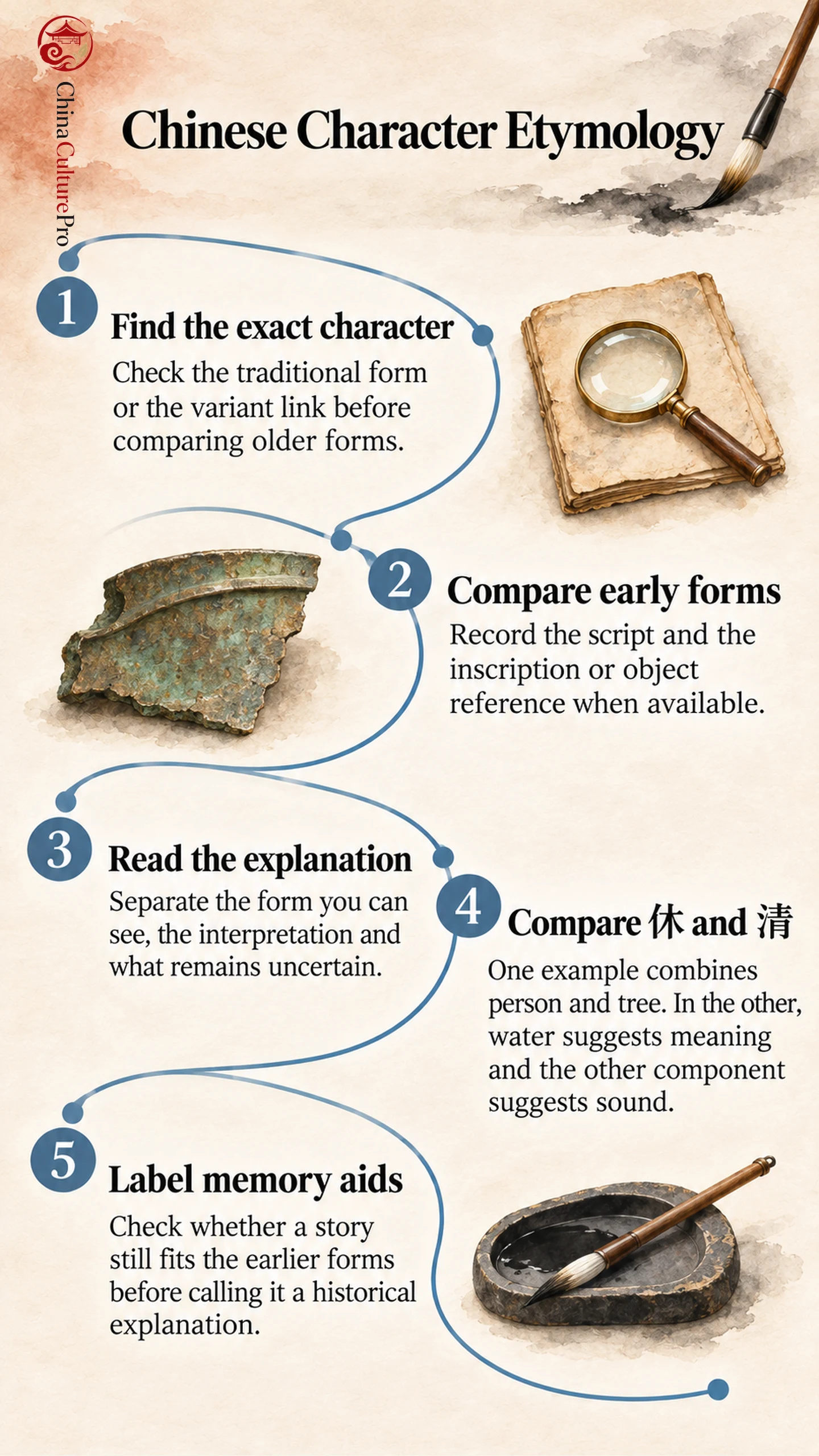
1. Search the exact character
Enter the character you want to explain. If you began with a simplified form, open its traditional counterpart or check the variant link. Record the form you searched and the meaning you are investigating. One written character can have several uses, and a result for one use may leave another unexplained.[1][2]
2. Compare forms by script
Start with the oldest forms the entry actually shows. Compare those examples with later forms, noting whether you are looking at oracle bone, bronze or seal script (小篆, xiǎozhuàn). Record the script label and, where supplied, the inscription or object reference. The overview of oracle bone script explains the medium behind many early forms.[1][2]
3. Read the explanation and record its limits
Compare the early forms with the entry’s editorial notes and any quotation from the Shuowen Jiezi (說文解字, Shuōwén Jiězì), an Eastern Han dictionary. Write down what the surviving form shows, how the source interprets it, and what it leaves uncertain. When the dictionary and a modern analysis differ, keep both accounts attributed to their sources.[1][5]
What 休 and 清 Show About Character Origins
The entry for 休 (xiū, “to rest”) displays person and tree shapes together in the early writing. The Shuowen entry reads the combination as a person leaning against a tree. That image works as a memory aid because it also reflects a documented explanation. Comparing the actual early forms shows why the account has more support than a story made from strokes in a modern typeface.[3]
The entry for 清 (qīng, “clear”) illustrates a different relationship. It identifies the water component as a meaning clue and 青 (qīng) as the phonetic component (聲符, shēngfú), which gives a clue to the sound. The bronze and bamboo-script forms support that component analysis. The same entry leaves the meaning in the documented bronze examples uncertain. Form and usage answer separate questions here: a visible component can help explain the written form even when the context of an early occurrence needs more evidence.[4]
The guide to Chinese characters places these examples in the wider writing system. Remember that a radical can serve as a dictionary’s lookup heading. In 清 the water component also carries a meaning clue, while 青 tells you more about the sound.[1][4]
How to Spot a Memory Aid in an Origin Story
Check whether the explanation would still work with the older forms on the page. A modern decomposition can help you recognise a character while overlooking a component that changed shape, or treating a sound component as though it supplied the meaning. Pay particular attention when a story depends on the visual details of only one recent printed form.[1][4]
For personal notes, use short labels such as “visible in the bronze form,” “the editor’s interpretation,” and “my memory aid.” If an online explanation supplies a precise story without a script label, inscription reference or historical source, keep it as a memory aid until you can trace the claim.[1][2]
FAQs About Chinese Character Etymology
Is a character’s radical always the key to its origin?
A radical is a dictionary indexing category. It can coincide with a meaning-bearing component, as water does in 清, but a historical explanation can also depend on a sound component or an older form.[1][4]
What if a database shows no oracle bone form?
Use the earliest example the entry provides and record its script. The entry describes the forms it has collected, so a blank oracle bone field only tells you that this database displays no example there.[1][2]
Can a character story still help me learn?
Yes. A memory aid can help you retain the modern form. To call the same story a historical explanation, check it against early forms and a source that explains how it reached that reading.[1][2]
Fuentes
[1] Chinese University of Hong Kong. Guide to the Multi-Function Chinese Character Database
[2] Academia Sinica. About the Xiaoxuetang Database
[3] Chinese University of Hong Kong. Character Entry for 休
[4] Chinese University of Hong Kong. Character Entry for 清
[5] Chinese Language Institute. Chinese Etymology and the Origins of Chinese Characters