

Quick Answer: How Can You Teach Chinese Culture with Objects and Stories?
Start with one object or text that students can inspect closely. Ask what they can see or read, what they infer from it, and what further information they need. These three lessons use a museum object, a poem in translation, and an export porcelain case. [1][2][3][4][5]
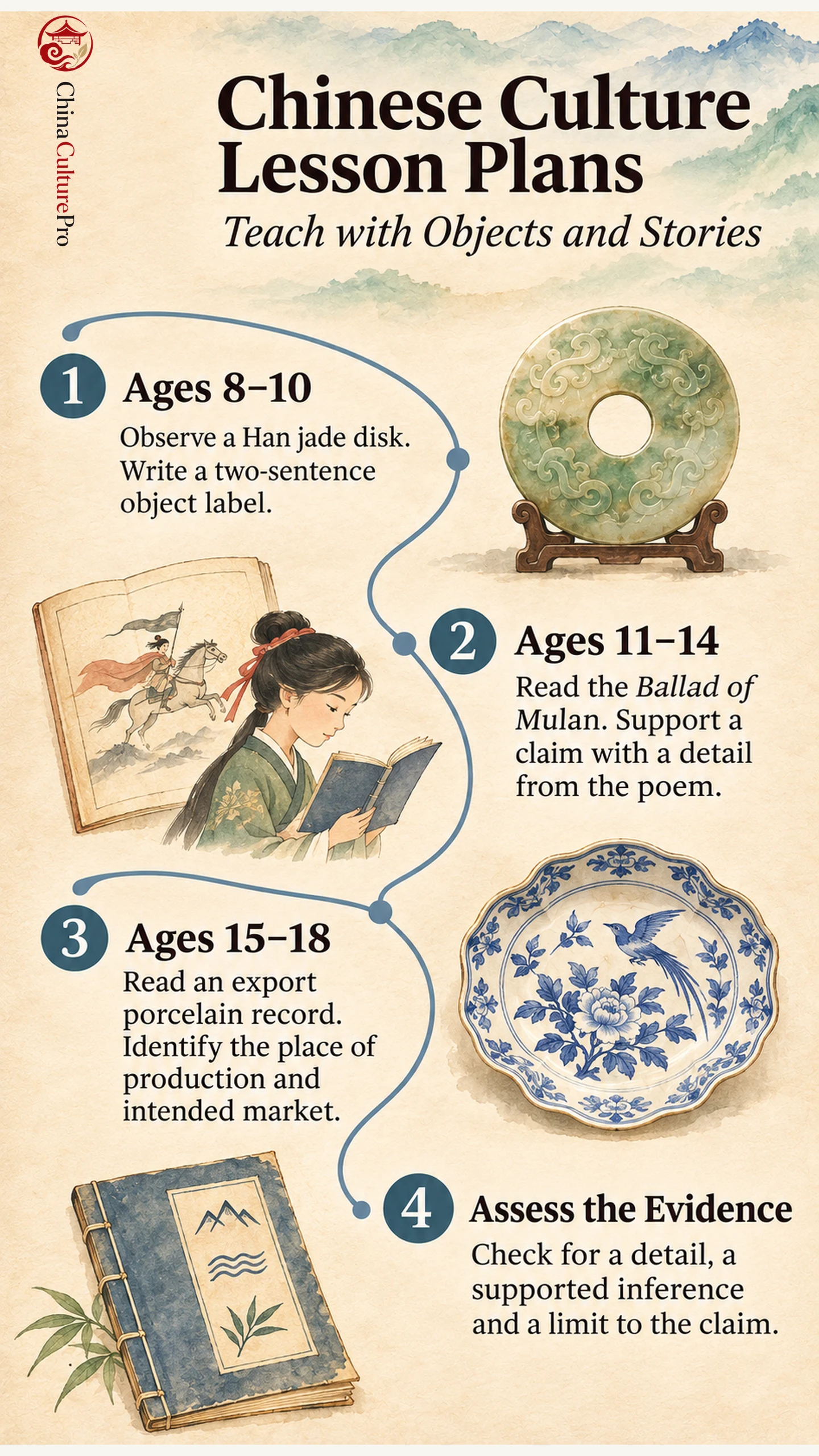
- Ages 8–10: Make an evidence label for a Han jade disk.
- Ages 11–14: Explain a character’s decision in a translated poem.
- Ages 15–18: Trace how a Chinese porcelain dish points to an overseas audience.
Plan for 30 minutes for the label, 40 for the poem, or 50 for the export object. Each lesson ends with student work you can check.
A classroom can learn a great deal about one thing in a short period. A jade object gives students shapes and materials to observe. A poem gives them decisions and language to interpret. A museum label gives them one account of when and for whom an object was made. Use the source that matches what you want students to practice. [1][2]
Lesson 1: Read an Object Label
Ages 8–10, 30 minutes. Use the Smithsonian’s Eastern Han jade disk record, accession F1916.155. The record identifies the material as nephrite and shows a disk with a hole, raised patterns, a dragon and a feline. This type of disk is called a bi (璧, bì). Open the museum record and show the picture before showing the label. [1][3]
Spend 5 minutes on quiet looking. Give pairs 8 minutes to list or sketch three visible details. Use 10 minutes to compare their details with the record and discuss what is hard to infer from a picture. For example, an outline may suggest an animal before students know how the museum identifies it. The museum’s lesson also leaves room for uncertainty about how these objects were used. [1][3]
Use the final 7 minutes for a two-sentence label. One sentence names an observable feature, and one raises a question the image alone cannot answer. Let younger students draw and dictate the second sentence. The guide to Chinese culture for kids offers vocabulary and starter ideas for learners who need more context.
Lesson 2: Read a Character’s Decision in a Poem
Ages 11–14, 40 minutes. Read the opening of the ballad about Mulan (木兰, Mùlán) in the English translation provided by Columbia University’s Asia for Educators. Students locate the moment Mulan learns that her father has been called to serve and explain what she decides to do. The poem is the evidence for how the story presents her, while the historical note supplies an account of the setting. [4]
Allow 8 minutes for reading and underlining. Use 12 minutes to fill a two-column chart recording a decision and the words or actions that show it. Spend 12 minutes discussing two supported interpretations, such as care for her father and expectations for someone in her family. In the last 8 minutes, students write a claim, paraphrase a detail and explain why it supports the claim. [2][4]
If students arrive with a film version in mind, give them one question to test against the poem. For example, what pressures does the poem name before the main character leaves home? Keep any interpretation tied to this version of the story. A broader reading guide, how to study Chinese culture with sources, helps explain why versions matter. [4]
Lesson 3: Ask Who an Object Was Made For
Ages 15–18, 50 minutes. Use the Met’s catalog record for the export porcelain dish dated about 1710–25, object 24.80.151. The catalog identifies it as Chinese porcelain for the Dutch market. The set includes dishes with coats of arms from several places. Compare it with the Met’s exhibition text on how export commissions could use drawings or prints supplied by customers. [5][6]
Give students 10 minutes to examine the object record, including date, material and place. Give pairs 15 minutes to mark one statement about production and one about the buyer or market, then note what evidence would be needed to name a particular commissioner. Take 15 minutes to compare findings with the exhibition text. Spend the final 10 minutes writing a short label that states an evidence-based claim about exchange and identifies one uncertainty. [2][5][6]
For extension, compare Chinese-made export objects with European works that reimagined Chinese designs. The guide to chinoiserie in European art and design gives background for that second category. Ask students to identify where each object was made before comparing motifs. [6]
Assess What Students Can Show
Check whether each label, chart, or paragraph cites a specific detail, draws a supported inference, and names what the evidence leaves open. The detail can come from a photograph, a collection record, or a translated text. Ask students to name which one they are using. [1][2]
For a classroom slide, keep the museum credit line and the object number with the image. Where an image is missing or its reuse status is unclear, open the original public record with students. Use the linked Columbia edition for its translation and credit. The Met labels its photograph of the dish as public domain. [3][4][5]
FAQs About Chinese Culture Lesson Plans
Do students need to read Chinese?
They can use museum records in English and an English translation for the poem. Older students can compare translation choices when they have access to another credited edition. [3][4][5]
Can I use one object for a shorter class?
Yes. Ask learners to identify two details, read one sentence from the collection record and write one question they still have. [1][2]
Fuentes
[1] Smithsonian National Museum of Asian Art. Lucky Symbols
[2] Library of Congress. Teacher’s Guides and Analysis Tool
[3] Smithsonian National Museum of Asian Art. Jade disk F1916.155
[4] Columbia University, Asia for Educators. The Ballad of Mulan
[5] The Metropolitan Museum of Art. Dish for the Dutch market, object 24.80.151
[6] The Metropolitan Museum of Art. Chinese Export Porcelain at The Metropolitan Museum of Art