

Quick Answer: What Was Chinese Indentured Labor Overseas?
In the nineteenth century, Chinese migrants were recruited for fixed-term labour overseas. Cuba and Peru became major destinations in the Americas. Surviving contracts describe wages, provisions and the length of service. Workers’ accounts and investigations document coercion and gaps between what contracts promised and what some workers experienced.[1][2][3][4][5][6]
- Contract: The written agreement set a term of service and described payments or provisions.[1]
- Coercion: Recruiting and employment arrangements could leave workers exposed to deception, confinement and pressure to sign further terms.[3][4][6]
- Community: Some migrants stayed and helped form neighbourhoods, businesses and associations.[5][7]
A contract gives evidence of an employer’s stated obligations. Other records help show what workers experienced, which rights they could exercise and how those conditions varied.[1][6]
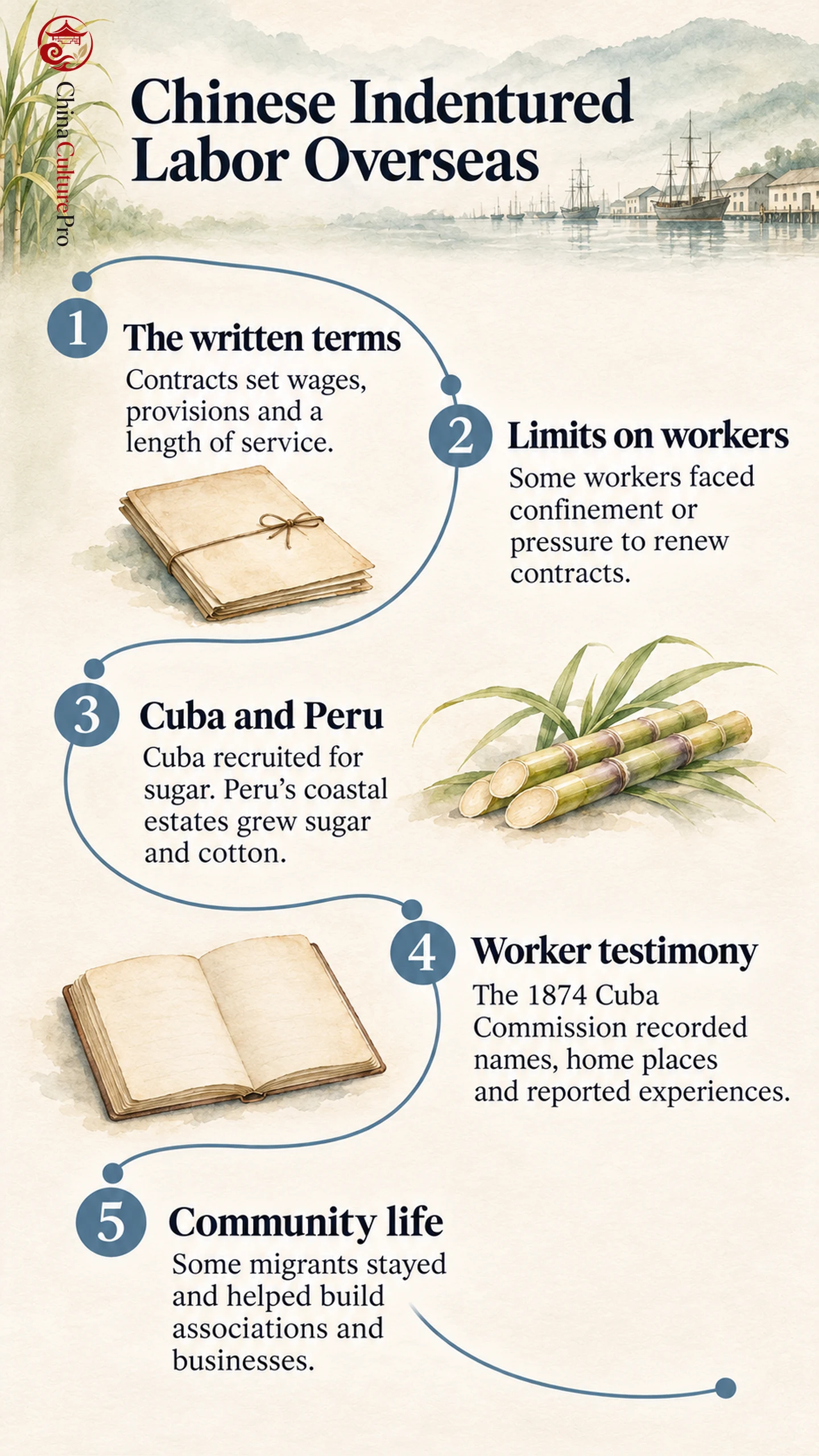
A nineteenth-century work contract could say how much a worker would be paid and how much rest he would receive. To learn how that agreement worked overseas, read the document alongside a worker’s testimony and the rules that limited his ability to leave.
What the Contract Said and What Workers Could Do
A University of Florida collection preserves Cuban work contracts from 1861 to 1878. Its catalogue describes terms such as duration, wages, food, clothing and rest. Some of the records also identify individual workers or the places where contracts were issued. This is where to start if you want to know what a particular agreement promised.[1]
The next question is how the terms were enforced. The original term in Cuba was often eight years. A worker could face pressure to sign another contract when it ended. In Cuba, contract labour operated alongside slavery. The systems had different legal forms, while historical evidence documents serious coercion and abuse in contract labour as well.[2][3][6]
Cuba and Peru Compared
In Cuba, labour demand from the sugar industry drove much of the recruitment. In Peru, coastal estates recruited workers, including for sugar and cotton. The dates below describe different milestones: a period of major arrivals and a recruitment law.[1][2][3][4][5]
| Destination | Nineteenth-century evidence | Important work settings |
|---|---|---|
| Cuba | Main ship arrivals conventionally dated 1847–74 | Sugar estates |
| Peru | Immigration law of 1849 supported foreign recruitment | Coastal sugar and cotton estates |
The end date for the main Cuban voyages refers to arrivals. Existing labour contracts continued after the last of those ships, and historians have identified later efforts to recruit more workers. In Peru, the 1849 law covered foreign recruitment more broadly, though Chinese migration became central to estate labour during the period.[3][4][5]
What Worker Testimony and Community Records Add
The 1874 Cuba Commission gathered testimony from Chinese workers. Its records preserve many workers’ names and home places, giving the history a source beyond contracts and employer reports. The published testimony was collected and summarised by investigators. A record can preserve someone’s account without reproducing every word of the interview.[6]
Some migrants stayed and built relationships and livelihoods during and after indenture. Later records trace local businesses and associations in Havana and Chinatown organisations in Lima. The guides to Chinese culture in Cuba and the wider Chinese diaspora follow those community histories beyond the period of recruitment.[5][7]
FAQs About Chinese Indentured Labor Overseas
Did Chinese indentured labour in Cuba end in 1874?
The main sequence of voyages carrying indentured workers to Cuba is conventionally dated through 1874. Some workers remained under existing contracts afterward, and further recruitment efforts followed.[3]
What does a work contract tell us about an actual worker?
It can record a name, destination, wage and promised provisions. To understand what happened during service, compare it with testimony, investigations and records of disputes.[1][6]
Fuentes
[1] University of Florida Libraries. Chinese Indentured Workers in Cuba Contracts
[2] Itinerario. Chinese Contract Labour and Nineteenth-Century Cuban Economic Change
[3] Mònica Ginés-Blasi. Chinese Indentured Migration to Cuba After the 1874 Commission Report
[4] Miguel Situ Chang. Captive Labour and Peru’s Immigration Law of 1849
[5] National Library of Peru. Portraits of Nineteenth-Century Immigration
[6] Evelyn Hu-DeHart. Chinese Contract Labor and the Cuba Commission Report
[7] Library of Congress digital collection. Diaspora and Trust: Cuba, Mexico, and the Rise of China