


Quick Answer: Who Was Zhang Liang?
Zhang Liang (张良, Zhāng Liáng) was a strategist who advised Liu Bang (刘邦, Liú Bāng) during the fall of Qin and the founding of the Han dynasty. Sima Qian’s biography portrays him advising on rival forces, allies and rewards. Liu Bang granted him the title Marquis of Liu (留侯, Liú Hóu).[1][2][3]
- Early allegiance: Zhang came from a family that had served one of the states conquered by Qin.
- Political role: His influence came chiefly through advice and relationships.
- Later memory: The same biography includes a story about an old man, a bridge and a military book.
The story of the book and the accounts of decisions can be read together while asking different questions of each.
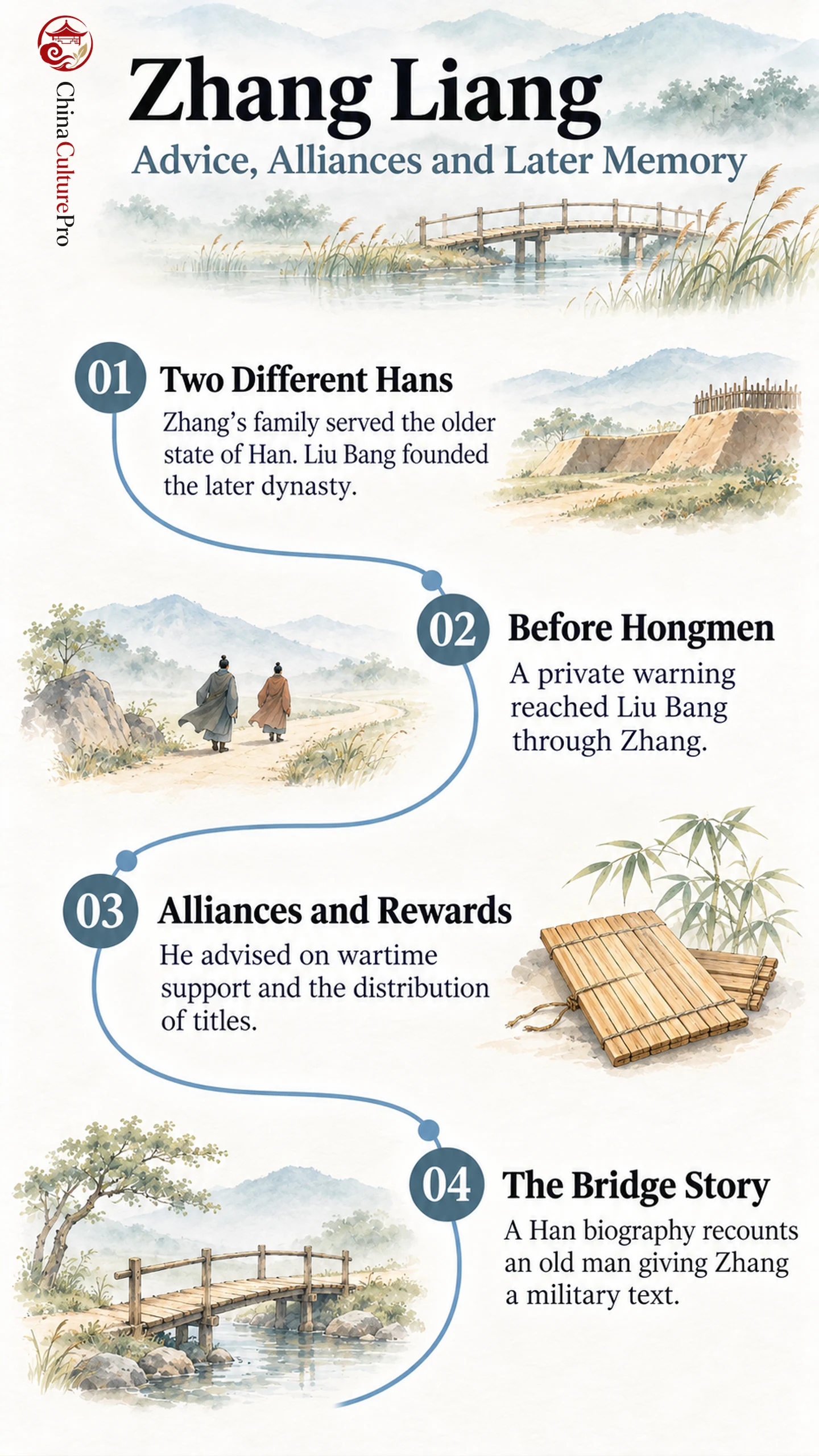
Zhang Liang’s most consequential work often began with a conversation. An ally warned him of an attack. Commanders needed reasons to join an army. A newly established court had to distribute rewards. These problems explain why Liu Bang listened to him.
From the State of Han to Liu Bang’s Camp
Zhang’s family had held high office in the state of Han (韩国, Hán Guó), one of the Warring States conquered by Qin. It was a different polity from the Han dynasty Liu Bang later founded. The Warring States name uses 韩, while the dynasty uses 汉. Sima Qian’s account presents Zhang’s early actions as an effort to avenge and then restore the older state.[1][2]
The biography describes an unsuccessful attack on the First Emperor of Qin at Bolangsha. A man hired by Zhang struck the wrong carriage. Zhang hid at Xiapi and later took part in the upheaval that brought Qin down. He initially supported restoration of a ruler of the old Han state and became closely associated with Liu Bang over the course of the struggle.[1][2][3]
The Warning Before the Hongmen Banquet
Before the Hongmen Banquet (鸿门宴, Hóngmén Yàn), Xiang Bo went to Zhang Liang privately to warn him that the army of Xiang Yu (项羽, Xiàng Yǔ) might attack. The two men knew each other from an earlier episode when Zhang sheltered Xiang Bo. Zhang told Liu Bang of the threat and brought the two men together. Liu could then have Xiang Bo carry his explanation to Xiang Yu. The biography says Liu presented the closing of a pass as protection against other intruders and denied any intention of breaking with Xiang Yu.[1]
The biography locates this work before the famous meal. The banquet belongs to a broader history of political encounters around elite meals, while Zhang’s intervention explains why an explanation could be delivered before the rivals met. His relationship with Xiang Bo opened a channel the military situation alone did not provide.[1]
Why Zhang Liang’s Advice Mattered After the War
After a defeat at Pengcheng, the biography has Zhang name three people who could help reverse Liu Bang’s position. He named Ying Bu, Peng Yue and Han Xin. After victory, the problem became how to reward people whose loyalty still mattered. The biography says Zhang recommended granting a title to Yong Chi, a man Liu disliked but whose contributions were known.[1][2]
Rewarding Yong Chi made a claim about how the new ruler would judge service. Other commanders could infer that past friction would not automatically exclude them. Zhang himself received the title Marquis of Liu. The two decisions concerned different phases of the same coalition. Before victory, Zhang urged Liu to bring commanders in. Afterward, he urged him to show how their service would be rewarded.[1][2]
The Bridge Story and the Book of Strategy
In the bridge story, an old man drops a shoe and has Zhang retrieve it. He tells Zhang to meet him again and rebukes him for arriving too late. Zhang eventually comes before the man, who gives him a book of military teaching. A later part of the account has Zhang find the yellow stone the man foretold. The stone is honored at his grave after his death.[1][3]
The story is already in Sima Qian’s biography. Its presence shows that the encounter was already part of Zhang’s reputation in the Han period. The biography can establish the existence of the story more securely than the circumstances of the meeting. The scene gives a narrative shape to qualities the reader can recognize in the rest of the life, including patience and judgment about when to act.[1][3]
FAQs About Zhang Liang
Was Zhang Liang a general like Han Xin?
Both contributed to Liu Bang’s victory. Han Xin led major armies in the field, while Zhang Liang’s principal role was to advise and negotiate.
Why is he called the Marquis of Liu?
Liu Bang granted him a marquisate named for Liu, the place where Zhang said he had first met him. The place name uses a different Chinese character from Liu Bang’s surname.
What did the old man give him in the bridge story?
The biography identifies the gift as a military text associated with the Grand Duke. The meeting is a story recorded in the biography.
資料來源
[1] Sima Qian, Records of the Grand Historian. Chapter 55: Hereditary House of the Marquis of Liu
[2] Institute of History and Philology, Academia Sinica. Study of patronage and advisers in the rise of Liu Bang
[3] Global Daoism Archive. Zhang Liang