

Quick Answer: Who Was Sima Qian?
Sima Qian (司马迁, Sīmǎ Qiān) was a Western Han court official and the principal author of the Records of the Grand Historian, known as the Shiji (史记, Shǐjì). The work organized centuries of history through rulers, events, institutions, families and individual lives.[1][2][3][4][5]
- Court role: His duties included observation of the heavens, alongside his work on history.
- Scope: The book reaches from accounts of early rulers to events in his own era.
- Structure: Its received text has 130 chapters in five divisions.
- Use: Different divisions let readers approach the same period through chronology, government and biography.[1][2][3][4][5]
The work draws on earlier records and traditions, and its choice of where to place an account is part of its historical argument.
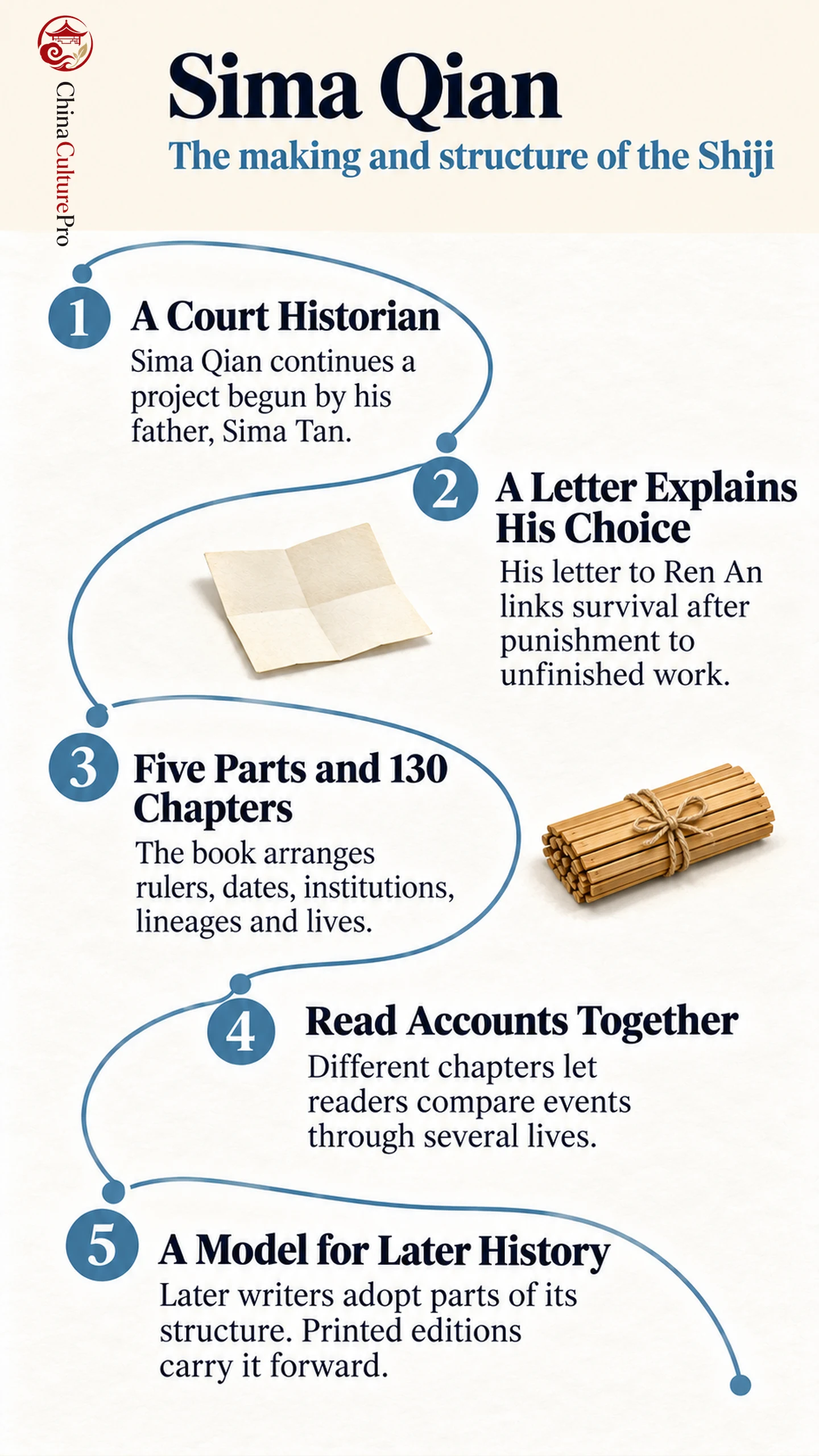
The Shiji can tell readers about a ruler in one division and about the institutions of that ruler’s time in another. Its arrangement allows someone to compare information that a single year-by-year account would keep apart. The design also helps explain why later historians took the book seriously as a model.[4][5][6]
Sima Tan, Court Service and the Project
Sima Qian was born in the second century BCE, conventionally dated to about 145 BCE. His father, Sima Tan (司马谈, Sīmǎ Tán), served as a senior historian at the court of Emperor Wu of Han. The office involved astronomy, the calendar and the interpretation of observations for the court. Its duties were broader than the job of a historian in the modern sense.[1][2][5]
Sima Tan began work on an extensive history and urged his son to continue it. Sima Qian later held his father’s court post and carried the project forward. The book covers events well before the founding of the Han dynasty and gives the Han a place within a longer account of political change.[1][2][4][5]
Li Ling and the Letter to Ren An
Sima Qian defended the commander Li Ling (李陵, Lǐ Líng), who had surrendered to the Xiongnu after a defeat. His intervention angered Emperor Wu and led to severe punishment. He faced a death sentence and survived after undergoing castration. He returned to work and continued the history.[1][2]
A letter to Ren An (任安, Rén Ān), transmitted under Sima Qian’s name, explains how he understood the choice to live and continue writing. He presents the unfinished work as a reason to endure disgrace. The letter provides a view of the author’s argument about his own life. It can be read alongside other records of his punishment and career.[1][2][7]
The Five Parts of the Shiji
The received text has 130 chapters. The divisions arrange the past by different units, including reign, date, institution, lineage and individual life.[3][4][5]
| Division | Chapters | What it helps readers find |
|---|---|---|
| Basic Annals | 12 | Major rulers and the course of political power |
| Chronological Tables | 10 | Events in different states or lines of succession aligned by date |
| Treatises | 8 | Subjects such as ritual, the calendar and other institutions |
| Hereditary Houses | 30 | The histories of ruling lineages and other influential figures |
| Biographies | 70 | Individual lives, groups and accounts of peoples beyond the court |
The headings guide readers but do not always indicate the political standing of the person in a chapter. Xiang Yu, who led a powerful rival regime before the Han was established, receives a Basic Annals chapter.[4][5][6]
How to Read Its Accounts
The account of Qin Shi Huang traces the ruler’s rise and reign. The account of Liu Bang follows a different political career through the collapse of Qin and the formation of Han. The Basic Annals of Xiang Yu gives a third view of the struggle for power between those dynasties. The same collapse appears differently from the viewpoint of the Qin ruler, the victorious Han founder and the rival who lost. Their chapters can be read together to see which events each account emphasizes.[4][6][7]
The Shiji preserves documents, stories, speeches and judgments from different settings. Some passages concern events centuries before the author. Ask where a report appears, what sources the author might have had and whether a surviving object or an independent record can bear on the claim. These are practical ways to distinguish history and legend when reading a transmitted account.[5][6][8]
Why the Shiji Endured
The book gave later historians a model for combining annals, institutions and biographies. It covers a long span and was eventually followed by dynastic histories with more specific chronological boundaries. Its narratives also circulated as works of literature. The Library of Congress preserves a later printed edition, an object that shows how the history was transmitted and read in a much later period. The surviving edition is evidence of printing and circulation.[3][5][8]
Among Chinese historical figures, Sima Qian is important both for the events his work preserves and for how he arranged them. Readers can start with a familiar person and then consult a table or treatise to put that life in a wider setting.[4][5][6]
FAQs About Sima Qian
What did Sima Qian write?
He was the principal author of the Shiji, or Records of the Grand Historian. He continued a project begun by his father, Sima Tan.[1][2][5]
Why was Sima Qian punished?
He defended the commander Li Ling after Li surrendered to the Xiongnu. Sima Qian survived a sentence by undergoing castration and continued writing his history.[1][2]
How is the Shiji organized?
Its 130 chapters are divided into Basic Annals, Chronological Tables, Treatises, Hereditary Houses and Biographies. Each division organizes historical information in a different way.[3][4][5]
資料來源
[1] The Chinese University of Hong Kong. Sima Qian
[2] Columbia University Asia for Educators. Excerpt from Sima Qian’s Letter to Ren An
[3] Library of Congress. Shiji in One Hundred and Thirty Chapters
[4] Chinese Text Project. Shiji
[5] The Oxford History of Historical Writing. Sima Qian and the Shiji
[6] Cambridge University Press. Sima Qian’s Critical Past
[7] Columbia University Press. Records of the Grand Historian: Qin Dynasty
[8] Early China. Sima Qian: A True Historian?