

Quick Answer: Who Was Soong Ching-ling?
Soong Ching-ling (宋庆龄, Sòng Qìnglíng, 1893–1981) was a Chinese political figure and organizer of wartime relief and social welfare. She worked as secretary to Sun Yat-sen (孙中山, Sūn Zhōngshān) before marrying him in 1915 and built her own public career through decades of political upheaval.[1][6]
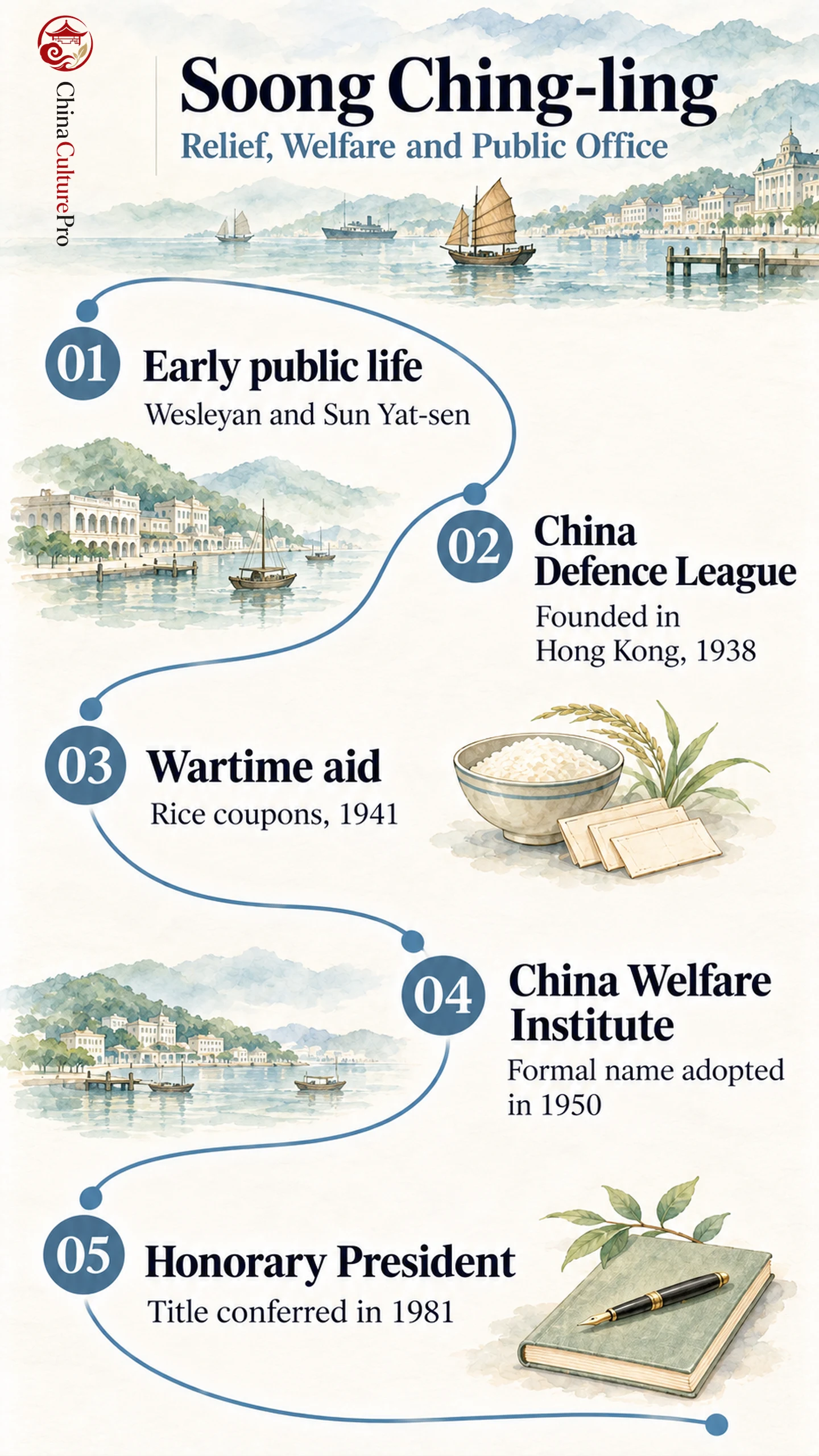
- Wartime relief: In 1938 she founded the China Defence League (保卫中国同盟, Bǎowèi Zhōngguó Tóngméng) in Hong Kong to raise funds and supplies during the war against Japan.[2][3]
- Women and children: The league developed into the China Welfare Institute (中国福利会, Zhōngguó Fúlìhuì), with long-term work in health, education and culture.[3][4]
- State office: She held several posts after 1949. In May 1981 she received the title Honorary President of the People’s Republic of China.[6]
She appears as Madame Sun Yat-sen in some English records. Relief campaigns, public writing and the organizations she built document her work under her own name.[1][2][7]
Soong Ching-ling’s name appears in accounts of her 1915 marriage, a wartime fundraising campaign and the founding history of a Shanghai hospital. The records follow her through different kinds of public work. Among Chinese historical figures of the twentieth century, her career offers a way to trace how a wartime aid organization became a permanent welfare institution.[1][2][3][5][6]
Education, Marriage and a Political Career
Soong grew up in Shanghai and studied at Wesleyan College in Macon, Georgia, graduating in 1913. She later joined Sun Yat-sen as his secretary and married him in Tokyo in 1915. The work placed her close to the political organizing of the early republic. The family objects shown at a later Hong Kong museum exhibition document the marriage, while records of the following decade show her taking positions of her own.[1][6]
In 1926, the year after Sun’s death, Soong was elected to the Central Executive Committee of the Nationalist Party (国民党, Guómíndǎng). In 1927, as the alliance between the Nationalists and Communists broke down, she publicly opposed the purge led by Chiang Kai-shek and accused party figures of departing from Sun’s political program. She then left for the Soviet Union and later spent time in Europe.[1][6]
How the China Defence League Raised Wartime Aid
Soong reached Hong Kong in December 1937, after the Japanese invasion had reached Shanghai and Nanjing. On 14 June 1938 she established the China Defence League there and became its chair. Hong Kong gave the group access to overseas donors and communications. Publications in Chinese and English carried news about the war and appeals for support. The league also set up a relief fund for children and raised money through events and sales.[2][3]
The August 1941 One Bowl of Rice campaign turned that fundraising network into a transaction local participants could see. Merchants provided rice and members of the public paid for the coupons. Hong Kong Memory records that the campaign, planned for three days, ran for about a month. The proceeds were earmarked for wartime aid on the mainland. Local merchants supplied the goods, and the league turned their donations and public purchases into relief funds.[2]
From Emergency Relief to the China Welfare Institute
In December 1945, Soong announced that the league would become the China Welfare Fund (中国福利基金会, Zhōngguó Fúlì Jījīnhuì). A draft of the announcement is reproduced by the institute’s research center. It called for continuing assistance during recovery, and described how the organization would continue connecting people in China who needed aid with supporters abroad. The organization moved to Shanghai and formally adopted the name China Welfare Institute in August 1950.[3][4]
Under its new name, the institute put more emphasis on lasting programs in maternal and child health and in children’s education and culture. Soong’s 1950 letter to the press described projects whose results could be shared with other organizations. The International Peace Maternity & Child Health Hospital, which she founded in 1952, is a concrete example. Children’s theatre and publishing were also part of the institution’s work. Her part in building those programs belongs to the wider history of women’s public work in China.[4][5]
Political Office and International Work
In 1949, Soong took part in the first plenary session of the Chinese People’s Political Consultative Conference and became a vice chair of the Central People’s Government. She was elected vice president of the People’s Republic of China in 1959 and again in 1965. In May 1981 the Standing Committee of the National People’s Congress conferred the honorary title. In the chronology of modern Chinese history, the 1949 appointment belongs to the founding government, while the two vice-presidential elections came a decade or more later.[6]
Publishing was another route to an international audience. Soong helped establish the periodical China Reconstructs in the early 1950s. Later known as China Today, it addressed readers outside China. The work carried an idea already visible in the league’s bilingual publications into a postwar setting, where the magazine’s role was to present a view of China abroad.[2][7]
How Museums and Institutions Preserve Her Legacy
A museum exhibition can set a wedding gift next to clothing from Soong’s wartime years. The objects document different episodes of the same life. The 2009 exhibition at the Dr Sun Yat-sen Museum drew on objects from the Soong Ching Ling Foundation. The draft of the 1945 announcement documents a different legacy. It records how the league described its responsibilities at the end of the war, before a permanent institute gave those responsibilities an institutional home.[1][3]
FAQs About Soong Ching-ling
Is Song Qingling the same person as Soong Ching-ling?
Yes. Song Qingling is the modern pinyin spelling. Soong Ching-ling is a conventional English spelling, and Madame Sun Yat-sen also appears in period records.
Was Soong Ching-ling the president of China?
She was elected vice president in 1959 and 1965. The title Honorary President of the People’s Republic of China was conferred in May 1981.
What did Soong Ching-ling do for children?
She organized wartime relief and supported long-term welfare programs in health, education and culture. The maternity and child health hospital she founded in 1952 is one example.
資料來源
[1] Hong Kong Leisure and Cultural Services Department. Artefacts and Photographs of Madam Soong Ching Ling
[2] Hong Kong Memory. The China Defence League and the One Bowl of Rice Movement
[3] China Welfare Institute Development Research Center. Soong Ching-ling’s Wartime Work and the League’s 1945 Announcement
[4] China Welfare Institute institutional account in People’s Daily. The Development of the China Welfare Institute
[5] Shanghai Jiao Tong University School of Medicine. International Peace Maternity & Child Health Hospital
[6] Chinese People’s Political Consultative Conference. Soong Ching-ling Biographical Profile
[7] China Today. Publisher’s Account of Soong Ching-ling and the Magazine