

Quick Answer: Who Was Zeng Guofan?
Zeng Guofan (曾国藩, Zēng Guófān, 1811–1872) was a Qing scholar-official and military organizer. He helped build the Xiang Army (湘军, Xiāngjūn) in Hunan and directed operations that helped defeat the Taiping Heavenly Kingdom. His surviving family letters document a different side of his life.[1][2][3][4]
- Government: He entered Qing service through the examination system.
- Wartime role: He raised a regional force that relied on provincial support.
- Writings: Dated letters and later collections let readers follow his family relationships alongside his public work.
The army and the correspondence require different kinds of evidence. One concerns institutions and command, while the other starts with individual letters and their recipients.
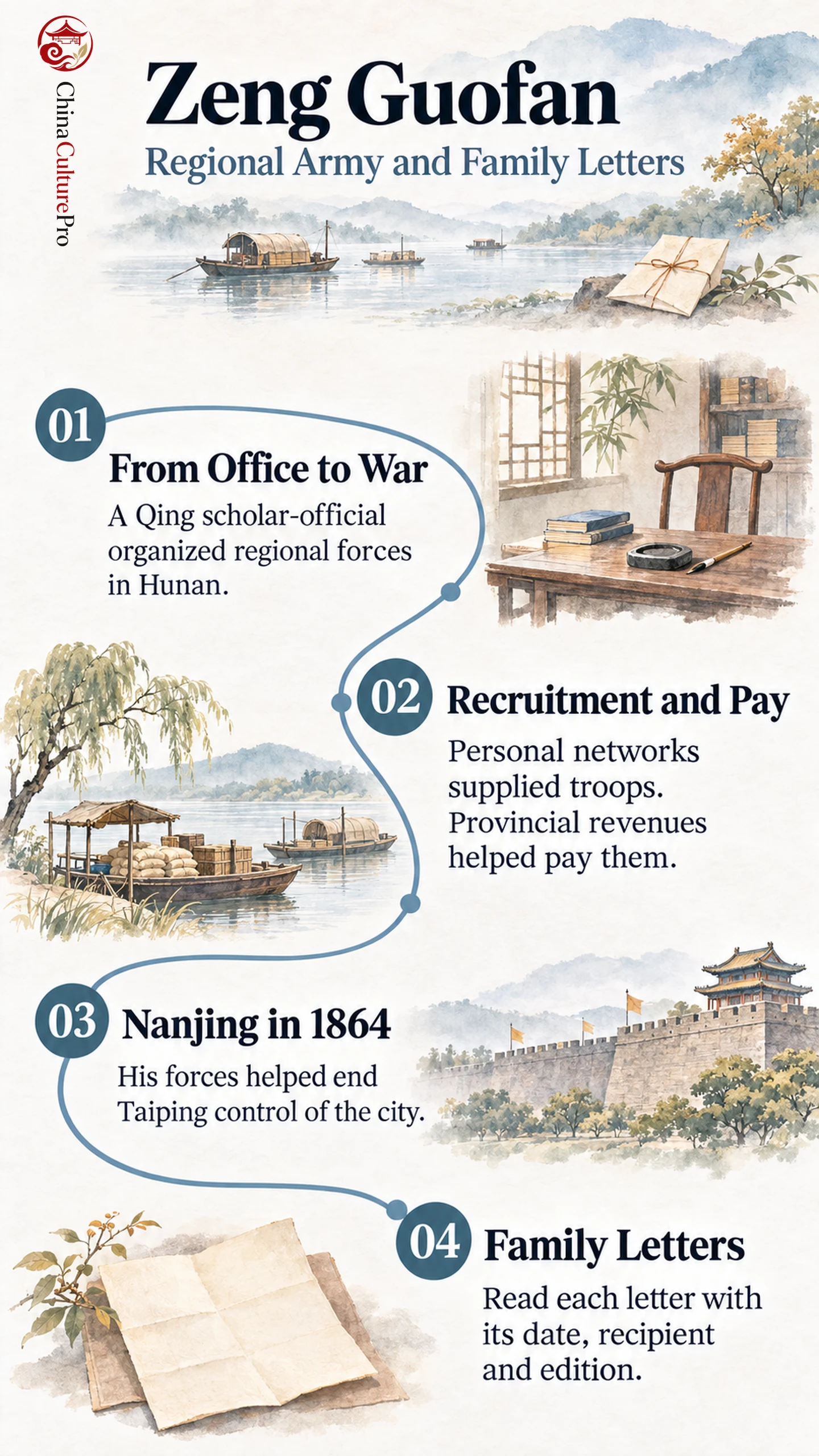
A Qing official raised troops through personal networks and paid them with revenues collected across provinces. The same official wrote home about travel and obligations. Reading those records side by side helps explain how Zeng Guofan’s public authority and family life intersected.
From the Hanlin Academy to Wartime Command
Zeng came from Hunan, earned the jinshi degree in 1838 and entered the Hanlin Academy. His posts at the capital belonged to the system of Qing civil service ranks and appointments. The Taiping Rebellion brought a different assignment. In 1852, while home for mourning after his mother’s death, he was called on to help organize local defense.[1][2][4]
The army took shape within a crisis of the Qing dynasty. The court relied on a regional organizer and the networks he could mobilize. In 1860 it appointed Zeng governor-general of Liangjiang. That gave him wider authority to direct operations and obtain resources across an important stretch of the Yangtze basin.[1][2][4]
How the Xiang Army Recruited and Paid Its Troops
Recruitment followed a chain of relationships. Higher officers selected subordinate officers, who recruited troops through their own local connections. The arrangement gave officers a direct stake in the cohesion and discipline of their troops. The army offered relatively high pay to attract and retain soldiers. As the force grew, the same policy created a larger and more persistent demand for revenue.[2]
Early financing included revenue from the sale of honorary ranks. As the army grew, Zeng drew on provincial collections including lijin (厘金, líjīn), levies on goods at points of production, storage or movement. Transfers from other provinces mattered as well. Provincial officials and regional commanders therefore had a large role in raising and directing military funds.[2]
The Yangtze Campaign and the Fall of Nanjing
Operations along the Yangtze preceded the final siege of Nanjing, which the Taiping used as their capital. Zeng Guofan coordinated the wider campaign, while forces under his brother Zeng Guoquan (曾国荃, Zēng Guóquán) conducted the final siege. The city fell in July 1864. Qing officials celebrated the victory as a restoration of dynastic authority. The capture ended Taiping control of its capital and secured the regime in a moment of crisis.[1][2][3]
The condition of the city gives that event a different scale. Much of Nanjing was devastated by the war. The date of the capture establishes when military control changed. Accounts of rebuilding and commerce show a much longer recovery.[3][5]
How to Read Zeng Guofan’s Family Letters
A University of Washington Press selection reproduces letters to Zeng’s eldest son, Zeng Jize (曾纪泽, Zēng Jìzé). In one letter from 1852, Zeng describes sending similar instructions by two routes because he worried about delivery. He was coordinating the family’s response to his mother’s death while he was away. The duplicated dispatch helps explain why an apparently private letter also records practical arrangements.[4]
Read such a letter with its date and addressee. A modern selection may follow a single relationship, while an older collected edition can include letters to more relatives. Catalogues also record diaries and other works under Zeng’s name. A maxim excerpted from a letter can lose the problem, relationship or event that originally made it relevant.[4][6]
FAQs About Zeng Guofan
Was Zeng Guofan a civil official or a general?
He entered government as a scholar-official and later organized and commanded troops. The court continued to give him civil appointments during the war.
Did Zeng Guofan personally lead the final assault on Nanjing?
He directed the wider campaign. His brother Zeng Guoquan commanded the forces that carried out the final siege.
Are the published family letters a complete record?
Different editions select different material. The Washington translation, for example, follows a group of letters to his eldest son.
資料來源
[1] Britannica International Encyclopedia, via Kotobank. Zeng Guofan
[2] Journal of Institutional Economics, Cambridge University Press. The last guardian of the throne: the regional army in the late Qing dynasty
[3] Kwang-Ching Liu, The Cambridge History of China. The Ch’ing Restoration
[4] University of Washington Press, Chinese Autobiographical Writing. Keeping Family Members Informed
[5] International Journal of Asian Studies, Cambridge University Press. Forgotten leaders: Chinese Hui Muslim merchants in the Yangzi River region, 1880s–1940s
[6] University of Pennsylvania Libraries, The Online Books Page. Zeng, Guofan, 1811–1872