


Quick Answer: Who Was Yuan Chonghuan?
Yuan Chonghuan (袁崇焕, Yuán Chónghuàn, 1584–1630) was a late Ming official and military commander. He helped defend Ningyuan (宁远, Níngyuǎn) in 1626, brought troops to the defense of Beijing in 1629 and was executed by the Ming government in 1630.[1][2][3][4][5]
- Frontier defense: He used fortified positions and artillery to hold part of the northeastern approach to Beijing.
- Capital crisis: An invading army came through other passes, forcing him to move troops back toward the capital.
- Prosecution: The court turned on him amid military pressure, suspicion and disputes about earlier decisions.
The battle record is easier to trace than the full chain of decisions that led to his conviction.
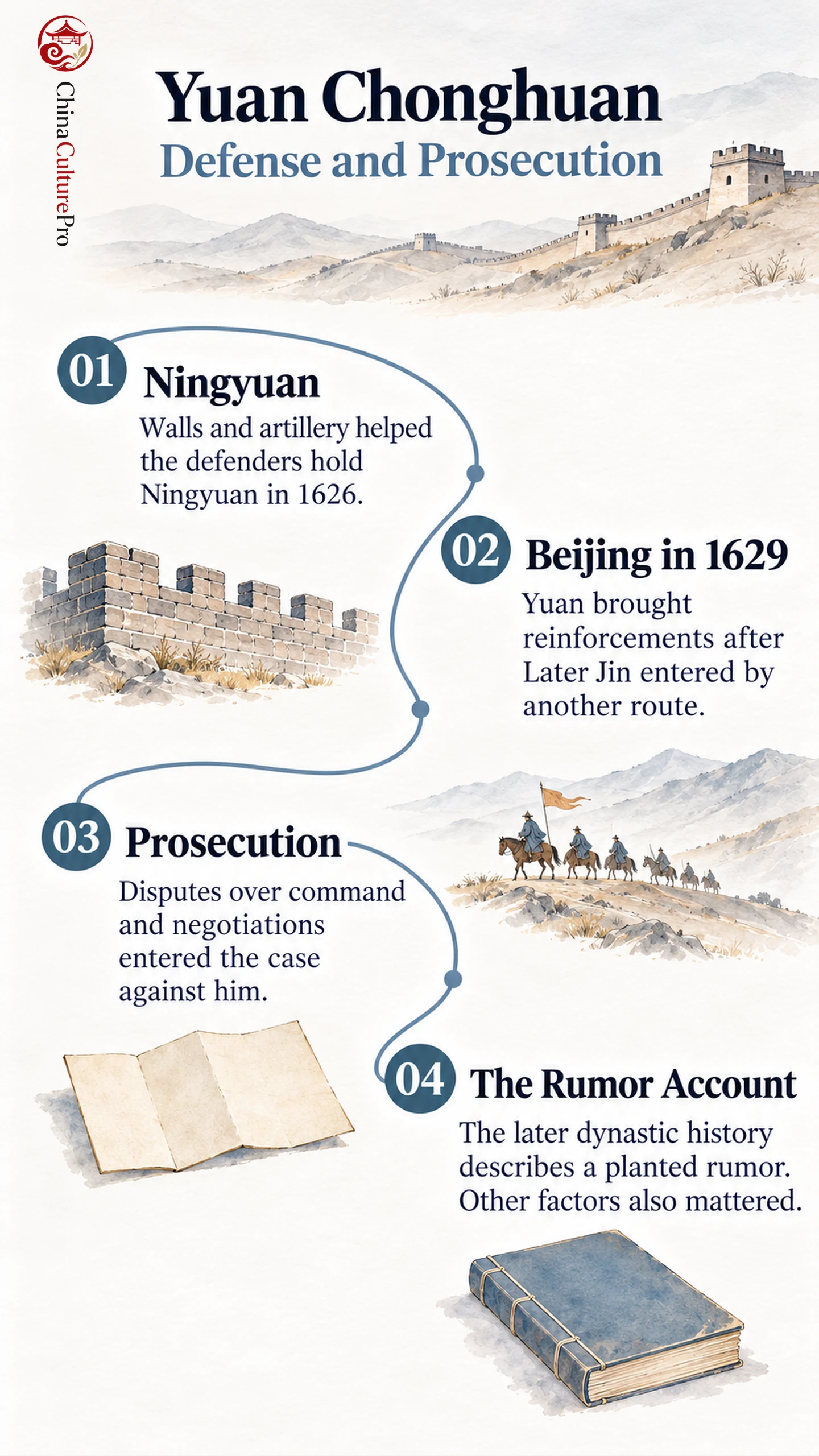
Yuan Chonghuan’s two best-known crises tested different defenses. At Ningyuan, he helped hold a fortified city. Near Beijing, an invading army came through another part of the frontier. The difference helps explain why success in one place could coexist with vulnerability elsewhere.
Why Ningyuan Mattered to the Ming
Yuan entered government after earning the jinshi degree in 1619 and began as a county magistrate. After a series of frontier losses, the Ming government debated where to defend the corridor east of Shanhai Pass (山海关, Shānhǎiguān). Yuan argued for holding Ningyuan beyond the pass. It occupied a position on the route between the northeastern frontier and the approaches to Beijing.[1][2][3]
Ningyuan is now part of Xingcheng in Liaoning. When the forces of Later Jin (后金, Hòu Jīn) attacked in 1626, the defenders used walls, coordinated garrison work and Western-style heavy cannon. The dynastic biography describes defenders firing heavy cannon as attackers tried to breach the walls. It also names commanders and people responsible for supplies. The defense shows how fortified sites operated within the wider Ming frontier system. The defenders also needed crews, food for the garrison and officers able to coordinate the defense.[1][2]
From Ningyuan to the Crisis at Beijing
The Ningyuan fighting of 1626 took place under the Later Jin ruler Nurhaci. The next year brought fighting around Ningyuan and Jinzhou under his successor Hong Taiji. Yuan later returned to high command under the Chongzhen Emperor. The new appointment covered a wider area than a single garrison and involved coordinating other commanders.[1][2][4]
In 1629 Hong Taiji’s forces took a different approach to Beijing, entering through frontier passes well west of Shanhai Pass. Yuan led reinforcements from the northeast and fought outside Guangqu Gate. Holding Ningyuan protected the coastal corridor. The route taken in 1629 exposed the capital to attack from elsewhere along the frontier.[1][5]
Mao Wenlong’s Death and Yuan’s Prosecution
Earlier in 1629 Yuan had executed Mao Wenlong (毛文龙, Máo Wénlóng), a Ming commander whose Dongjiang forces operated from islands near the Korean coast. Yuan presented charges about command and administration, then carried out the execution before receiving express authorization from the emperor. Disagreement about Mao’s forces and about Yuan’s authority became part of later interpretations of both men’s deaths.[1][4][5]
Yuan was arrested after his return to defend Beijing and executed in 1630. The dynastic biography records accusations involving negotiations and the execution of a senior commander, and the judicial authorities treated the case as one of treason. The charges show how the court framed the case. They require separate evidence if used to establish what Yuan had done.[1][4][5]
Why the False-Rumor Story Needs Context
The History of the Ming, compiled under Qing rule, gives a specific account of a planted rumor. It says the enemy let captured palace eunuchs hear that Yuan had a secret agreement, then secretly let a captive go. According to the account, the captive reported the story to the emperor. That version gives the rumor a direct role in the arrest. The National Palace Museum’s survey also describes other factors historians consider, including court factions and resentment as war reached the capital.[1][4]
A reader comparing Chinese historical sources can separate three questions. What do the sources record about the arrest and execution? What did the courts and writers of different periods claim about his loyalty? Which explanation do they offer for the emperor’s decision? Accounts from the Ming–Qing transition and the later Qing compilation can agree on the sequence of events and differ sharply on guilt and motive.[1][4][5]
FAQs About Yuan Chonghuan
Where was Ningyuan?
Ming Ningyuan occupied the site of present-day Xingcheng in Liaoning. It guarded part of the corridor northeast of Shanhai Pass.
Who ordered Yuan Chonghuan’s execution?
The Chongzhen Emperor ordered Yuan’s arrest, and the Ming government executed him in 1630.
Was the planted rumor the only reason for his execution?
The Qing-compiled dynastic history records a planted rumor. The surviving accounts also describe earlier disputes, pressure after the incursion and political conflict at court.
資料來源
[1] History of the Ming. Chapter 259: Yuan Chonghuan
[2] Liaoning Provincial Department of Culture and Tourism. Xingcheng Ancient City
[3] Encyclopedia of China, Berkshire Publishing. Yuan Chonghuan (1584–1630)
[4] National Palace Museum, Taipei. Qing Documents Concerning the Descendants of Yuan Chonghuan
[5] History, Fiction, and Public Opinion, via vLex. Writings on Mao Wenlong in the Early Seventeenth Century