
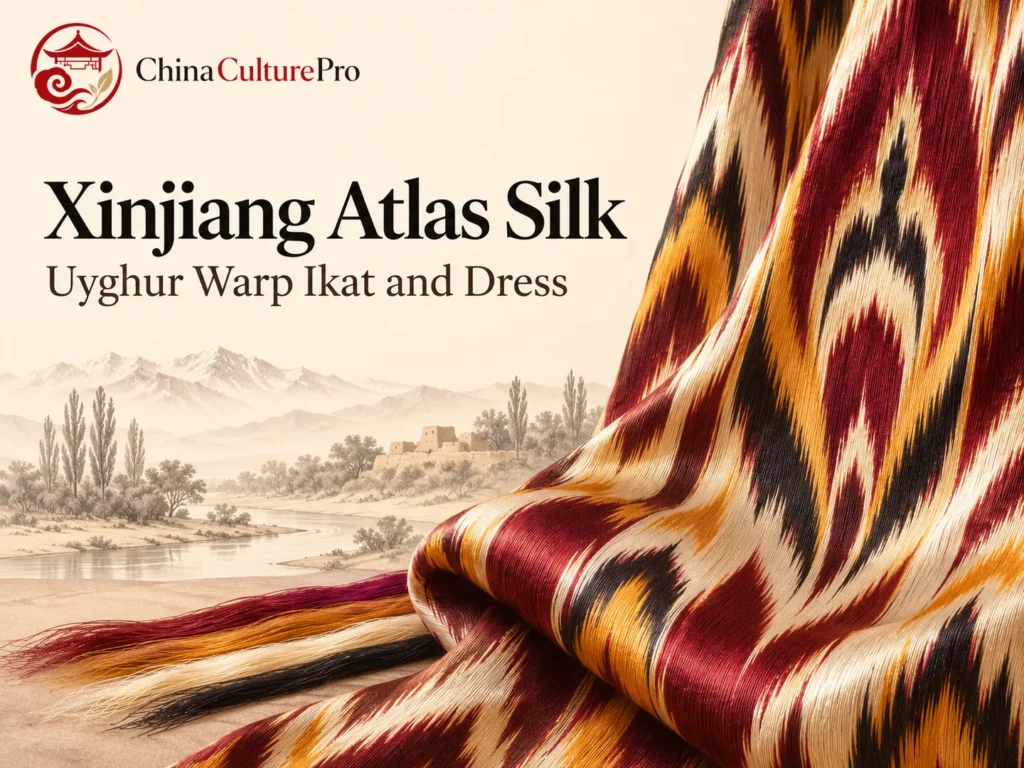

Quick Answer: What Is Xinjiang Atlas Silk?
Xinjiang Atlas silk (艾德莱斯绸, Àidéláisī chóu), also called Etles, is a Uyghur textile traditionally made by binding and dyeing lengthwise silk threads before weaving. The method is a form of warp ikat. Color boundaries can soften across neighboring threads, giving the finished cloth its characteristic feathered patterns.[1][2][3]
- Material: Traditional examples use silk, and the warp is patterned before weaving.[1][2]
- Pattern: The weaver brings the dyed threads together on the loom so their colored areas form the planned shapes.[2][3]
- Use: The fabric appears in dress and in later designs that adapt its colors and motifs.[4][5]
Use the pattern and the visible yarns together when reading the cloth.
A row of almond shapes can look as if it was painted in broad strokes. Follow its edges and the color changes appear along individual threads. Those threads carried the design before they became cloth.
The Design Begins Before Weaving
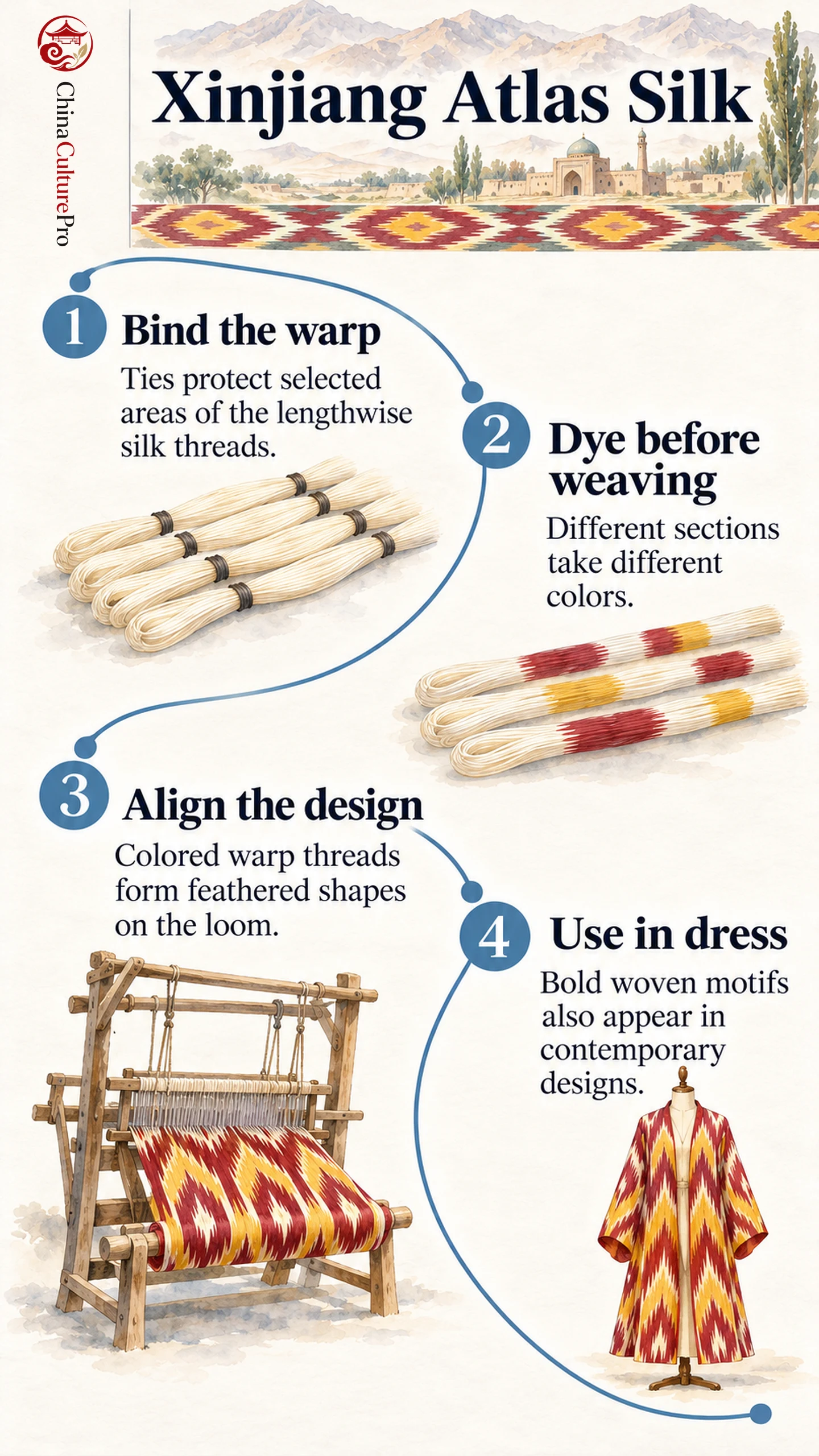
The warp is the set of lengthwise threads on a loom. In the Hotan process, the maker plans which areas of a bundle of those threads will take each color. The China National Silk Museum records the use of cornhusk and cotton thread in binding. The bindings limit the dye in selected sections of yarn. With successive bindings and dye baths, different sections can take different colors.[2][3][4]
After dyeing, the warp threads go onto the loom in an order that brings the dyed areas into alignment. Their boundaries can shift slightly from thread to thread or soften where dye reaches the edge of a binding. The crosswise weft interlaces with the prepared threads. A close view can show the same warp thread changing color at intervals along its length. In Bai tie-dye in Dali, the maker compresses parts of fabric that has already been woven. Both approaches use a physical resist, at different stages.[2][3]
Patterns, Color Groups and Garment Use
The national heritage record describes groups with black, red or yellow dominant colors, as well as a group associated with Shache, also known as Yarkand. It lists ram’s horns among the black-dominant designs and almonds, fruit or instruments among the red-dominant examples. A motif described as a rawap refers to the shape of a lute. The record gives different examples for different color groups. An almond or a ram’s horn can be abstracted into a repeated outline rather than shown as a lifelike picture.[1]
The China National Silk Museum has exhibited a contemporary dress that brings Atlas motifs into formalwear. Its note describes bold elongated shapes, hooks, branches and irregular blocks of color. That work shows how a designer can use the scale and direction of a textile pattern within the cut of a garment. The guide to Chinese silk clothing distinguishes garment shape from textile construction.[4]
Hotan Workshops and the Heritage Listing
The national listing for Uyghur Atlas silk weaving and dyeing dates to 2008 and records Lop County as the applicant. The entry identifies Jiya and Buya as important places in the craft’s history. A 2024 workshop report from Jiya, described there as part of Hotan City, documents a workshop using wood looms and plant dyes. Its demonstration makes the two stages visible, with yarn prepared before it is woven on the loom.[1][2]
The craft is part of a larger family of ikat methods. A comparative textile study describes Atlas alongside examples from India, Indonesia, Japan and Uzbekistan. The grouping helps explain what the pre-dyed threads do. The regional name identifies a more specific tradition.[6]
FAQs About Xinjiang Atlas Silk
Is Atlas silk another name for silk satin?
Atlas silk here refers to a regional warp-ikat tradition. Silk satin names a fabric by its fiber and weave. A shiny surface alone gives little information about how the yarn was patterned.[2][3]
Can the feathered edge identify real Atlas silk?
It is one clue. A printed design can imitate a blurred boundary. Look for color changes on the lengthwise threads, then use a maker or catalogue description for the fiber and origin.[2][3]
Is all ikat Atlas silk?
Ikat is a wider family of yarn-resist methods. Atlas identifies a Uyghur textile tradition in Xinjiang.[1][6]
資料來源
[1] China Intangible Cultural Heritage Digital Museum. Uyghur Atlas Silk Weaving and Dyeing
[2] Xinjiang Daily via China News Service. The Color of Atlas Silk
[3] China National Silk Museum. A Workshop on Warp Resist-Dyed Cloth
[4] 中國絲綢博物館。 Exhibition of Silk and Contemporary Dress
[5] Xinjiang Daily. Atlas Silk Fashion in Hotan
[6] Korea Citation Index. Characteristics of Traditional Uyghur Atlas Textiles in Xinjiang