


Quick Answer: Who Was Wu Changshuo?
Wu Changshuo (吴昌硕, Wú Chāngshuò; 1844–1927) was a painter, calligrapher, poet and seal artist of the Shanghai School (海上画派, Hǎishàng huàpài). Ancient writing informed his bold flower paintings. [1]
- Painting: Tangled vines and bright flowers combine bold ink with strong color. [5]
- Writing: Ancient stone inscriptions supplied models for his calligraphy.
- Carving: His engraved seals connect writing with sculpted stone. [1]
The examples below are documented museum works, not a checklist for authenticating an unknown signature.
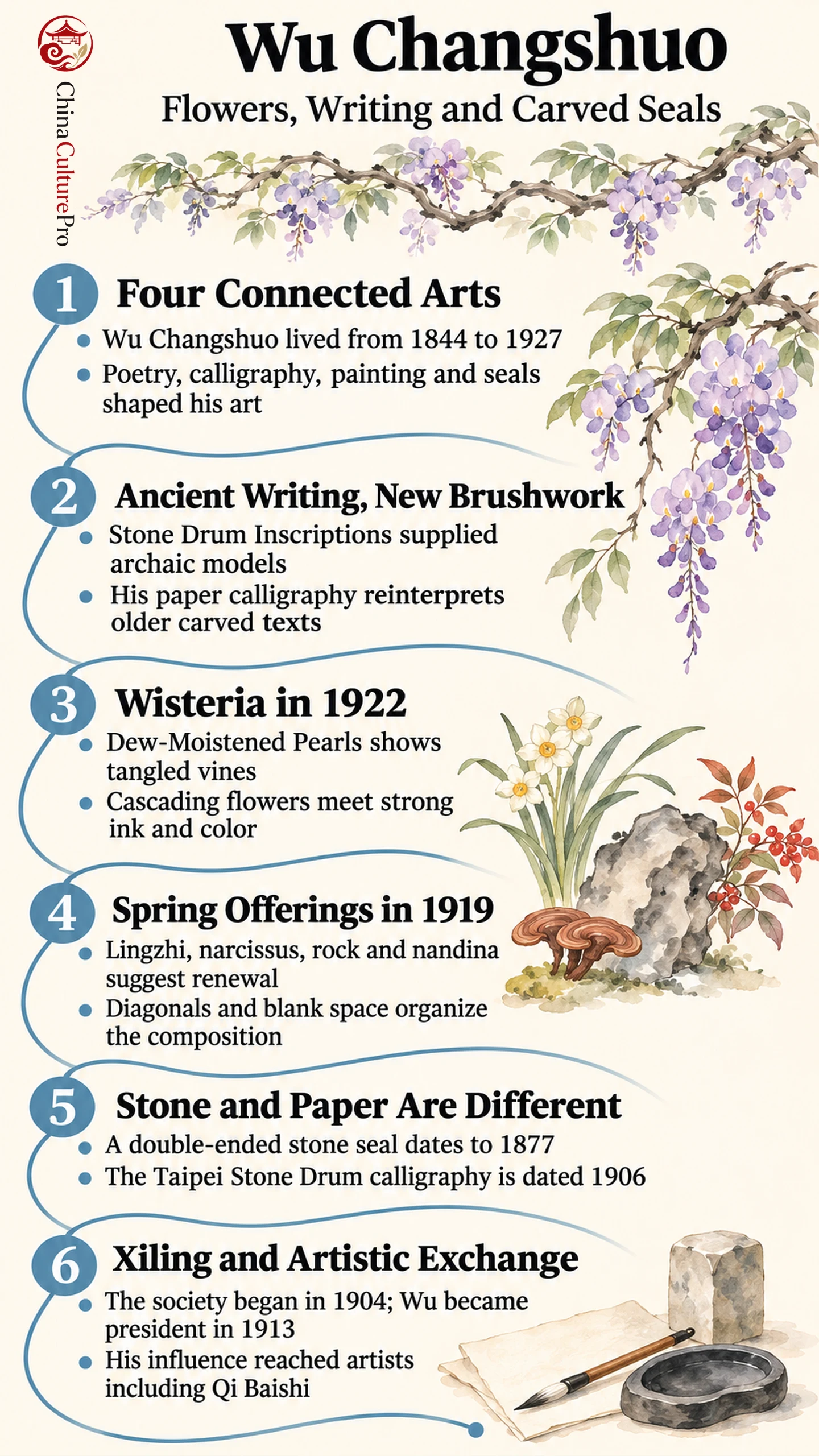
Wu’s flowers, writing and carved seals share an interest in the weight and rhythm of a line. Compare the different materials as well as the subjects.
From Anji to the Shanghai Art World
Born in Anji, Zhejiang, Wu experienced displacement during the Taiping conflict. His later career connected Suzhou and Shanghai, and his life crossed the end of the Qing dynasty and the early Republic. Among his artist friends was Ren Bonian. [1][2]
He studied earlier freehand painters including Xu Wei 及 Shitao, while bringing established calligraphic skills to painting. [1][2]
Stone Drum Writing and the Painted Brushstroke
The Stone Drum Inscriptions (石鼓文, Shí gǔ wén) were ancient texts known to later scholars through rubbings. Wu studied their seal script (篆书, zhuàn shū), one of the major Chinese calligraphy styles. His paper works are later brush interpretations, not the ancient carved stones themselves. [3]
The 1906 Taipei scroll includes his own note correcting a copied character, showing active engagement with the text. Inscriptions and seals supply evidence beyond a work’s main subject. [4]
The Smithsonian’s 1917 excerpt combines large archaic forms with his own comment in a distinctively left-slanting running hand. Comparing the two makes variation within a single scroll visible. [3]
Grand freehand painting (大写意, dà xiě yì) applies calligraphic force to flowers and stems. Expressive painting here involves trained control, rather than careless execution. [1]
Four Works Across Painting, Writing and Carving
Image sizes below exclude mountings. The stone seal’s dimensions describe the object itself.
| Work | Date and collection | Material, format and size |
|---|---|---|
| Dew-Moistened Pearls | 1922; Metropolitan Museum of Art | Hanging scroll; ink and color on paper; 131 × 37.5 cm. [5] |
| Spring Offerings | 1919; Metropolitan Museum of Art | Hanging scroll; ink and color on paper; 147.3 × 80 cm. [6] |
| Central Panel in Stone Drum Script | 1906; National Palace Museum, Taipei | Calligraphy hanging scroll; ink on paper; 134.8 × 39.6 cm. [4] |
| Double-ended private seal | 1877; Shanghai Museum | Stone; 2.25 × 2.3 cm, height 8 cm. [7] |
Flowers, Rocks and New Year Offerings
Dew-Moistened Pearls shows wisteria’s knotted vines and descending clusters of flowers. Saturated ink and pigment give this narrow vertical picture its energy. The plant’s twisting structure becomes an opportunity for forceful brushwork. [5]
Spring Offerings arranges lingzhi, narcissus, a rock and nandina berries as emblems of longevity and renewal appropriate to New Year greetings. Rather than recording one natural scene, it balances rounded, centered brushstrokes, blank space and crossing diagonals. The composition matters alongside the plants’ associations. [6]
Seals, Xiling and Artistic Influence
Seal carving (篆刻, zhuàn kè) gave Wu another way to reinterpret old writing. Shanghai’s double-ended personal seal draws on archaic script traditions. The museum explains that chipping and abrasion could create an intentionally worn appearance: irregular edges alone do not establish an object’s antiquity. Reading Chinese seal carving alongside his paintings reveals a shared preference for vigorous, weighty forms. [7]
In 1913 he became the first president of the Xiling Seal Engraving Society (西泠印社, Xīlíng Yìnshè). The society had been founded in 1904. His presidency and its foundation are separate events. [8][9]
Wu influenced Qi Baishi; his artist-fee manuscript for Qi also documents their professional connection. [1]
FAQs About Wu Changshuo
Did Wu Changshuo carve the ancient Stone Drums?
No. He studied their inscriptions and reinterpreted them with brush and ink centuries later. His paper calligraphy must be distinguished from the ancient carved objects. [3]
Did he found the Xiling Seal Engraving Society in 1913?
No. The society began in 1904; Wu became its first president in 1913. [8][9]
Was Wu Changshuo only a flower painter?
No. Poetry, calligraphy and seal engraving were integral to his art alongside painting. [1]
資料來源
[1] 故宮博物院。 Blossoming Iron Brush, Flowering Literary Brilliance: The Art of Wu Changshuo
[2] Palace Museum. Wu Changshuo
[3] Smithsonian National Museum of Asian Art. Excerpt from the Third Stone Drum Poem, in Large-Seal Script
[4] National Palace Museum, Taipei. Central Panel in Stone Drum Script
[5] Metropolitan Museum of Art. Dew-Moistened Pearls
[6] Metropolitan Museum of Art. Spring Offerings
[7] Shanghai Museum. Wu Changshuo’s Double-Ended Stone Seal
[8] Xiling Seal Engraving Society. Wu Changshuo: First President
[9] Xiling Seal Engraving Society. Society Overview