

Quick Answer: What Is The Scholars?
The Scholars (儒林外史, Rúlín Wàishǐ) is an episodic Qing novel by Wu Jingzi (吴敬梓, Wú Jìngzǐ), set mainly in the Ming. It follows people whose livelihoods and reputations turn on the imperial examinations (科举, kējǔ), alongside people who pursue other kinds of skill. Wang Mian (王冕, Wáng Miǎn) and Fan Jin (范进, Fàn Jìn) give you two contrasting starting points.[1][2]
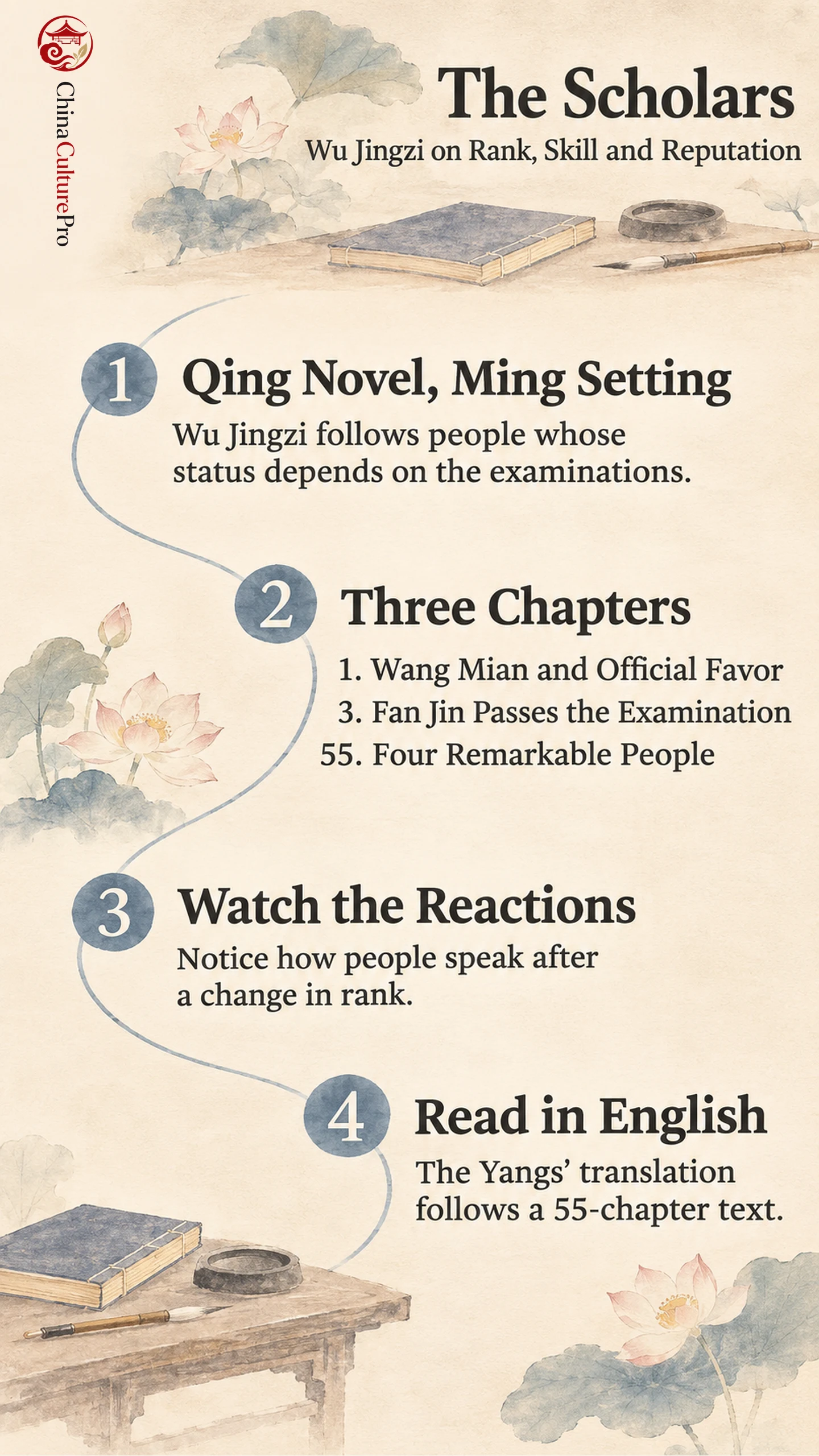
- Read chapter one first: Wang Mian shows what learning can look like outside official patronage.
- Then read chapter three: Fan Jin’s success changes how his family and neighbors treat him.
- Add chapter 55: The Nanjing episodes give attention to people whose abilities are less easily measured by rank.
- Look for the English translation: Yang Xianyi and Gladys Yang’s edition follows a 55-chapter text.
The chapter sample follows the book’s order. You can use it to see how the satire works before reading the many connected episodes.
In one chapter of The Scholars, a painter avoids a magistrate who wants to meet him. In another, a butcher hesitates to strike his son-in-law after the younger man passes an examination. Each scene shows what people will do when learning comes with the prospect of office or prestige. The novel keeps shifting the point of view so that a person who seemed important in one episode can look different in another.[3][4]
The Novel’s World of Scholars and Examinations
Wu Jingzi wrote under the Qing dynasty. Much of the story takes place under the Ming dynasty. Scholar Shang Wei notes that Wu drew on his own circle while placing many of the resulting episodes in an earlier period.[1] That helps explain why the setting and the social habits the book describes can point to different dates.
The imperial examinations give many of the characters a shared measure of success. Passing an examination can change who will receive them, lend them money or speak to them with deference. As the cast changes, keep track of the people who can translate a formal credential into help. Look at what they do for the person who has passed, and what they would have done the day before.
Three Chapters to Read First
Read the first and third chapters together, then sample chapter 55. The distance between those points lets you compare official recognition with forms of achievement that do not depend on it.
1. Wang Mian and Official Favor
Wang Mian makes a living in part by selling paintings and verse. He avoids a magistrate whose conduct he distrusts and leaves for a time rather than meet him.[3] Notice how he can refuse because his household has other resources and someone who can help look after it. The scene makes independence a practical problem before it becomes a judgment about the kind of person he is.
3. Fan Jin Passes the Examination
Fan Jin loses his composure when he learns he has passed the provincial examination. His father-in-law, Butcher Hu, agrees to strike him in the hope of bringing him back to his senses, then becomes anxious about having hit a man with new standing.[4] Pay attention to what Hu says before and after the result. It is the same relationship, but he has started to treat it as if the rules have changed.
55. Four Remarkable People
The narrator turns to four people in Nanjing after describing a decline in the city’s celebrated circles. One of them, Jing Yuan (荆元, Jīng Yuán), brings his qin (琴, qín), a Chinese zither, to play for an older friend in a garden.[5] Read this beside Fan Jin’s chapter. One scene follows a crowd responding to the news of an examination. The other gives a listener time to attend to an individual performance. Earlier in the same chapter, Ji Xianian refuses to provide a specimen of his calligraphy on a powerful man’s command.[5] Compare that refusal with the musician’s willingness to play for his friend.
How the Satire Works
The novel often gives a character a chance to explain himself, then puts him in a conversation where other people are making calculations of their own. Shang Wei’s reading emphasizes how these separate voices create the larger narrative.[1]
If the name at the center of a chapter is new, look first at how that person is connected to someone you already know. The book can pass from one part of society to another through a visit, a recommendation or a chance meeting.
A single sarcastic judgment would give you less to observe than an exchange like the one between Fan Jin and his father-in-law. You can see that money, respect and fear change at different speeds. For another novel that lets travel and local encounters reveal social habits, see The Travels of Lao Can.
Which English Edition to Read
Look for The Scholars translated by Yang Xianyi and Gladys Yang. A 2011 bilingual set is recorded under Wu Jingzi. A 1973 Foreign Languages Press edition uses the older spellings Wu Ching-tzu and Yang Hsien-yi.[6][7] Try the older spelling if the title and modern romanization give you too many results.
A bilingual edition record identifies the Yangs’ translation as based on a 55-chapter text. Some Chinese versions include chapter 56, and even the closing wording of chapter 55 can vary according to whether another chapter follows.[5][8] Check the contents of your copy before comparing its ending with a reader using a different edition. For help selecting other texts, see the Chinese classic books guide.
FAQs About The Scholars
Does The Scholars have one main character?
The focus passes among many characters. Wang Mian and Fan Jin are useful early examples, but the book does not follow either man throughout.
Why do some editions have 55 or 56 chapters?
The surviving editions differ in how they close the story. The Yangs’ English translation is based on a 55-chapter text, while other editions continue to chapter 56.
Who translated The Scholars into English?
Yang Xianyi and Gladys Yang translated it. Some catalogues spell Yang Xianyi’s name Yang Hsien-yi.
資料來源
[1] Shang Wei, Journal of Chinese Humanities. Examining Narrative Form in The Scholars
[2] Wikisource. Rulin Waishi: Chinese Chapter Index
[3] Wikisource. Rulin Waishi: Chapter One
[4] Wikisource. Rulin Waishi: Chapter Three
[5] Wikisource. Rulin Waishi: Chapter Fifty-Five
[6] National Diet Library. The Scholars: 2011 Chinese–English Set
[7] CiNii Books. The Scholars: Foreign Languages Press Edition
[8] Google Books / Hunan People’s Publishing House. The Scholars: 1999 Bilingual Edition