


Quick Answer: What Is The True Story of Ah Q?
The True Story of Ah Q (阿Q正传, Ā Q Zhèngzhuàn) is a novella by Lu Xun (鲁迅, Lǔ Xùn) about Ah Q (阿Q, Ā Q), a man who takes odd jobs in Weizhuang (未庄, Wèizhuāng). The story follows the ways he turns humiliations into imagined victories and the ways people in his village use status to decide whose account matters.[3][4][5]
- The signature idea: The spiritual victory method (精神胜利法, jīngshén shènglì fǎ) lets Ah Q reinterpret a real defeat until he feels he has won.[4]
- The setting: News of the 1911 Revolution (辛亥革命, Xīnhài Gémìng) reaches the village through rumors and changes how people address each other.[5][9]
- The publication: The nine-chapter work appeared as a newspaper serial between December 1921 and February 1922. Lu Xun later included it in Call to Arms (呐喊, Nàhǎn).[1][9]
- Reading in English: Yang Xianyi and Gladys Yang translated it as The True Story of Ah Q. Julia Lovell’s Penguin Classics volume calls it The Real Story of Ah-Q.[7][8]
This guide discusses the opening and the arrival of revolutionary news. It leaves the final chapter and its outcome to the reader.
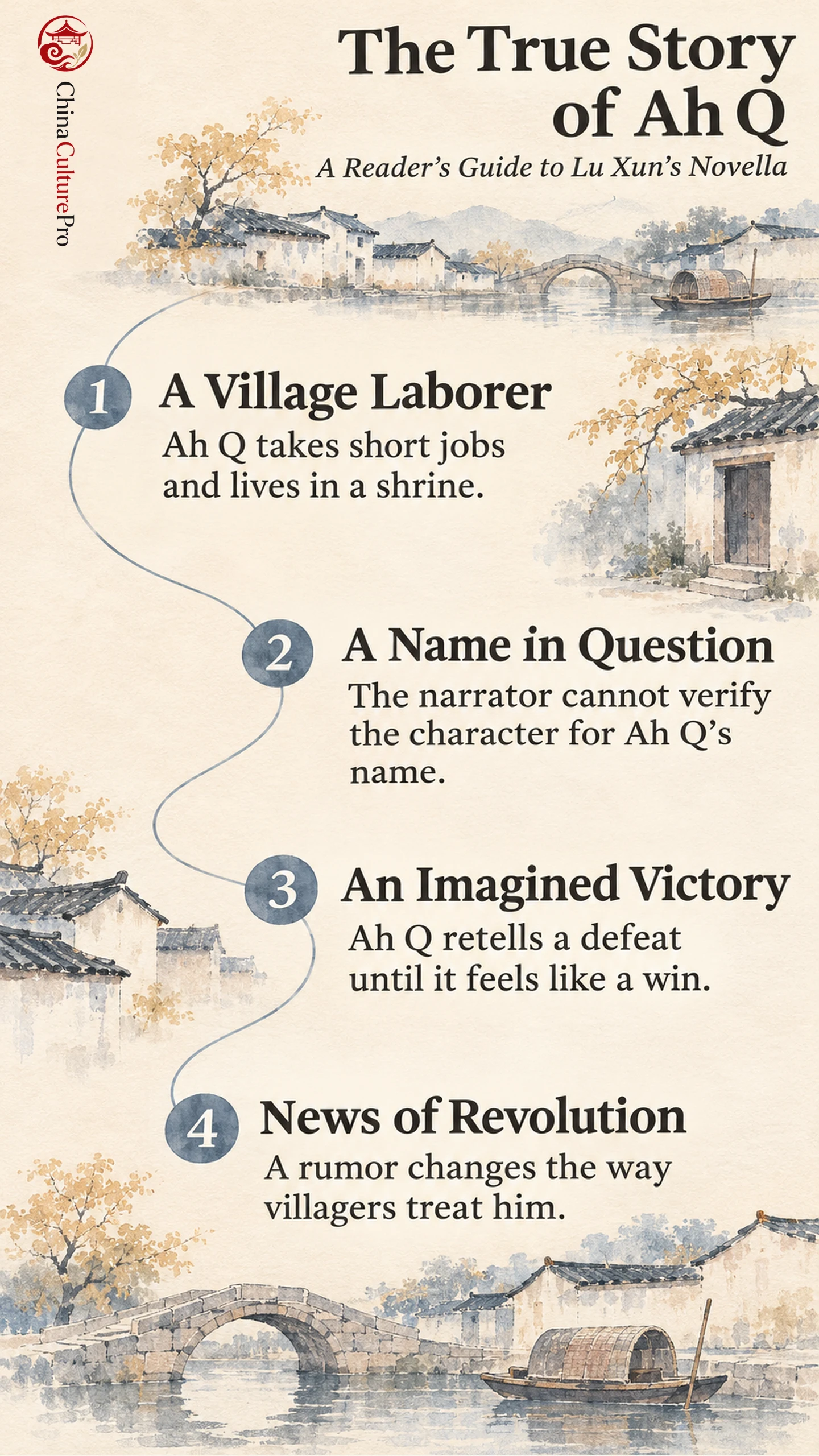
The first puzzle in the story belongs to the person telling it. He wants to write a biography but cannot establish his subject’s surname, the correct characters for his name or where he came from. The head of the Zhao household can put a stop to a claim of kinship with a slap.[3]
This beginning gives the story two subjects. One is a man who would like to think well of himself. The other is a village that finds it easy to remember his labor and hard to take an interest in who he is.
Who Is Ah Q?
Ah Q stays in a village shrine and takes short-term work where he can find it. When people need someone to cut wheat, pound rice or pole a boat, they remember him. Between jobs, they have little reason to think about him at all.[4]
He sometimes claims a better past or a brighter future than the people around him. One early episode has him boast that his family is related to the prominent Zhao household. Mr. Zhao rejects the connection, and villagers who hear of the incident blame Ah Q for speaking as he did.[3] The incident tells you something about what Ah Q wants from the claim and what the older man can do to keep him from making it.
Read the character as both a target of cruelty and someone who wants a share of the power others have over him. This combination lets Lu Xun move between ridicule and sympathy without asking you to settle on just one response. A broader guide to Lu Xun’s fiction and essays places that narrative voice in the context of his other work.
Three Chapters to Read Closely
1. The Biographer Cannot Find a Name
The narrator runs through the kinds of biography he might write and finds that the established categories fit poorly. He settles on a spelling using the Roman letter Q because he cannot verify the Chinese character for the sound people used when addressing his subject.[3]
The difficulty is funny, but it also has consequences. The narrator seeks information in the records and in conversations with educated people. Even that effort leaves him unable to start with the basic facts a conventional biography assumes.
2. An Imagined Victory
After some men beat him, Ah Q tells himself to think of them as sons striking their father. The change puts him above his attackers in his imagination. When the men learn how he consoles himself, they try to take even that consolation away.[4]
Keep two accounts of the encounter in mind. The men have been able to hurt him and leave. Ah Q supplies an account that lets him feel superior as he walks away. The imaginary victory changes how Ah Q feels. His attackers can still come back and do it again.
7. Revolution Reaches the Village as a Rumor
A covered boat arrives at night. People disagree about why it came and what it carried, but talk of revolution makes some of the local elite uneasy. The possibility that powerful people are afraid makes revolution suddenly attractive to Ah Q.[5]
Read the talk in public alongside the scene in which Ah Q lies awake imagining the furniture and money he might take from the families he envies. The chapter measures a change in the village through its whispers and forms of address, without moving the reader to the center of national events.
Why Revolution Changes the Stakes
The story brings the end of the Qing dynasty into view from a place that hears reports of events elsewhere. Ah Q briefly enjoys the deference he receives when people believe he may know something about the revolution.[5] He wants to participate, but chapter eight makes access depend on people who can still decide who belongs.[6]
That is a reason to read the chapters on revolution after the early chapters on names and victories. If a story begins with uncertainty about what a man can call himself, a later struggle over who gets called a revolutionary has more weight. The Travels of Lao Can offers a different vantage on late Qing authority, through the observations of a traveling doctor.
Which English Translation Should You Read?
A 1960 Foreign Languages Press edition lists the Yangs as translators, with Yang Xianyi’s name romanized as Yang Hsien-yi. It uses The True Story of Ah Q.[7]
Penguin Classics published Julia Lovell’s translation in its 2009 collection The Real Story of Ah-Q and Other Tales of China. The paperback ISBN is 9780140455489.[8] Both titles identify Lu Xun’s novella. Check the translator if you are matching passages or following a syllabus.
The opening is a good place to compare translations. Look at how the narrator describes his difficulty choosing a title and how he accounts for the letter Q. The two problems make the opening a useful comparison for other works in modern Chinese literature. Read it alongside other works in Chinese literature to see how many kinds of attention an apparently ordinary life can receive.
FAQs About The True Story of Ah Q
Is Ah Q a historical person?
Ah Q is a fictional character. The narrator’s claim to write his biography is part of the satire, including the difficulty of verifying his surname or given name.[2][3]
What is the spiritual victory method?
It is Ah Q’s habit of changing the story he tells himself about a defeat until it feels like a win. Chapter two shows him doing this after an attack.[4]
Is The Real Story of Ah-Q the same work?
Yes. The Real Story of Ah-Q is the title used in Julia Lovell’s translation. The Yangs’ translation uses The True Story of Ah Q.[7][8]
資料來源
[1] Zhang Mengyang via China Writers Association. A Century of Ah Q
[2] The Commercial Press. A Century of Ah Q: An Exploration of Lu Xun’s Literary Spirit
[3] Bailu Academy Library. The True Story of Ah Q, Chapter One
[4] Bailu Academy Library. The True Story of Ah Q, Chapter Two
[5] Bailu Academy Library. The True Story of Ah Q, Chapter Seven
[6] Bailu Academy Library. The True Story of Ah Q, Chapter Eight
[7] CiNii Books. The True Story of Ah Q, Foreign Languages Press Edition
[8] Penguin Classics. The Real Story of Ah-Q and Other Tales of China
[9] Wikisource. The True Story of Ah Q, Chinese Text