
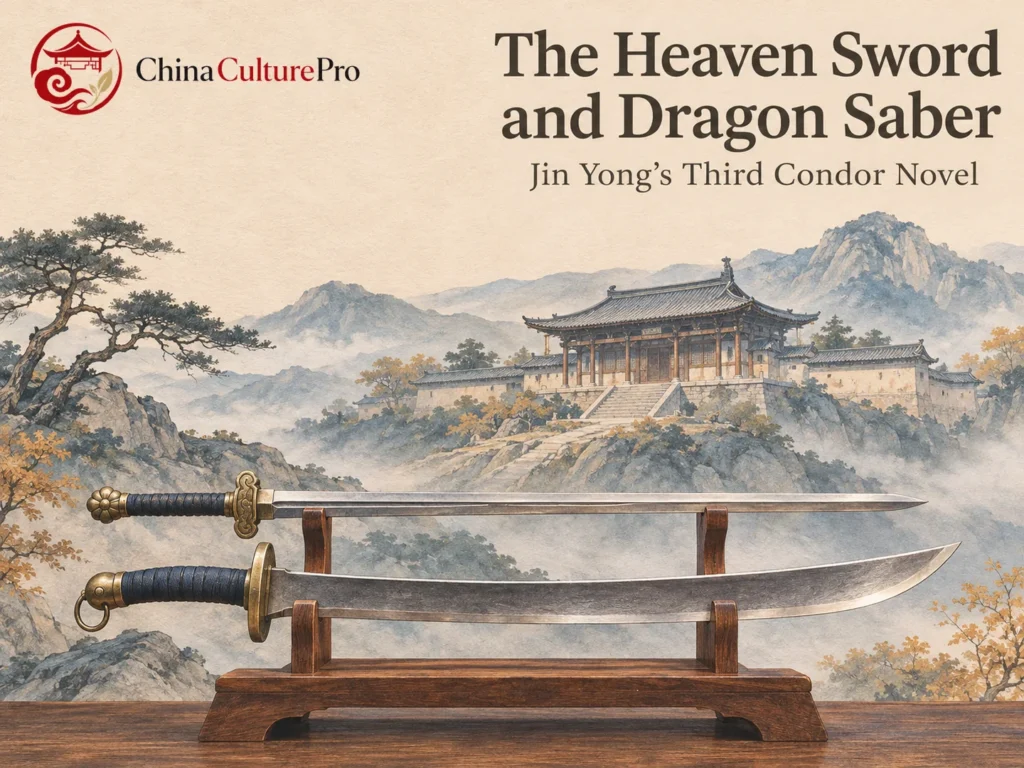

Quick Answer: What Is The Heaven Sword and Dragon Saber About?
The Heaven Sword and Dragon Saber (倚天屠龙记, Yǐtiān Túlóng Jì) is a wuxia (武侠, wǔxiá) novel by Jin Yong (金庸, Jīn Yōng) and the third work in his Condor trilogy. Its main story follows a young fighter pulled between factions that seek the Heaven Sword (倚天剑, Yǐtiān Jiàn) and Dragon Saber (屠龙刀, Túlóng Dāo).
- The protagonist: Zhang Wuji (张无忌, Zhāng Wújì) inherits loyalties on opposing sides of a struggle for two weapons believed to confer authority.
- The setting: The main action takes place in the waning years of the Yuan dynasty, long after most of the previous novel.
- The order: Read The Legend of the Condor Heroes, then The Return of the Condor Heroes, then this novel for the full generational arc.
You can follow Wuji’s central story from this book. The earlier novels add context to the opening and the inheritance that sets the conflict in motion.

The struggle over the Dragon Saber is already under way before Zhang Wuji can make choices about it. The people who raise him give him reasons to care about opponents who regard one another with suspicion. When he later has the power to intervene, choosing how to use it becomes more difficult than acquiring it.
Why the Sword and Saber Matter
The Dragon Saber draws people into a struggle because they believe whoever controls it can command the martial world. The Heaven Sword is spoken of as a counterweight. The two are separate weapons, and their reputation matters before the story explains why either is so valuable. Watch how a group’s expectations change when someone is rumored to have seen or carried the saber. [1]
The saber’s pursuit brings Wuji’s parents and future godfather together on a remote island before he is born. That early connection makes a dispute about a weapon into a story about family. [8]
Readers new to Chinese wuxia can follow this distinction between the skill of one fighter and the authority a group believes an object confers. Once an object has that reputation, possessing it draws people to the fighter whether or not the fighter wants followers.
Zhang Wuji and the Loyalties He Inherits
Wuji grows up with his parents and Xie Xun (谢逊, Xiè Xùn), who becomes his godfather. A relationship Wuji experiences as family can look very different to other people in the martial world. As he becomes involved with the Ming Cult (明教, Míngjiào), he also has to respond to groups that judge one another by membership and past conflicts. [3][8]
Two relationships show the pressure of those divisions. Zhao Min (赵敏, Zhào Mǐn) is tied to the Yuan ruling side, while Zhou Zhiruo (周芷若, Zhōu Zhǐruò) is associated with the Emei school. Both bring loyalties and political judgment to their encounters with Wuji. Keep track of what each woman has reason to want before treating either relationship as a simple choice available to Wuji. [1][3]
The confrontation at Bright Peak (光明顶, Guāngmíng Dǐng) brings this problem into the open. Six schools besiege the Ming Cult’s headquarters, and Wuji intervenes. [9]
By entering the dispute, he changes what people can expect from someone with ties across their lines. Follow the expectations before keeping score of the fights. The scene makes it possible to see both why members of one side might trust him and why a different side might find his help difficult to accept.
In his afterword, Jin Yong contrasts Wuji with the protagonists of the earlier novels. Wuji can act decisively to help someone and still hesitate when several people ask for his loyalty. That combination gives you a way to read choices that might otherwise look like a change in character. [2]
How the Late Yuan Setting Shapes the Story
The main narrative belongs to the late Yuan, when armed movements and rival leaders challenged Yuan rule. In recorded history, Zhu Yuanzhang established the Ming dynasty in 1368. A Chinese dynasties timeline can help place that transition without requiring a reader to memorize it before starting the novel. [3][4]
The story draws on that political instability while creating its own martial alliances. The Ming Cult names a group within the story. The Ming dynasty names the state Zhu founded. Keeping those referents separate helps you see when the novel is asking about loyalty to a person, leadership within a group or political rule.
Where It Fits in the Condor Trilogy
Read the three original novels in this order:
- The Legend of the Condor Heroes
- The Return of the Condor Heroes
- The Heaven Sword and Dragon Saber
The third novel was serialized in Hong Kong’s Ming Pao from 1961 to 1963. [8] Although the opening retains connections to the earlier generation, the main story has a new protagonist and a later political setting. Start with the first book for the inheritance across all three. Start with this one if Wuji and the two weapons are your main reasons for reading Jin Yong. [2]
English labels vary. The Heavenly Sword and the Dragon Sabre also points to this story. A ComicsOne English volume with Wing Shing Ma is a comics adaptation. Online prose projects can be fan translations, and one published archive explicitly identifies its text as an unofficial rendering of the second Chinese edition. Check the format, translator or adapter, and source edition before comparing chapters or ordering a book. [1][5][6][7]
FAQs About The Heaven Sword and Dragon Saber
Is this the third Condor novel?
Yes. It follows The Legend of the Condor Heroes and The Return of the Condor Heroes in the original trilogy.
Do I need the first two books to follow Zhang Wuji?
The central plot introduces the relationships Wuji has to navigate. The first two novels explain more about the generation and martial legacy that precede him.
How do I tell a prose translation from the comic?
Check the format and credits. The ComicsOne volume with Wing Shing Ma is an adaptation in comics. A prose translation should identify the translator and, ideally, the Chinese edition used.
資料來源
[1] WuxiaSociety. The Heavenly Sword & the Dragon Sabre
[2] Jin Yong, author’s afterword. Afterword to The Heaven Sword and Dragon Saber
[3] Communications Research and Practice, Shih Hsin University archive. Discussion of Jin Yong’s Condor Trilogy
[4] Encyclopaedia Britannica. Hongwu
[5] OCLC WorldCat. Heaven Sword & Dragon Sabre, Volume 1
[6] WuxiaSociety. The Heavenly Sword & the Dragon Sabre: Translation Archive
[7] ComicsOne, via Google Books. Heaven Sword & Dragon Sabre: Comic Edition
[8] Chien Kuo High School, Chen Wanyi. The Heaven Sword and Dragon Saber: Reading Notes
[9] WuxiaSociety. Bright Peak in The Heavenly Sword and the Dragon Sabre