

Quick Answer: What Is The Ancient Ship About?
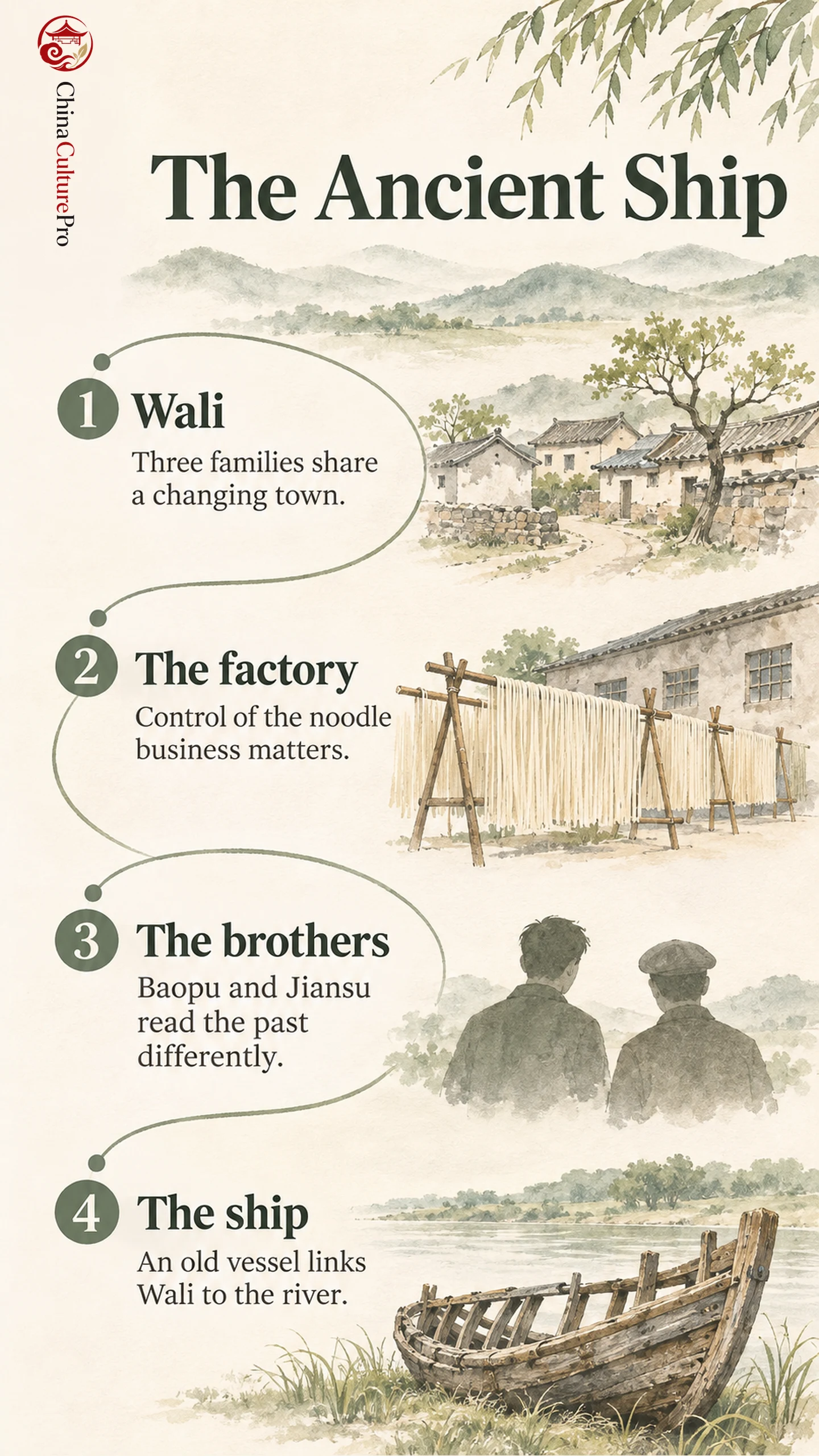
*The Ancient Ship* (古船, Gǔchuán) is a novel by Zhang Wei (张炜, Zhāng Wěi) about three families in the fictional town of Wali (洼狸镇, Wālí Zhèn). Changes in land ownership, political power and enterprise reshape the Sui, Zhao and Li families over roughly four decades. In the later part of the story, a noodle factory brings past disputes back into view.[1][2][3]
- The town: Its families remember the same history from different positions.
- The factory: Control over the business matters to workers as well as to the competing families.
- The title: An old ship recovered from the river connects present-day Wali with a longer past.[3][4]
The book returns to earlier events to show why the later dispute is so difficult to settle.
Follow the factory first. The people arguing over its future remember very different things about how they arrived at the same point.
Wali and the Three Families
Zhang sets Wali in a fictional version of the Jiaodong region of Shandong. The Sui family loses a position of wealth. Members of the Zhao clan gain power amid political upheaval. The Li clan helps push the town toward industrial work.[1][2][5][6]
| 人物 | What to follow |
|---|---|
| Sui Baopu (隋抱朴, Suí Bàopǔ) | The elder brother, who reflects on the town’s losses while keeping to the old mill. |
| Sui Jiansu (隋见素, Suí Jiànsù) | The younger brother, who sees the factory as a chance to regain a place for his family. |
| Zhao Duoduo (赵多多, Zhào Duōduō) | A man whose control of the noodle factory renews the struggle over the town’s livelihood. |
The factory dispute is easiest to follow through the two brothers. They share a family history and draw different conclusions from it.[3][4]
Why the Noodle Factory Divides the Brothers
The factory makes starch noodles. It is a place to earn a living and an enterprise whose control carries influence in the town. For Jiansu, taking it back would answer a wrong done to the family. Baopu has to decide what such a reversal would change for the people who depend on it.[3][5]
Baopu thinks through these questions at the older mill and in his reading. He returns to *The Communist Manifesto* while trying to understand the relation between what he sees in Wali and what a political text promises. The novel lets him consider whether replacing the person in charge can end a history of taking revenge.[3][4]
In Lu Yao’s Ordinary World, a brick business gives one family a different way into the economic changes of the reform years. In Wali, a change in factory control reopens arguments about what older generations did.
Why the Old Ship Matters
Sui Buzhao (隋不召, Suí Bùzhào), the brothers’ uncle, cares for the old ship brought out of the river. He has spent years away on the water. He also keeps an old navigation manual, which he entrusts to Baopu. The object he passes on is a book about finding one’s way on water. The ship gives that interest a visible place in Wali.[4]
One way to read the ship is as a piece of history people can protect or neglect. It belongs to a longer relationship with the river than any of the present owners can remember. The mill and factory show who can shape work today. The ship asks what people will carry forward.
How to Follow the Novel’s History
The story spans the period from land reform through the Cultural Revolution and into the early reform years. Changes in a family’s fortunes can make a shift in time easier to place than a date. When the narrative jumps backward, ask who has authority in the earlier scene and what the later scene assumes the reader already knows.[1][2]
Books also become part of what people inherit. A vernacular version of Tian Wen passes into the brothers’ reading lives. Baopu values it as a way to question himself. The book he reads becomes part of what he can offer his brother.[4]
FAQs About The Ancient Ship
Is Wali a real town?
Wali is fictional. Zhang interviewed people and studied noodle factories in the Jiaodong region while preparing the novel. The setting draws on that work.[1][2][5]
When did The Ancient Ship appear in Chinese and English?
The novel appeared in *Dangdai* magazine in 1986 and in book form in 1987. Howard Goldblatt’s English translation appeared in 2008.[1][2]
資料來源
[1] People’s Daily. The Ancient Ship, publication history and publisher’s discussion
[2] WorldCat. The Ancient Ship, English edition and synopsis
[3] China Writers Network. Reading The Ancient Ship, Baopu and the noodle factory
[4] Yantai Evening News. The river, the ancient ship and the Sui family’s reading
[5] Zhang Wei. Interview on the novel and field research in Jiaodong
[6] Publishers Weekly. The Ancient Ship, families and narrative structure