

Quick Answer: Who Was Su Shi?
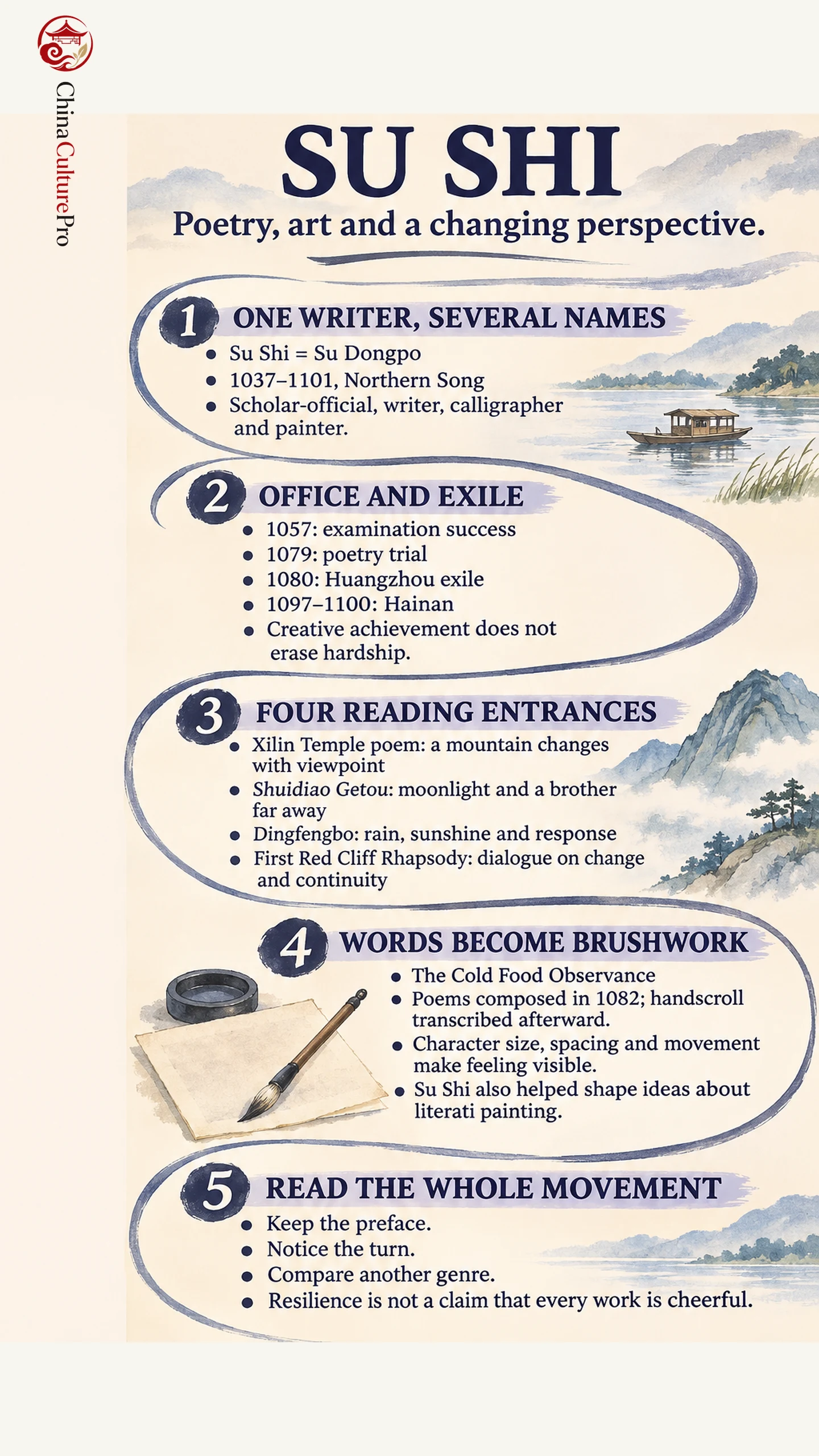
Su Shi (苏轼, Sū Shì; 1037–1101), also known as Su Dongpo (苏东坡, Sū Dōngpō), was a Northern Song (北宋, Běi Sòng) scholar-official, writer, calligrapher and painter. His work ranges from short poems and song lyrics to expansive prose and reflections on art.[1][2][8]
- One person, several names: Dongpo is the literary name by which Su Shi is widely remembered.
- Several ways into his writing: Begin with a mountain poem, a moon lyric, a rain-walking lyric or a river journey in prose.
- A varied emotional life: Political adversity matters, but grief, uncertainty, pleasure and changes of perspective all belong to his work.
His reputation for resilience is a starting point for reading, not a substitute for the particular feelings and arguments of each work.
A mountain changes shape as the viewer moves. Rain becomes sunshine, and then a poet questions whether either should govern his response. These are useful entrances into Su Shi: his writing repeatedly asks how an experience changes when viewed differently. The Chinese poetry guide places his work among other poets; this introduction follows the connections between his writing, public life and art.
A Life Shaped by Office and Exile
Born in Meishan (眉山, Méishān), in present-day Sichuan, Su Shi came from a literary family. His courtesy name was Zizhan (子瞻, Zǐzhān). His father and younger brother were also prominent writers. Family learning, correspondence and literary exchange therefore belong to his story alongside individual achievement.[1][8]
He passed the prestigious civil-service examination in 1057. His official career included periods of service, political controversy and banishment. The 1079 poetry trial, in which his writing became evidence against him, was a major crisis. He subsequently lived in Huangzhou (黄州, Huángzhōu), now associated with Huanggang in Hubei; the museum account places his arrival in exile there in 1080.[7][8]
Huangzhou was an especially productive setting. Two of the works discussed below date to 1082, as do the poems later written out in his celebrated calligraphic handscroll. Yet productive writing does not make imprisonment or banishment a fortunate event. The texts show different responses to hardship rather than one ready-made lesson.[5][6][7]
Later banishments took him farther south, including Hainan from 1097 to 1100. He died in 1101. The Song dynasty overview supplies the wider historical frame; for a first reading, keep the distinction between a particular work’s occasion and the whole shape of his career.[2][8]
Four Literary Works to Begin With
Su Shi wrote shi poetry (诗, shī), a major family of verse; ci (词, cí), lyrics composed to named tune patterns; and fu (赋, fù), rhapsodic writing that can combine rhythmic language, description and argument. His prose and criticism further extend the range. The verse-form comparison 及 Song ci guide explain the formal distinctions.[1][2]
| Work | 留意重點 |
|---|---|
| Inscribed on the Wall of Xilin Temple (题西林壁, Tí Xīlín Bì) | Four seven-character lines turn changing mountain views into a question about the observer’s position.[3] |
| Shuidiao Getou (水调歌头, Shuǐdiào Gētóu), beginning with a question about the bright moon | The 1076 Mid-Autumn preface mentions his younger brother; celestial imaginings lead back to human separation and shared moonlight.[4] |
| Dingfengbo (定风波, Dìngfēngbō), beginning with rain striking leaves | The preface describes a rain-interrupted walk. The lyric moves through discomfort, sunshine and a changed response to both.[5] |
| First Red Cliff Rhapsody (前赤壁赋, Qián Chìbì Fù) | A 1082 boat journey develops into dialogue about historical greatness, human brevity, change and continuity.[6] |
In the mountain poem, Lushan (庐山, Lúshān) is not simply an attractive backdrop. Seen across, from the side, near and far, it assumes different shapes. The final observation connects the inability to see its whole appearance with being inside it. An English sense of the last couplet is: I do not recognize the mountain’s true appearance, precisely because I stand within it. That is a reading grounded in the whole scene, rather than a free-floating maxim about being wrong.[3]
The moon lyric works differently. Its speaker entertains departure for a celestial world, then returns attention to life among people. The ending wishes for long life and connection across distance; the preface makes the brotherly occasion explicit. Follow Chinese moon poetry for the larger range of meanings that moonlight can carry.[4]
In the rain lyric, the ending does not merely celebrate good weather. Looking back, the speaker moves beyond treating rain and clear skies as opposed conditions controlling his state of mind. The attitude is achieved through the lyric’s sequence. Reading only the confident middle loses the small physical experiences—wind, chill and returning sunshine—that make the movement convincing.[5]
The rhapsody gives difficulty a speaking voice through a guest. His sorrow over short human lives receives an answer framed through water and moonlight: things can be considered through change or through continuity. The work stages a conversation and returns to companionship. It is richer than a claim that sadness is irrational or that Su Shi never felt it. Notes on literary allusions help with the historical references.[6]
Calligraphy, Painting and the Literati Ideal
The Cold Food Observance (寒食帖, Hánshí Tiè), preserved in Taipei’s National Palace Museum, brings writing and visual form together. Its two poems arose from the rainy festival season at Huangzhou in 1082; the museum distinguishes those poems from their subsequent transcription into the surviving handscroll. A composition date and the date of every physical ink stroke need not be identical.[7]
The poems contain frustration and dejection. In the calligraphy, changes in character size, spacing and brush movement give those feelings a visible rhythm. Read the words, then look at how the writing occupies the paper. The calligraphy guide offers a broader introduction to script as expressive art.[7]
Su Shi is also important to the literati (文人, wénrén) understanding of art: poetry, cultivated judgment, brushwork and personal expression can illuminate one another. His discussion of painting valued expressive likeness beyond mere outward copying. This does not mean that all accurate representation was rejected, or that a painting needs an autobiographical explanation for every brushstroke.[8]
His importance therefore includes ideas about painting as well as the objects attributed to him. When looking at a particular work, check its museum attribution and history instead of assuming every later image associated with Dongpo was painted by him. The landscape painting guide develops the wider artistic tradition.
Reading Su Shi in English
For a poetry selection, Burton Watson’s Selected Poems of Su Tung-P’o offers a direct entrance. The older spelling in the title refers to the same writer. A selection is useful for sustained reading but should not be mistaken for his complete poetry, prose and art criticism.[10]
Ronald Egan’s Word, Image, and Deed in the Life of Su Shi is a different kind of resource: a scholarly study connecting literary and artistic activity with the writer’s life. Use it when the relationship among forms matters more than finding a single familiar quotation.[9]
Start with one complete short work, including its preface when present. Then compare a second genre: the mountain poem beside the moon lyric, or the rain lyric beside the river rhapsody. Ask where each text turns and what changes between its beginning and ending. That comparison makes a more revealing introduction than collecting statements attributed to him online. The Chinese literature guide provides routes outward into other writers.
FAQs About Su Shi
Are Su Shi and Su Dongpo the same person?
Yes. Su Shi is the personal name; Su Dongpo is the widely used literary name. Older English books may use spellings such as Su Shih or Su Tung-P’o.[1][2][10]
Was Su Shi only a ci poet?
No. He wrote shi poetry, ci lyrics, fu and prose, and was also a calligrapher, painter and critic. Reading across forms reveals a broader range than the label “Song lyricist” alone.[1][2][8]
Was Su Shi always optimistic?
His works include grief, discouragement and uncertainty as well as pleasure and composure. The rain lyric develops a particular response to difficulty, while the Cold Food poems express distress. Neither should erase the other.[5][7]
Where should I start reading Su Shi?
Try the four-line mountain poem for a compact example, then the moon or rain lyric with its preface. The First Red Cliff Rhapsody is a useful next step for sustained description and philosophical dialogue.[3][4][5][6]
資料來源
[1] Academy of Chinese Studies. Su Dongpo
[2] Chinese University of Hong Kong, Renditions. Su Shi
[3] Su Shi, Chinese primary text via Wikisource. Inscribed on the Wall of Xilin Temple
[4] Su Shi, Chinese primary text via Wikisource. Shuidiao Getou: When did the bright moon appear?
[5] Su Shi, Chinese primary text via Wikisource. Dingfengbo: Do not listen to the rain
[6] Su Shi, Chinese primary text via Wikisource. First Red Cliff Rhapsody
[7] National Palace Museum, Taipei. The Cold Food Observance
[8] Palace Museum, Beijing. Su Shi: Zhiping letter
[9] Stanford University, Ronald Egan. Word, Image, and Deed in the Life of Su Shi
[10] Copper Canyon Press. Selected Poems of Su Tung-Po