


Quick Answer: What Is the Song Surname?
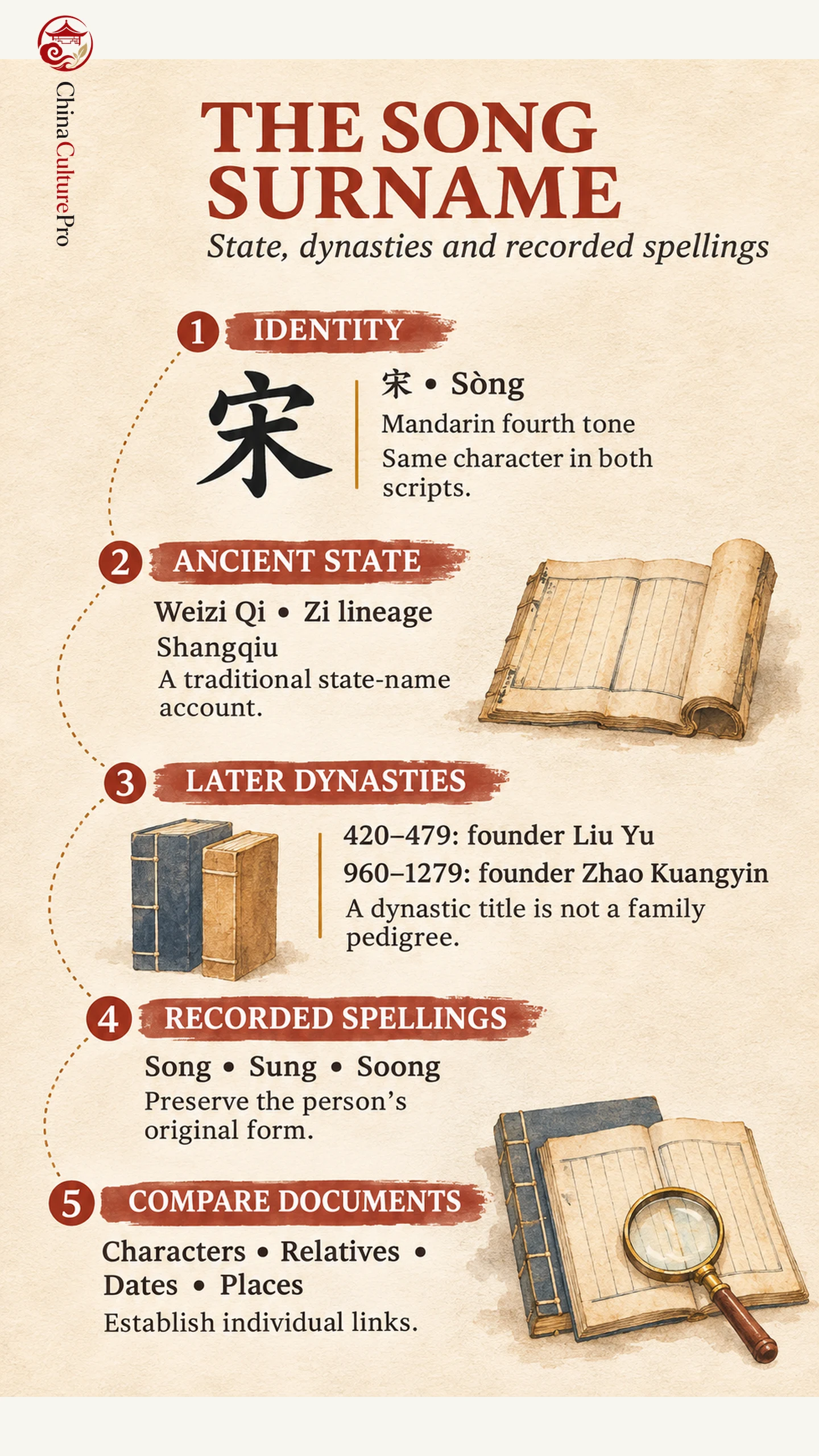
The Song surname (宋, sòng) is a Chinese family name pronounced with Mandarin’s fourth, falling tone. The same character names an ancient state and later dynasties, which must be distinguished.[1][3]
- Written form: 宋 is used in both simplified and traditional Chinese.
- Traditional connection: An old surname account links it to the ancient state of Song.[2]
- Recorded spellings: Song, Sung and Soong appear in actual personal records.[4][5][6]
The shared character does not establish descent from a dynasty’s rulers.
Sung or Soong in a family document may represent the surname written Song elsewhere. Read the spelling beside the Chinese character before connecting that record to an older historical account.
What Does 宋 Mean in a Name?
宋 is a family name, not a translation of English “song.” Dictionaries distinguish its surname, ancient state and dynastic uses.[1]
2019 mainland rank: 24th.[7]
The Ancient State and the Surname Tradition
The medieval compilation Tongzhi (通志, tōngzhì) describes the Song family name under names associated with states. Its account connects Weizi Qi (微子启/微子啟, wēizǐ qǐ), the Zi lineage (子, zǐ), and the state’s capital at Shangqiu (商丘, shāngqiū). This is an ancient political and lineage tradition, not a reference to the medieval dynasty.[2]
The state lay in what is now Henan (河南, hénán).[1] A state-name tradition cannot supply a household’s missing generations.
Why the Song Dynasties Are a Separate Question
The Song dynasty (宋朝, sòng cháo) of 960–1279 was founded by Zhao Kuangyin (赵匡胤/趙匡胤, zhào kuāngyìn), whose family name was Zhao. Another dynasty, conventionally called Liu Song (刘宋/劉宋, liú sòng), lasted from 420 to 479 and was founded by Liu Yu (刘裕/劉裕, liú yù). Thus, even “Song dynasty” can denote different regimes; a state or dynasty’s title is not automatically its ruler’s surname.[3]
Song, Sung and Soong in Recorded Names
These documented names illustrate three spellings; none prescribes a form for every family.
| Recorded spelling | Person and Chinese name | 證據 |
|---|---|---|
| 宋 | Jun Song (宋俊, sòng jùn) | University research profile.[4] |
| Sung | Rosa Ka Yee Sung (宋家怡, sòng jiāyí) | University school profile.[5] |
| Soong | Soong Ching Ling (宋庆龄/宋慶齡, sòng qìnglíng) | Bilingual official residence description.[6] |
How to Compare Song Family Documents
- Copy the Chinese name exactly, alongside its original Roman spelling.
- Compare relatives’ names, dates and places before joining two entries.
- Keep a modern pinyin search form separately; retain Sung or Soong when quoting the original record.
An index match is a lead. A matching parent, spouse or address provides a more specific connection than the surname alone.
FAQs About the Song Surname
Does the Song Surname Mean an English Song?
No. Song here represents the Chinese family name 宋, read sòng in Mandarin.[1]
Does Song Prove Descent from the Song Emperors?
No. The later dynasty’s founder bore the surname Zhao; sharing its dynastic title proves no family connection.[3]
Should Sung or Soong Be Changed to Song?
Preserve the spelling used by the person or document. Add pinyin as a search aid rather than silently replacing an established name.
資料來源
[1] Ministry of Education. 宋: Revised Mandarin Chinese Dictionary
[2] Zheng Qiao. Tongzhi, volume 26: surname accounts
[3] Ministry of Education. 宋: Concised Mandarin Chinese Dictionary
[4] Hong Kong Baptist University. Jun Song: research profile
[5] University of Hong Kong. Sung Ka Yee Rosa: school profile
[6] Xicheng District Government. Soong Ching Ling Former Residence
[7] Ministry of Public Security, reproduced report. 2019 National Name Report