

Quick Answer: What Does the Deng Surname Mean?
Deng(邓,Dèng), written 鄧 in traditional Chinese, is a Chinese surname principally associated with an ancient state and place-name. It is more accurately understood through that historical connection than through a one-word English translation. [1]
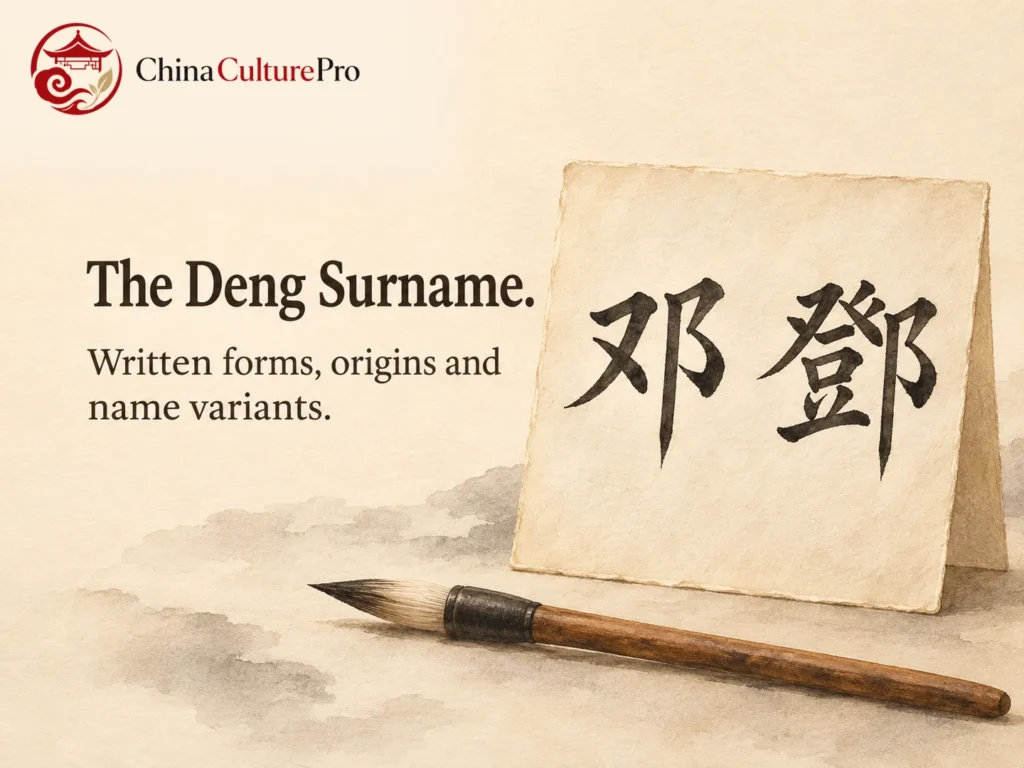
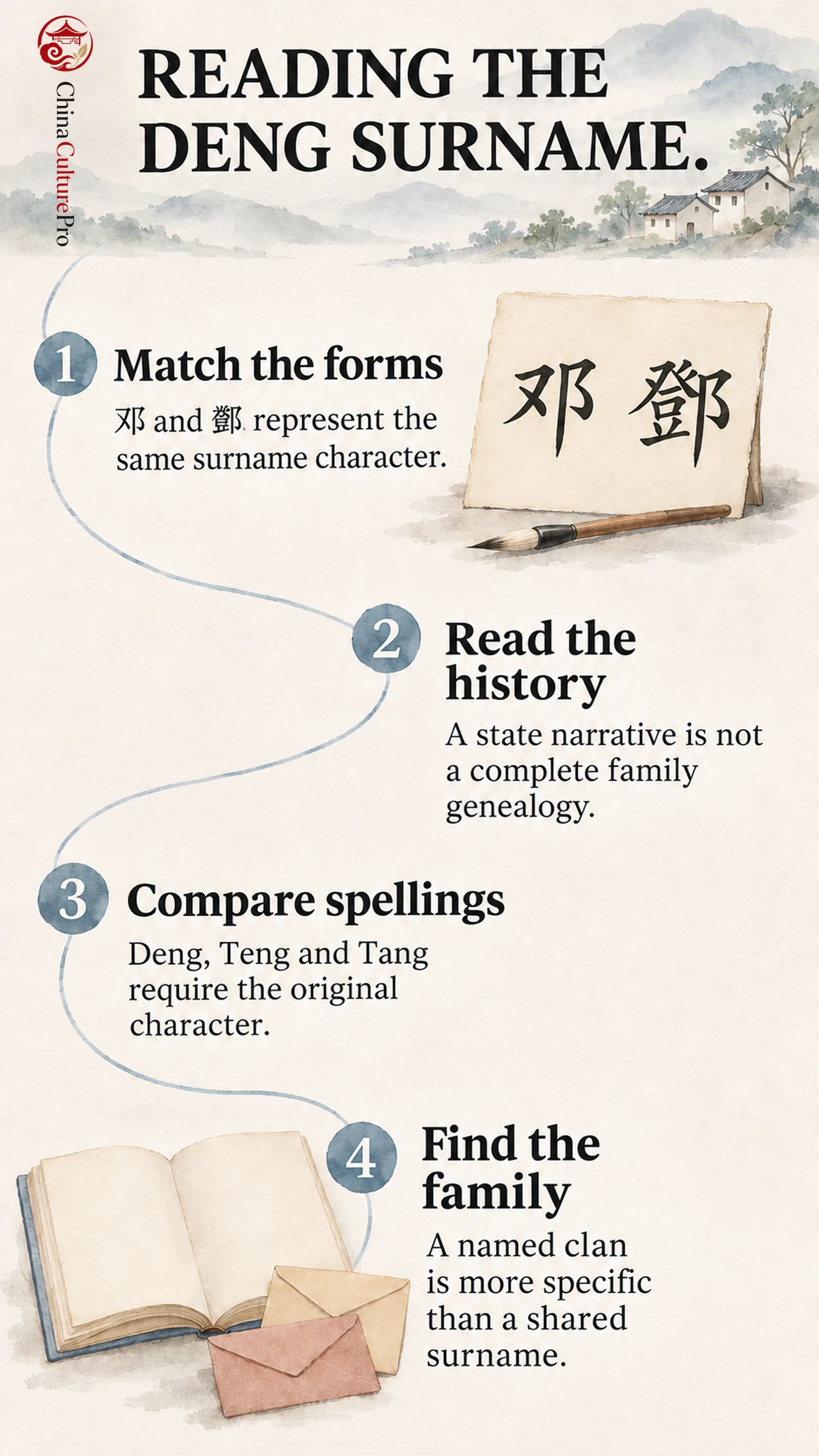
- Character: 邓 and 鄧 are simplified and traditional forms of the same surname.
- Pronunciation: The Mandarin reading dèng has a falling fourth tone.
- Spellings: Teng and Tang can also represent this family character.
- Family history: A particular clan’s records are different evidence from a general surname origin account.
The traditional character contains a sound-bearing component; that does not make its surname meaning “ascending.”
The surname written as Deng in pinyin may appear as Tang on a Hong Kong heritage sign or Teng in another record. These differences are part of the wider history of Chinese surnames. Understanding them starts with the character, then moves from ancient state names to the evidence for a particular family.
邓 and 鄧: Character, Sound and the Place-Name Connection
The traditional form 鄧 combines a right-hand place-related component with 登 on the left. An early dictionary explicitly analyzes 登 as the sound-bearing element and identifies Deng as a state associated with the Man lineage in the Nanyang region. [2]
That analysis separates sound from meaning. Translating 登 as “ascend” and treating the whole surname as a wish for upward success skips the function assigned to it in the character. The name’s historical place association is the more useful explanation here.
The simplified form 邓 is shorter to write but continues to represent the surname. A change between these written forms need not indicate a change of family identity. For the distinction between a component’s position, dictionary classification and function, see Chinese character radicals.
The Ancient State and Later Ancestry Traditions
A transmitted origin story links the name to a grant made by the Shang king Wu Ding(武丁,Wǔ Dīng)to his uncle. It is preserved as an origin account in later dictionary tradition. [1] This is an ancestry account to identify as such, rather than a securely documented founding date for every Deng family.
The state also appears in the received Zuo Commentary. Its narrative of Duke Zhuang’s sixth year tells of Deng Qihou(邓祁侯,Dèng Qíhóu)entertaining the ruler of Chu, whom he calls his nephew. Three advisers urge him to kill the visitor, warning that this man will destroy Deng. The ruler refuses; the passage goes on to describe Chu’s attacks and the state’s destruction in the sixteenth year. [3]
This is a political narrative shaped around kinship, hospitality and a warning ignored. Its account of a doomed decision is not a list of the families who later bore the surname. Nor should its remembered dialogue be presented as a verbatim contemporary transcript.
The old dictionary’s state-name explanation and the historical narrative make clear why an ancient polity is central to discussions of Deng. They do not fill the many generations between that polity and a living household. A claimed connection needs to be followed through the family’s evidence, with uncertainty retained where the record stops.
Deng, Teng and Tang in Roman Letters
An indexing reference associates these spellings with the character. Their value is to widen a search for a name while preserving the differences in the documents themselves. [4]
| 形式 | What the spelling establishes |
|---|---|
| Deng | The Mandarin pinyin form, commonly written without the tone mark. |
| Teng | A Wade–Giles form associated with 鄧; the original character remains important. |
| 唐 | An attested alternative, including the Hong Kong clan example below. |
A Roman spelling alone does not establish that all entries refer to this surname. In particular, Tang may belong to another Chinese character or another naming context. Confirm the original writing before treating a spelling difference as a family connection.
Regional romanization traditions explain why personal spellings can persist across generations and borders. Retain the established name used by a person or source rather than silently converting every occurrence to pinyin.
The Ping Shan Tang Example and Family Evidence
The Tang Ancestral Hall(鄧氏宗祠,Dèngshì Zōngcí)in Ping Shan, Hong Kong, supplies a concrete example: its English Tang corresponds to 鄧 in the Chinese name. The hall belongs to the Ping Shan Tang clan. Its three halls and two courtyards organize a shared ancestral space, with ancestral tablets in the rear hall. [5]
That is evidence for a named community and its institutional setting, not a claim that everyone called Tang belongs to it. Chinese ancestral halls explain the wider relationship between clan identity, ritual and community buildings.
For a particular family, compare named relatives, dates and places in its records. A statement about an ancient founder serves a different purpose from an entry identifying a parent or a migration. Chinese family genealogy provides context for reading those connections without substituting a general surname story for them.
Record both the Chinese characters and each source’s Roman spelling. Identifying which element is the surname, as explained in Chinese naming traditions, keeps a promising name match from becoming an unsupported pedigree.
FAQs About Deng Surname
Are Deng and Tang the same surname?
They can both represent 邓/鄧, as the Ping Shan example shows. The letters alone do not identify every Tang name.
Are 邓 and 鄧 different family names?
No. They are simplified and traditional forms of the same surname character.
Does Deng mean climbing or ascending?
That interpretation confuses the whole surname with 登, its traditional sound-bearing component. The surname’s main historical explanation is a state-name connection.
資料來源
[1] Ministry of Education. Dictionary of Chinese Character Variants: 鄧
[2] Xu Shen, with commentary by Duan Yucai. Explaining Graphs and Analyzing Characters: 鄧
[3] Zuo Commentary. Duke Zhuang, sixth year
[4] The Indexer. The hundred surnames: a Pinyin index
[5] Antiquities and Monuments Office. Tang Ancestral Hall, Ping Shan Heritage Trail