

Quick Answer: What Is Reluctant Departure at Tiger Hill?
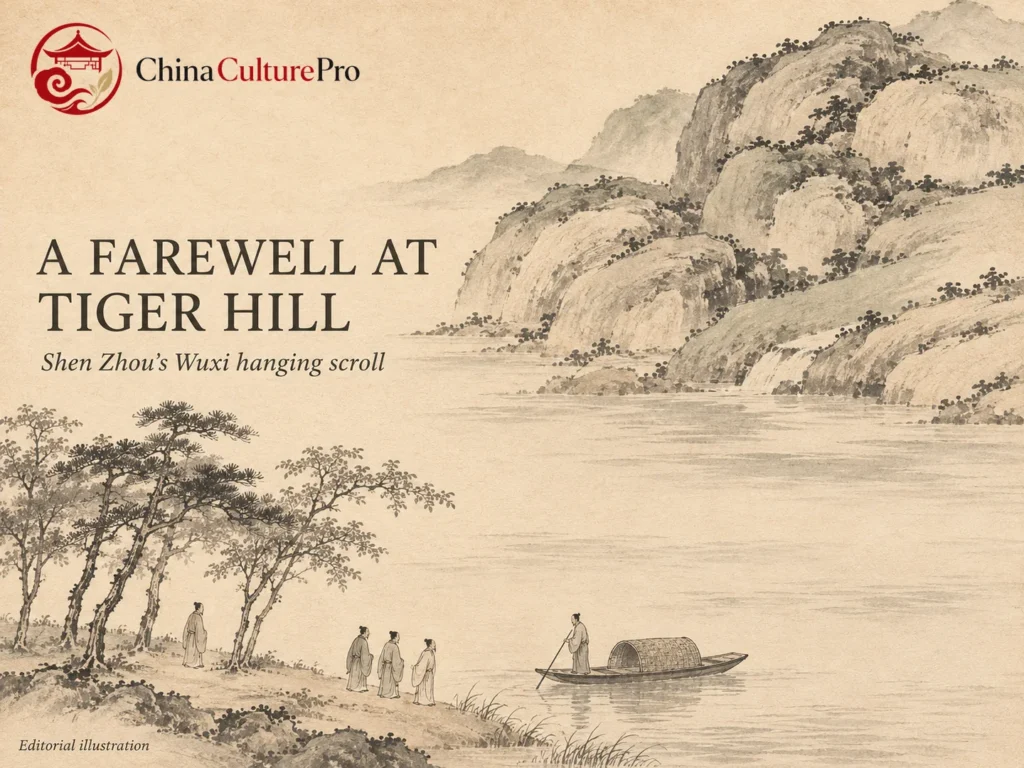
Reluctant Departure at Tiger Hill (虎丘戀別圖, Hǔqiū Liànbié Tú) is a 1494 ink landscape on paper by Shen Zhou (沈周, Shěn Zhōu), preserved in Wuxi Museum. Four people gather on the near shore, with a boatman waiting beside them. The dated inscription connects the landscape to a farewell. This is the small Wuxi hanging scroll, rather than the much larger, earlier Tiger Hill farewell painting in Tianjin.[1][2][4]

A farewell can occupy a tiny corner of a landscape and still determine how we read the whole picture. Here, a few people beside a waiting boat give the broad water and rocky distance a human timescale: someone is about to leave, while others remain.
Identify the Wuxi Painting Before Comparing Images
Similar English titles can lead to photographs of different objects. Begin with the collection and the composition, then check the measurements.
| 欄目 | Wuxi painting |
|---|---|
| 藝術家 | Shen Zhou |
| 日期 | Third lunar month of 1494 |
| Medium and format | Ink on paper; hanging scroll |
| Collection | Wuxi Museum |
| Height | 70 cm |
| Width | Approximately 27 cm in the museum’s 2025 account; 33.2 cm in its 2018 account |
| Main action | A shore-side farewell beside a waiting boat |
The two museum pages give different widths without explaining their measurement boundaries. Treat the discrepancy as unresolved, rather than silently combining the figures into a single exact catalogue measurement.[1][2]
The Farewell Takes Place on a Small Near Bank
Look near the bottom of the painting. The shore projects from the left beneath a small grove. One figure stands closer to the trunks; the others form a loose group farther right. Their pale robes leave the bodies mostly open, while small dark marks distinguish heads, sleeves and gestures.
The figures do not form a procession. They seem to have paused within a space that the bank makes available. Their separation matters: the interval between the person nearest the trees and the central group gives the gathering an uneven, conversational rhythm.
Just beyond them, a narrow boat sits parallel to the water’s edge. Its low covered section contrasts with the upright people, and the standing boatman supplies another vertical accent. The means of departure is already present. We do not need a dramatic embrace or a visibly moving vessel to understand the event.
Open Water Separates the People from the Hills
Follow the bank outward and the scene opens into a largely unmarked channel. Small rocks interrupt the water, but they do not fill it. Across that interval, blocky hills rise into a much larger mass than the foreground gathering.
The contrast is between different kinds of attention. The people reward close inspection; the hills become clearer when viewed as groups of broad forms. Dark dots and short strokes collect along ridges and crevices, while lighter interiors keep the rocks from becoming a single black wall.
The near trees and far hills also frame an indirect route for the eye. You can move upward through the open water before returning down the shore. This use of distance belongs to Chinese landscape painting: the space between forms helps organize the experience as much as their outlines do.
A Dated Poem Gives the Landscape Its Occasion
Tiger Hill (虎丘, Hǔqiū), northwest of old Suzhou, was a recurring place of gathering for the painter. His inscription dates this work to 1494 and names Pu Shouan (浦守庵, Pǔ Shǒu’ān) in its dedication.[1][2][3]
The classical poem brings spring growth, departure and anticipated welcome into the same sequence. Willows put out green; flowering trees seem to recognize returning wheels. Later lines imagine doors opening and a backward glance amid white clouds. These are poetic relationships, rather than a key identifying every tree or person in the picture.[3]
The signature uses yousheng (友生, yǒushēng), a modest self-designation associated with friendship. Read alongside the dedication, it makes the sheet a personal exchange. The broader tradition of Chinese friendship and farewell poems helps explain why leave-taking could generate both a landscape and a literary response.[1]
The Side Inscription Belongs to a Later Viewer
Some photographs include a tall, brown-toned strip of writing to the left of the painting. This is a later inscription by Fang Xiaobiao (方孝標, Fāng Xiàobiāo), dated 1672. Its account of the work’s acquisition and its praise of the artist belong to the painting’s later reception.[2]
Distinguish that strip from Shen Zhou’s writing within the painted sheet, at upper right. Their different positions and surfaces make the distinction visible even before the text is translated. The guide to painting inscriptions and seals explains why a mounted work can contain voices from more than one period.
How to Read the Farewell across the Whole Scroll
- Locate the gathering: Find the four shore figures before looking for the separate boatman.
- Follow the open channel: Trace the unpainted interval between the near bank and the opposite hills.
- Compare the marks: Move from the figures’ light outlines to the darker accents along trees and rocks.
- Separate the writing: Identify the painter’s upper-right inscription and, when included, the later strip on the left mounting.
FAQs About Reluctant Departure at Tiger Hill
Is this the same as Shen Zhou’s Bidding Farewell at Tiger Hill?
No. The Tianjin farewell painting dates to 1480 and measures 173.1 × 64.2 cm. It is an ink-and-color landscape associated with a different farewell.[4]
Why do published dimensions differ?
Wuxi Museum’s own pages list different widths. Until a catalogue explains the measurement scope, retain that qualification instead of choosing a precise width with unwarranted confidence.[1][2]
Does the painting show a literal tiger?
No tiger appears in the landscape. Tiger Hill names the place associated with the farewell; the visible action centers on people, trees, water and a boat.
資料來源
[1] Wuxi Museum. Reclusive Landscape Feeling: Shen Zhou’s Reluctant Departure at Tiger Hill
[2] Wuxi Museum. Shen Zhou’s Reluctant Departure at Tiger Hill: Collection Research
[3] Wuxi Museum. Shen Zhou’s Reluctant Departure at Tiger Hill: Inscription
[4] Tianjin Museum. Shen Zhou’s Bidding Farewell at Tiger Hill