

Quick Answer: What Is Red Sorghum About?
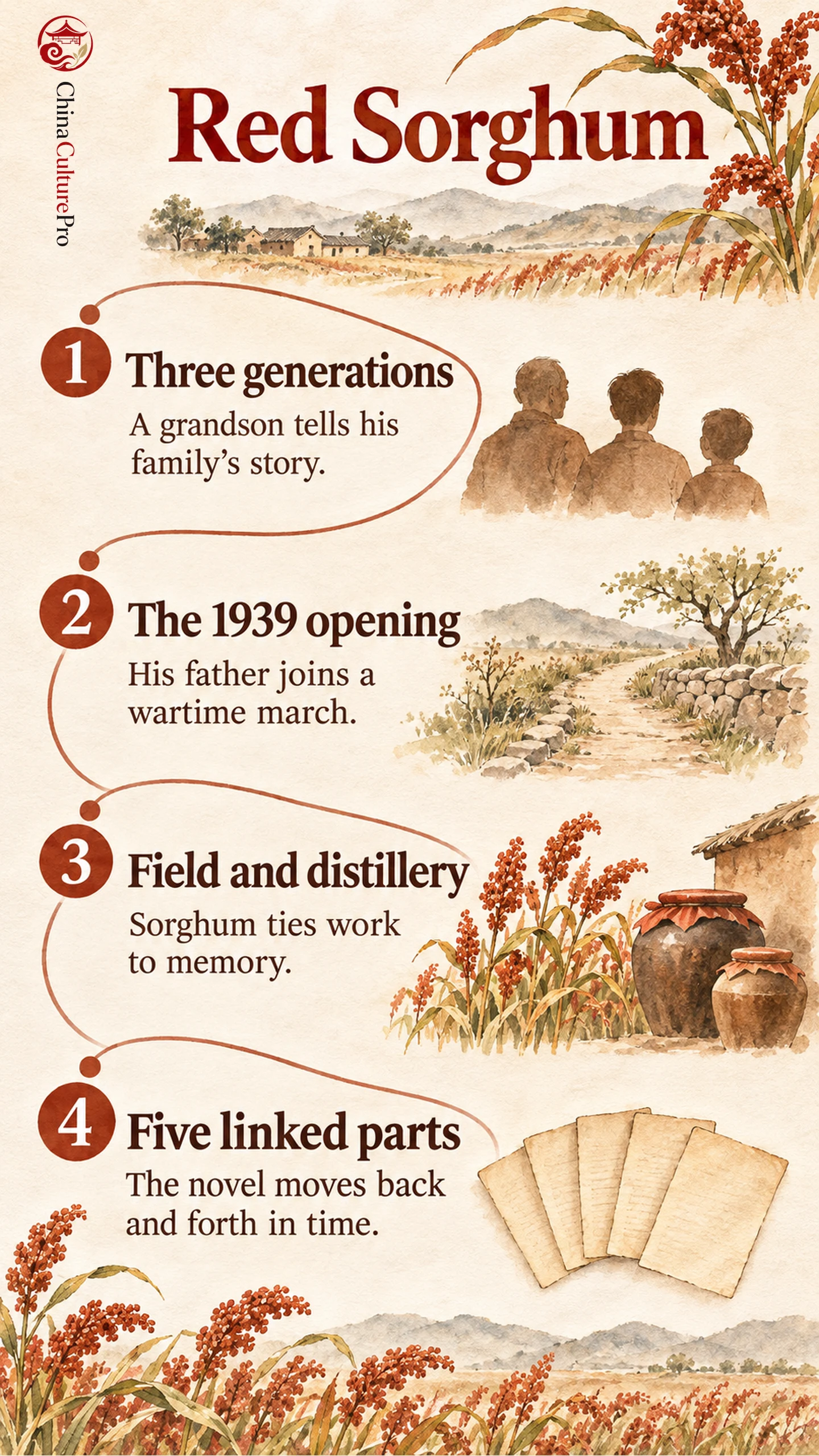
*Red Sorghum* (红高粱家族, Hóng Gāoliáng Jiāzú) is a novel by Mo Yan (莫言, Mò Yán) set in and around a fictionalized Gaomi (高密, Gāomì) in Shandong. A grandson tells stories about his father and grandparents. Their lives bring together a distillery, local rivalries and fighting against the Japanese invasion.[1][2][3]
- The opening: The narrator’s father is a teenager when he joins a group heading to confront a Japanese convoy in 1939.[1]
- The structure: The story moves back and forth in time across five linked parts.[1][2]
- The crop: Sorghum supplies a livelihood and grows across ground where some of the family’s worst experiences take place.[1][2]
The film draws mainly on the novel’s first two parts.[4][5]
The boy who heads out with the men is already “my father” to the grandson telling the story. That name keeps a later generation present.
The Family at the Center of the Novel
| 人物 | Role in the family story |
|---|---|
| Yu Zhan’ao (余占鳌, Yú Zhàn’áo) | The narrator’s grandfather. His reputation as a bandit and his part in wartime resistance both matter. |
| Dai Fenglian (戴凤莲, Dài Fènglián) | The narrator’s grandmother. Her marriage into a distilling family and her relationship with Yu link the household to the wine business. |
| Douguan (豆官, Dòuguān) | The narrator’s father. He is still a teenager during the opening march and sees parts of the war close up. |
Grandfather, grandmother and father are the narrator’s labels. They orient you when the novel moves from a wartime incident to the much earlier events that brought these people together.[1][2]
Why the Novel Starts in 1939
The group heads out to intercept a convoy. Among the people present are relatives whose earlier choices the reader has yet to learn. The narrator can name what the commander will mean to later generations even while telling the story through what his father experiences at fifteen.[1]
The book uses flashbacks to move from the Japanese invasion to family affairs that began before it. The new information changes the significance of people and places already introduced. Yu’s role in resistance carries more tension once you know about the local violence in which he has been involved. Dai’s distillery belongs to a story about marriage and work before it becomes part of a wartime story.[1][2][4]
The grandson can give an older relative’s remembered world the immediacy of a scene. The switches in time also show how much work goes into making a story out of those different experiences. Ask what the narrator adds when he links the fear his father felt on one day to the reputation his grandfather acquired over years. Mo Yan’s Big Breasts and Wide Hips follows a different family whose story also makes historical change visible through work, care and loss.
Why Sorghum Keeps Returning
People in the novel grow sorghum and turn it into liquor. The distillery depends on what comes out of the fields. In the opening it is also part of the ground Douguan has to cross. A field the family knows through work becomes a place to remember what happened during the fighting.[1][2]
Keep an eye on what someone is doing whenever the grain comes into view. The crop can have a different meaning to someone making a living from it and to a descendant trying to picture the lives of people he never knew as they were then. The crop stays recognizable even as the people who work among the stalks, hide in them and remember them keep changing.
What the Film Takes From the Novel
Zhang Yimou (张艺谋, Zhāng Yìmóu) drew primarily on the sections called *Red Sorghum* and *Sorghum Wine*. The adaptation centers on the grandmother, the distillery and the arrival of Japanese troops. It won the Golden Bear at the Berlin International Film Festival in 1988.[4][5]
The novel gives the grandson more stories to assemble and more occasions to move backward and forward in time. For another adaptation by Zhang that makes color carry a distinctive part of the story, compare Raise the Red Lantern.
FAQs About Red Sorghum
Why is the novel also called Red Sorghum Family?
The Chinese title names a family or clan. *Red Sorghum* also names the first of five linked works that appeared in periodicals in 1986 and were published together as a novel in 1987.[2][4][6]
Who translated Red Sorghum into English?
Howard Goldblatt translated it as *Red Sorghum: A Novel of China*. The translation appeared in 1993, and Penguin publishes a paperback edition.[1][6]
資料來源
[1] Penguin Random House. Red Sorghum, English edition and sample
[2] China Federation of Literary and Art Circles. Red Sorghum Family, five-part novel synopsis
[3] Nobel Prize Outreach. Mo Yan, literary work and Gaomi
[4] China.org.cn. Red Sorghum in print and on screen
[5] Berlinale. Zhang Yimou’s Red Sorghum and the 1988 Golden Bear
[6] Jonathan D. Spence. Red Sorghum, book and translation history