
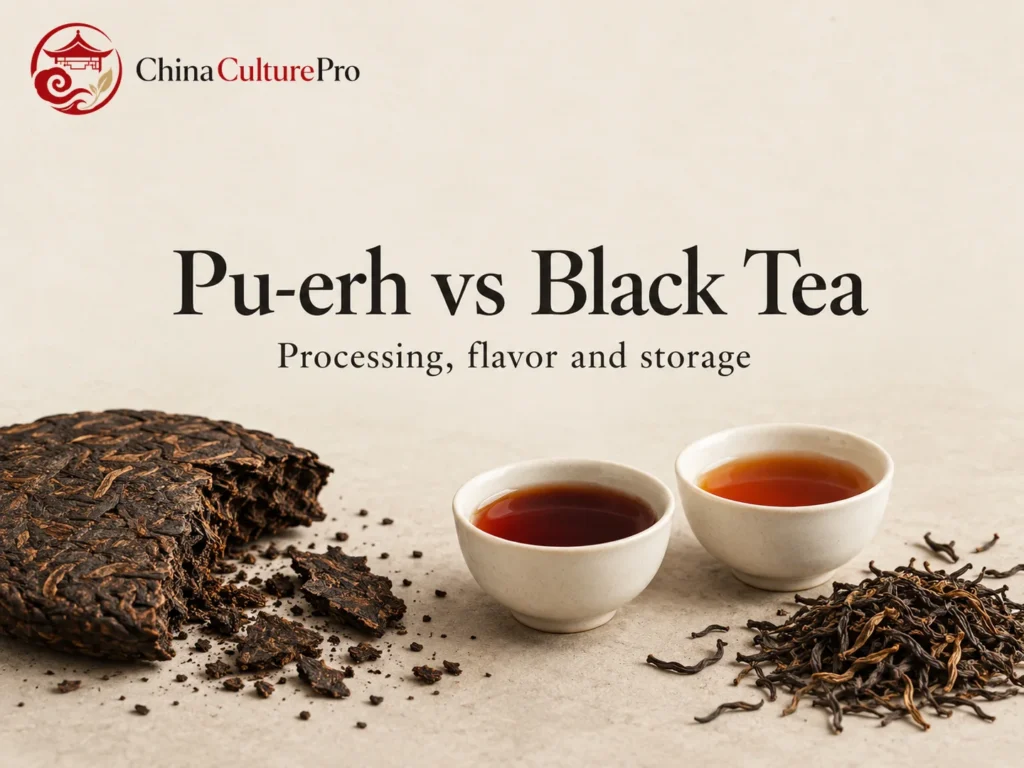

Quick Answer: Is Pu-erh the Same as Black Tea?
Pu-erh tea (普洱茶, pǔ’ěr chá) and black tea (红茶, hóngchá), called hongcha in Mandarin, are different tea traditions. Both come from the tea plant, but their processing follows different paths. Pu-erh is associated with Yunnan and includes two major production styles.
- Black tea: Deliberate enzymatic oxidation shapes the leaf before drying.
- Pu-erh: A sun-dried base underlies the raw and ripe styles, which differ in further processing.
- Choosing: Taste and storage depend on the actual style, production and condition, not darkness alone.
A ripe-style cup may look much darker than a young raw-style cup. Neither appearance makes pu-erh the same product as English black tea.

A dark cup and a deep-colored leaf do not identify how a tea was made. The confusion becomes easier to resolve once Chinese names, production methods and storage goals are separated. That distinction is especially useful when choosing among Chinese teas and drinks.
Black Tea, Hongcha and Heicha: The Translation Problem
English black tea corresponds to Chinese hongcha, literally “red tea.” Chinese dark tea (黑茶, hēichá), or heicha, literally contains the word “black,” but describes a different processing family associated with post-fermentation. Translating both words simply as black tea hides that distinction.[2]
Pu-erh is often discussed alongside dark teas, especially its ripe style. Its raw style adds a classification nuance because its initial processing is closer to sun-dried green tea. For shopping, identify which pu-erh style is being sold before comparing its color with other teas. Other dark teas are not automatically pu-erh.
Processing: Black Tea, Raw Pu-erh and Ripe Pu-erh
For black tea, withering and rolling or breaking allow leaf compounds and enzymes to react extensively before drying. This enzymatic oxidation is often called fermentation in tea terminology; it is not the same mechanism as a microbial wet-pile process.[2]
Raw pu-erh (生茶, shēngchá), commonly called sheng, starts from a heated, rolled and sun-dried leaf base. It can be made into compressed tea and can change during storage. Young examples need not already have the mellow character associated with long storage.[1][7]
Ripe pu-erh (熟茶, shúchá), called shou, undergoes an additional managed fermentation. Wet-piling (渥堆, wòduī) is the warm, moist piled-leaf process used to produce this ripe style. Microbial activity contributes to the transformation; it is distinct from black-tea oxidation.[3][7]
The raw versus ripe pu-erh comparison explains that division in detail. The oxidation and fermentation guide separates the chemical and microbial processes. A compressed shape alone does not settle the question: compressed teas include more than one processing category.
Taste and Appearance: Compare Three Cups
| Tea or style | Possible cup character | 適用界線 |
|---|---|---|
| Black tea | Often sweet, brisk, malty, fruity or floral, depending on the product. | A reddish or amber liquor does not make it Chinese heicha. |
| Young raw-style pu-erh | Often fresher and more astringent, with a yellow-green or golden liquor. | Its flavor can differ greatly from the ripe style. |
| Ripe-style pu-erh | Often mellow and deep, with reddish-brown liquor and an aged-aroma character. | A very dark cup does not prove age or quality. |
The official Yunnan descriptions distinguish the green-yellow liquor and strong returning sweetness of raw tea from ripe tea’s reddish-brown appearance and mellow character. These are useful reference profiles, not promises that every packet will taste identical.[1]
Brewing Choices and Caffeine
Choose a method before comparing numbers. One producer’s short-infusion guide uses black tea at about 90°C with 5–6 g per 100 ml and an initial drinking infusion around ten seconds. Its pu-erh guidance uses about 6 g per 100 ml with 95–100°C water, and describes early drinking infusions of twenty seconds or less. Those are concentrated small-vessel examples, not a recipe for a lightly dosed mug.[5]
Give the leaf room to open, especially when a compressed piece expands. A glazed vessel or 蓋碗 lets you compare teas without assigning each a clay pot. Adjust the next infusion to the actual strength; neither a fixed rinse count nor a guaranteed number of infusions defines either category.
Both normally contain caffeine. Leaf quantity, water volume, infusion conditions and the amount consumed affect the serving. A smooth or earthy taste is not evidence of decaffeination, and a short individual steep does not describe the total caffeine consumed over a long session. Consult the Chinese tea caffeine guide for that separate question.
Storage: Preserving Flavor versus Deliberate Aging
For black tea bought for its current aroma, preservation is the usual goal. Keep it in a well-sealed, opaque food-storage container, dry and away from strong odors. Divide a larger purchase so the main supply is opened less often; do not store different aromatic teas loose in the same tin.[4]
Pu-erh storage may instead include deliberate aging, particularly for raw tea. That is a different objective from keeping an opened black tea unchanged. It requires attention to the actual storage environment and the tea’s condition; a paper wrapper alone does not control dampness. There is no universal home humidity recipe implied by the word pu-erh.
Both need protection from unsuitable moisture, odors and poor storage. Do not deliberately wet a cake to hurry aging, or treat visible deterioration as a flavor stage to be corrected with a quick rinse. Official agricultural guidance notes that poor storage can compromise any tea.[6]
Age is context rather than a quality guarantee. The aged tea guide considers that distinction, while the Chinese tea storage guide covers containers and tea-type differences.
FAQs About Pu-erh and Black Tea
Is pu-erh just an old black tea?
No. Black tea develops through substantial enzymatic oxidation during manufacture. Pu-erh has its own raw and ripe production paths; storage time alone does not turn ordinary black tea into pu-erh.
Does raw pu-erh turn into ripe pu-erh with age?
No. Storage can change raw tea’s taste and color, but it does not reproduce the managed wet-piling step that defines ripe-style manufacture. Mature raw tea remains raw-style tea.
Is pu-erh caffeine-free?
No. It is made from tea leaves and normally contains caffeine. Ripe processing, dark color and a mellow taste do not establish that a serving is caffeine-free.
Does older tea always taste better?
No. Initial material, processing, storage and personal preference all matter. Some tea changes favorably; some becomes stale or deteriorates. A date alone cannot establish quality.
資料來源
[1] Yunnan Provincial Department of Agriculture and Rural Affairs. 有一种叫云南的生活丨跟着云茶去旅行!
[2] Taiwan Tea and Beverage Research Station. 臺灣特色茶分類及加工製程簡介
[3] Original microbiome research. Integrated Meta-omics Approaches To Understand the Microbiome of Spontaneous Fermentation of Traditional Chinese Pu-erh Tea
[4] Tea and Beverage Research Station, Ministry of Agriculture knowledge portal. 少量茶葉貯藏方法
[5] Yunnan Sourcing, original brewing method. Brewing Guide for Green, Black, Oolong and Pu-erh Teas
[6] Taiwan Ministry of Agriculture. 網路上有甚多普洱茶致癌的說法,眾說紛紜,是否真有此事?
[7] Original national product-protection processing record. 关于批准对普洱茶实施地理标志产品保护的公告(2008年第60号)