

Quick Answer: How Should You Store Chinese Tea?
Store dry Chinese tea in clean, suitable packaging protected from unwanted moisture, strong odors, excessive heat and light. Then adjust the method to the actual tea and your goal: preserving its current character or managing a product intended for aging.
- Environment: A dry, odor-free location away from steam and direct sun is a useful starting point.
- Packaging: Check the seal and inner bag as well as the outer caddy.
- Tea type: Cold storage can help some freshness-focused teas, while aging requires a separate, product-specific plan.
Container, moisture control and shelf life must be matched to the tea and storage goal. Follow the packet’s storage and date information and control moisture before pursuing an aging experiment.
An attractive tea caddy may not provide the barrier a tea needs against moisture or odors. Storage works when the package, container, environment and tea type fit together. This guide separates everyday freshness protection from deliberate aging for Chinese tea.
What Damages Dry Tea in Storage
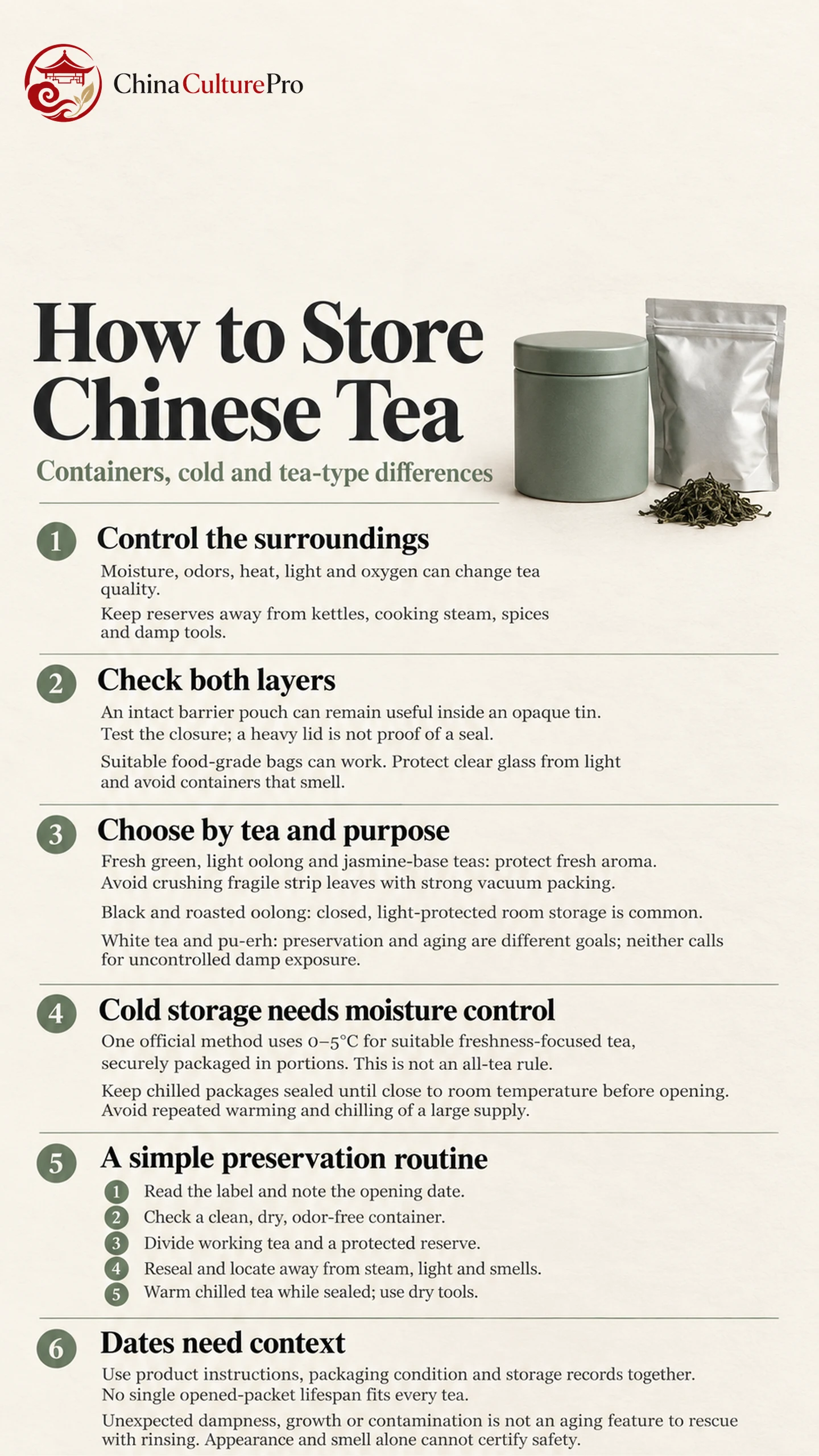
Dry tea can absorb moisture and surrounding odors. Light, heat and oxygen also contribute to deterioration in color, aroma and taste. The aim of preservation is to slow those unwanted changes, not simply to hide the leaves in an attractive container.[1]
A shelf beside a kettle, cooker or spice collection is therefore a poor location. Move the tea away from steam, heating cycles and strong smells. Even a good bag becomes less useful if it is left open during brewing or handled with a damp scoop. Keep the reserve supply away from the wet preparation area.
Choose the Container and the Packaging Together
For ordinary preservation, choose clean, odor-free food-storage packaging with a dependable closure. An intact high-barrier inner pouch can remain useful inside a tin; transferring everything into a decorative ceramic jar may remove that protection. Inspect the actual closure rather than assuming that a heavy lid is airtight.[1]
Opaque metal tins and suitable sealed pouches protect against light. A clear glass jar needs a dark storage location or an opaque outer cover. Food-grade plastic is not automatically unsuitable: official household guidance includes appropriate food-storage bags. Avoid materials that already smell of coffee, spices or cleaning products.[3]
Separate strongly scented products from plain tea, keeping each in its own closed packaging. Portioning a larger purchase into a small working supply and a protected reserve reduces repeated opening. It also makes the tea you are using easier to track.[2]
Match Storage to the Tea Type and Your Goal
| 茶 | Main goal | Practical direction |
|---|---|---|
| Green tea (绿茶, lǜchá) | Preserve fresh leaf character. | Barrier packaging; cool, dark, dry storage. Properly sealed cold storage can be useful. |
| Fresh-style oolong tea (乌龙茶, wūlóngchá) | Preserve a fresh aromatic style. | Follow producer guidance; distinguish flat or strip leaf from robust rolled leaf when considering vacuum packing. |
| Black tea (红茶, hóngchá) and roasted oolong | Protect current aroma and intended roast character. | Well-closed, light-protected storage at suitable room conditions is a common approach. |
| Jasmine tea (茉莉花茶, mòlì huāchá) | Protect both the base tea and floral aroma. | Treat the actual base and instructions as the guide; keep the scented product separately packaged. |
| White tea (白茶, báichá) | Preservation or a specified aging goal. | Protect from dampness, heat, light and odors; aging does not require an open jar. |
| Pu-erh (普洱茶, pǔ’ěr chá) | Current drinking supply or deliberate aging. | Use guidance for the actual product and climate; a wrapper alone is not moisture control. |
Official guidance distinguishes strip-shaped leaves, which can be crushed by strong vacuum packing, from rolled leaves that may tolerate it. The oolong and green tea comparison explains processing differences; the jasmine tea guide separates scent from the underlying tea base.[4]
When Refrigeration Helps—and When It Adds Problems
Cold storage is a targeted option, not a universal refrigerator rule. An official household method describes 0–5°C refrigeration for suitable freshness-focused tea, with secure packaging and portions. General food-storage guidance also notes that putting dry tea in a household refrigerator can introduce moisture; a loosely closed bag is not controlled cold storage.[3][5]
Keep the cold package sealed until it has returned close to room temperature before opening. Otherwise moisture can condense on cold leaves. Avoid repeatedly chilling and warming the same large supply. A protected reserve and a separate working portion make this easier to manage.[3]
Freezing is also described in the official household guidance for suitable reserves, but it requires the same attention to seals, portions and warming before opening. Do not apply a cold-storage method automatically to an aging project.
A Practical Storage Routine after Opening
Use this sequence for tea whose immediate goal is preserving its present character. Set aside a separate plan for deliberate aging.
- Read and label: Check the tea type, maker’s storage instructions and printed date information. Add the opening date to the working package.
- Inspect the container: Choose a clean, dry, odor-free food-storage container or intact pouch. Check that its closure actually works.
- Divide the supply: Use clean, dry tools to separate a manageable working portion from a reserve. Keep different teas in their own packages.
- Close and locate: Reseal promptly and place the tea away from light, steam, heat and strong odors. If using suitable cold storage, keep reserve packages fully sealed.
- Open only when ready: Keep chilled tea sealed while it warms close to room temperature. Take out the working tea with dry tools and close it again promptly.
The sequence combines household portioning and moisture-control guidance; it does not certify that an already damaged tea has become suitable to drink.[2][3]
Shelf Life, Aging Claims and Warning Signs
A best-before or production date is useful information, but it is not a universal countdown for every opened tea. Packaging integrity, initial condition, tea style and storage environment affect the result. Read the product’s instructions rather than replacing them with a fixed internet rule.
Intentional aging is not permission for dampness. A published 2024 amendment to an aged-white-tea industry standard still specifies cool, dry, odor-free, light-protected and relatively sealed storage.[6] The raw and ripe pu-erh guide 及 aged tea discussion explain why age and manufacture are different questions.
Unexpected dampness, visible growth or contamination calls for stopping use and seeking product-specific advice, not rinsing or reheating the tea as a rescue method. Food-storage guidance also cautions that smell and appearance alone cannot guarantee safety.[5] The processing guide distinguishes intended manufacture from uncontrolled deterioration, while grade labels do not substitute for storage records.
FAQs About Storing Chinese Tea
Can you store tea in a glass jar?
Yes, if it is clean, dry, suitable for food and has an effective closure. Protect a clear jar from light and check that its lid provides the barrier the tea needs.
Should all Chinese tea go in the refrigerator?
No. Some freshness-focused teas benefit from properly packaged cold storage. Other products suit room storage or a separate aging plan. A household fridge adds moisture and odor risks when packaging is poor.
Does pu-erh need to sit exposed to the air?
No. A wrapper or aging tradition is not a reason to leave leaves exposed to damp air and household smells. Follow guidance for the specific product, storage goal and local climate.
How long does tea last after opening?
There is no single duration for all tea. Use the label, opening date, packaging condition and storage record together. A universal six-month or multi-year promise cannot describe every opened packet.
資料來源
[1] Taiwan Tea and Beverage Research Station. 茶葉之包裝貯藏
[2] Tea and Beverage Research Station, Ministry of Agriculture portal. 少量茶葉貯藏方法
[3] Taiwan Ministry of Agriculture knowledge portal. 如何保存茶葉
[4] Taiwan Ministry of Agriculture food education platform. 茶:茶葉的保存方式
[5] Taiwan Food and Drug Administration. 食品開封後的保存管理原則
[6] Straits Tea Exchange Association, original2024 amendment. 《老白茶》团体标准第1号修改单