
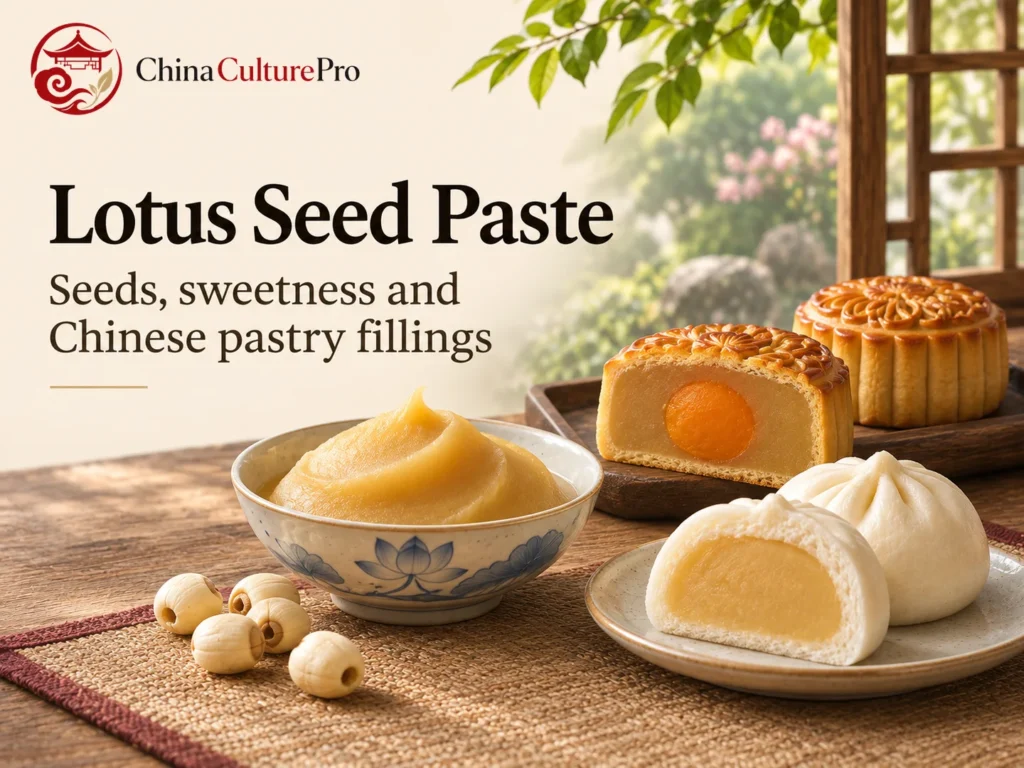

Quick Answer: What Is Lotus Seed Paste?
Lotus seed paste(莲蓉,liánróng)is a smooth, sweet filling made from cooked lotus seeds(莲子,liánzǐ), usually combined with sugar and fat. It belongs to the filling inside a pastry, rather than the dough surrounding it. [1][2][4]
- Base ingredient: The seeds come from the lotus plant’s above-water seed-bearing structure, not its underground rhizome.
- Texture: Cooked seeds are reduced to a fine paste that can become dense enough to shape.
- Flavor: Gentle seed flavor combines with sweetness and richness from the chosen sugar and fat.
- Variation: Pale, golden and blended products have different formulations; color alone does not explain the recipe.
A lotus-flavored pastry can contain other ingredients in its filling, wrapper or glaze. The paste’s name cannot identify the whole product. [2][3][7]

Cut open a Chinese pastry and the dense, golden layer may be lotus seed paste. Its smoothness comes from a series of changes to the seeds, not from grinding the familiar hole-patterned vegetable. Its dense texture also differs from a loose sweet soup or a plain seed puree.
From Lotus Seeds to a Smooth Filling
Lotus seed paste and lotus root share a plant, but not a plant part. The vegetable is an underground stem. Seeds develop above water and provide the base for the pastry filling. [1]
Preparation brings several distinct changes. Cooking softens the seeds, grinding removes the obvious grain structure, and further cooking with sweeteners and fat produces a smoother, more cohesive mass. These stages explain why simply crushing dry seeds does not create finished filling. [2][4]
The seed’s small green center is bitter and is removed in the documented sweet-paste preparations. Skinned seeds provide another useful distinction: their pale appearance is different from seeds that retain a reddish-brown outer skin. Neither the removed skin nor the bitter center is the same thing as the seed’s pale edible body. [2]
Sugar supplies sweetness, while fat changes richness and mouthfeel. Some preparations also use maltose syrup to help give the paste a smooth, rounded texture. A shapeable pastry filling contains less free water than an early, loose puree; the target is determined by its eventual use. [3][4]
White, Golden and Blended Lotus Pastes
White lotus paste(白莲蓉,bái liánróng)is a familiar name, but “white” does not mean sugar-free, fat-free or literally snow-white. A documented version made with skinned seeds still has a golden appearance once cooked with its other ingredients. [2]
Color can also come from the sugar treatment. Another original preparation caramelizes sugar to develop a deeper golden hue and a caramel note. A brown color alone cannot establish the full processing history, seed quality or exact flavor. [3]
Commercial labels introduce a separate issue. One product sold as “pure lotus paste” lists lotus seed, peanut and palm oil, and sugar. The word “pure” in that name clearly does not mean that the package contains nothing but seeds. [5]
A different labeled lotus paste includes white bean alongside lotus seeds, sweeteners and oil. That demonstrates the existence of blended fillings, not that every prepared paste contains beans. For a purchase, the current ingredient list is more informative than an assumption based on the front-of-pack name. [6]
How Chinese Pastries Use the Filling
Mooncakes(月饼,yuèbǐng) are a prominent use, especially around the 中秋節. Lotus paste buns(莲蓉包,liánróngbāo)offer another setting: the same category of filling sits inside a soft bun rather than a baked mooncake shell. [1][4][7]
| 部分 | Its role in the finished pastry |
|---|---|
| 蓮蓉 | Provides the dense, smooth, sweet center or surrounding filling layer. |
| Optional salted egg yolk | Adds a separate salty, crumbly center inside the paste. |
| Wrapper and finish | Supplies the outer texture and may introduce wheat, egg or other ingredients. |
In a documented Cantonese mooncake preparation, the paste is shaped around optional salted duck egg yolk, enclosed in dough, molded and baked. The yolk is an additional component, not something naturally present in lotus paste. The same preparation also includes plain-paste versions without yolk. [7]
A bun and a mooncake therefore should not be treated as identical merely because both contain lotus filling. The enclosing dough and finishing process change the bite, while the filling provides its own smooth contrast. Within traditional Chinese desserts, the paste is one material used in several finished forms. [4]
Choosing a Paste and Checking the Finished Pastry
First decide whether you are choosing a prepared filling or a completed pastry. A filling needs a suitable consistency for its intended wrapper. A finished pastry needs a separate check of crust, filling additions and surface finish.
For the paste, look at the listed seed base, any bean blend, sweeteners and fat. Published examples use vegetable oils, including peanut oil, while one home preparation explicitly offers lard. These are different formulations, not interchangeable dietary descriptions. [2][5][6]
Then check the rest of the pastry. A plant-based filling does not make an egg-washed, yolk-filled mooncake vegan. Likewise, a wheat-free paste does not remove wheat from a surrounding dough. Peanut-containing filling is another detail that cannot be judged from a smooth, uniform appearance. [5][7]
Color and sweetness preference can guide what you enjoy, but they do not replace those ingredient checks.
FAQs About Lotus Seed Paste
Is Lotus Seed Paste Made from Lotus Root?
No. It is made from the lotus plant’s seeds. Lotus root is the underground stem used as a vegetable, so a puree of that vegetable is a different ingredient.
Is White Lotus Paste Unsweetened?
No. White lotus paste can contain sugar and oil. The name does not promise an unsweetened product; check the ingredients of the particular paste.
Is Lotus Seed Paste Always Vegan?
No. Many versions use vegetable oil, but others use lard. Even when the paste is plant-based, the finished pastry may include egg yolk, egg wash or animal-derived ingredients elsewhere.
資料來源
[1] NParks. Nelumbo nucifera
[2] The Hong Kong Cookery. Homemade Lotus Seed Paste
[3] Maggie Zhu and Lilja Walter. Homemade Lotus Seed Paste
[4] Elaine. Lotus Seed Paste
[5] Bake King. Pure Lotus Paste: Original Product Ingredients
[6] Yau Brothers. Honor Lotus Seed Paste: Product Ingredients
[7] Elaine. Cantonese Mooncakes