

Quick Answer: What Is the Kangxi Dictionary?
The Kangxi Dictionary(康熙字典,Kāngxī Zìdiǎn)is a large Chinese character dictionary completed in 1716 under Qing imperial patronage. It gathers about 47,000 characters, with historical sound glosses, meanings and quotations from earlier writing.[1]
- Organization: Its 214 radicals(部首,bùshǒu)provide an indexing framework, rather than a list of all Chinese characters.[2]
- Reading task: Look up a written form, then distinguish pronunciation information from definitions and supporting quotations.
- Modern use: Consult it for historical character evidence, while checking which edition and digital additions you are using.
Use it for individual historical characters; consult a modern dictionary for present-day words and usage.
The character 林 is easy to recognize as two trees, but finding it in an old dictionary requires another kind of reading. A radical heading, a stroke group and a string of quotations all do different jobs. This guide follows one entry from lookup to interpretation, then separates the historical text from modern search aids.
A Qing Reference Compiled Under Imperial Patronage
The project was commissioned in 1710 and completed in 1716. Zhang Yushu and Chen Tingjing were leading editors in a larger scholarly undertaking. The emperor’s reign name identifies its patronage; it does not mean he personally composed every entry. The work is arranged in twelve major sections and exists in different printed editions.[1]
Its character-level focus matters when choosing a reference. An entry can supply readings, senses and examples from classical texts without explaining a present-day multi-character expression. If you want to know how a phrase functions in an ordinary conversation, a modern word dictionary answers a different question. The older compilation also contains errors: imperial sponsorship does not make every explanation conclusive.[3]
Use the dictionary when a historical form, an older meaning or a quoted source is the problem. For a first introduction to how the writing system works, start with the broader guide to Chinese characters. An entry’s cited evidence still needs interpretation after you recognize its head character.
Finding a Character by Radical and Remaining Strokes
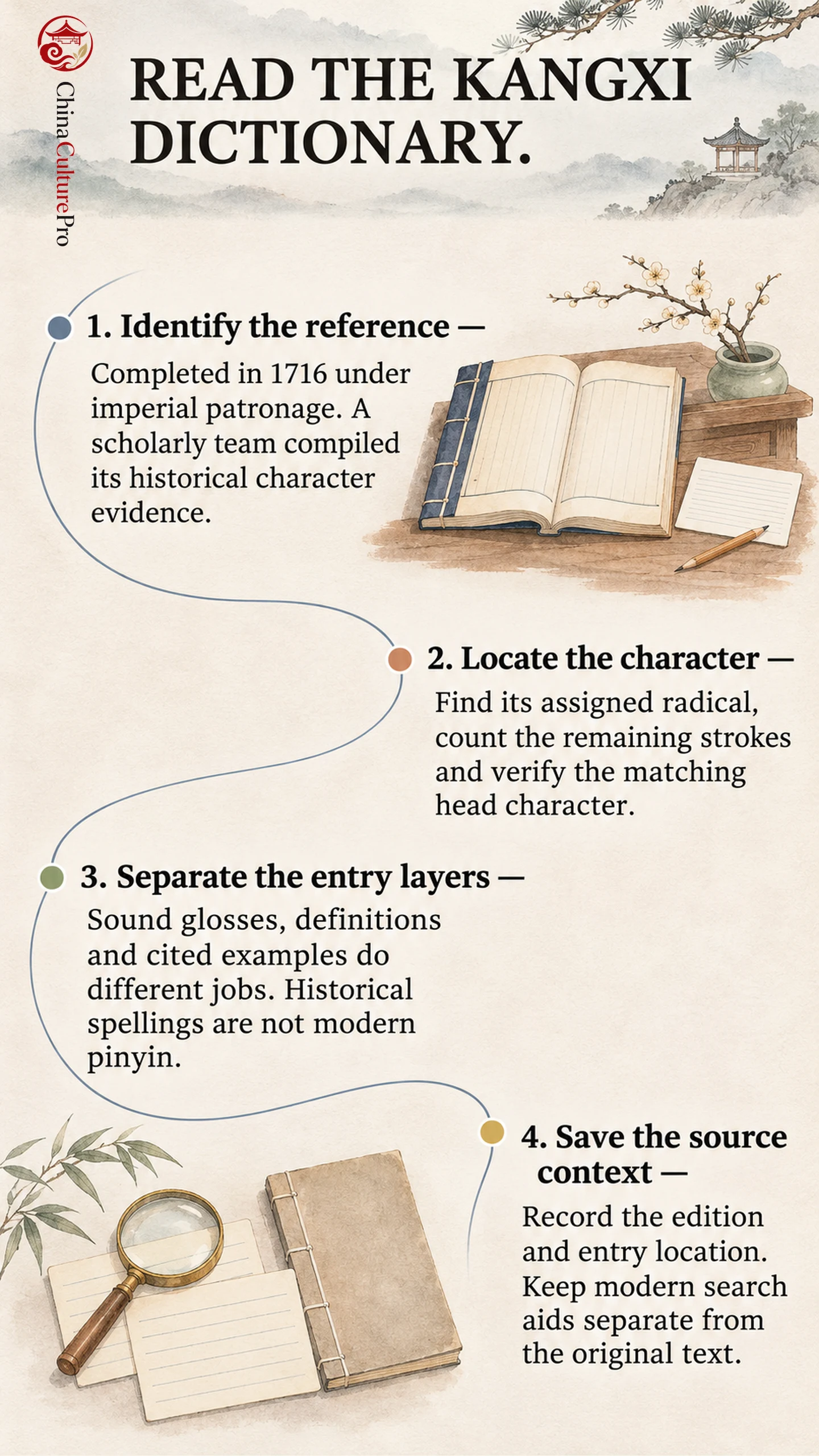
The arrangement groups characters by radical and then by strokes within that group. The radical headings themselves are ordered by stroke count. This makes the printed dictionary navigable without an alphabetical spelling, but it requires you to inspect the written form before searching.[4]
- Copy the form: Preserve the character as it appears in your source. Compare a modern or variant form separately. Do not assume that a modern simplified form is the head character used in the historical edition.
- Find the radical: Use the edition’s radical index to locate the assigned heading. A visually prominent component is a useful starting guess, but the index decides where that edition places the entry.
- Count the remainder: Count strokes outside the radical. This residual count is different from the total strokes in the whole character.[2]
- Verify the head character: Find the matching entry within that stroke group. Record the edition and its section or page before using the explanation in a translation or research note.
If the first search fails, revisit the form and the assigned radical. Repeating the same total-stroke search will not fix a residual-stroke mistake. The distinction between simplified and traditional Chinese is also relevant when a modern keyboard supplies a different form from the one on the historical page.
Reading the Lin Entry: Sounds, Meanings and Citations
林, read lín in modern Mandarin, appears under the wood radical 木 in the four-residual-stroke group. 木 has four strokes; the remaining part contributes another four. The whole character therefore has eight strokes. “Four strokes” in this section heading does not describe the whole written form.[5]
The entry opens with pronunciation evidence. It cites Tangyun(唐韻,Tángyùn)and gives 力尋切, followed by other cited rhyme books and sound glosses. This is fanqie(反切,fǎnqiè): a historical spelling method combining the initial of one character with the rhyme and tone supplied by another. It is not an instruction to splice the modern Mandarin pronunciations of those two characters together.[6] The guide to the Guangyun rhyme dictionary explains the related sound-reference tradition.
Next, distinguish the cited book from the content attributed to it. The reference to Shuowen Jiezi(說文解字,Shuōwén Jiězì)introduces an explanation of trees growing together on level ground. Other passages supply examples, additional uses or further readings. A marker such as 又 signals added material; its precise function depends on the passage. An opening sound gloss, a definition and a quotation are not three interchangeable translations of the character.[5]
For an initial reading, annotate those functions before attempting a polished translation: sound evidence, meaning, example and additional note. Leave uncertain details marked as uncertain. A familiar modern pronunciation can orient you, but it cannot decode every historical reference on its own.
Keeping Editions and Digital Fields Separate
A catalogue record describes a particular object, not every copy of the work. A later Japanese printing, for example, can belong to the Kangxi Dictionary tradition without being a physical book printed in 1716. Check the catalogue’s publication details as well as the title. The number of bound booklets is likewise a feature of the copy or edition being described.[7]
Digital fields need the same care. In Unihan, kRSUnicode records a radical number and an additional-stroke value. The kKangXi field instead points to a dictionary page and character position using a specified reference edition; its decimal-looking notation is not a stroke count or a pronunciation.[2]
Keep three layers in your notes: the original entry, the edition or transcription carrying it, and the modern explanation you used to understand it. A pinyin search box can help locate a character without making pinyin part of the original entry. The Lin passage above is cited from a digital transcription. Check a page image when the exact printed form is disputed. Save that image reference alongside your transcription so another reader can check your reading.
FAQs About the Kangxi Dictionary
Did the Kangxi Emperor write the dictionary himself?
No. He commissioned the project; a scholarly team compiled it under leading editors including Zhang Yushu and Chen Tingjing.
Are the 214 radicals all the characters in the dictionary?
No. They are indexing categories used to organize a much larger collection of characters.
Does the original Kangxi Dictionary use modern pinyin?
No. Pinyin on a search page is a modern aid. The historical entries use older sound-glossing methods.
Does a radical give the complete origin of a character?
No. An indexing assignment alone does not establish a character’s full graphic history or etymology.
資料來源
[1] 故宮博物院。 Kangxi Dictionary collection record
[2] Unicode Consortium. Unicode Standard Annex #38: Unicode Han Database
[3] Tokyo Metropolitan Library. Kangxi Dictionary digital showcase
[4] National Printing Bureau, Japan. Kangxi Dictionary collection essay
[5] Kangxi Dictionary. Wood radical, four additional strokes: digital transcription
[6] Guillaume Jacques. Introduction to Chinese Historical Phonology
[7] National Archives of Japan. Kangxi Dictionary catalogue record