

Quick Answer: What Are Suzhou Numerals?
Suzhou numerals(蘇州碼子,Sūzhōu mǎzi)are commercial number signs used in Chinese price marking and accounts.[1] They are also called huama(花碼,huāmǎ), a name familiar in Hong Kong contexts.[2]
- Identify the digits: Learn the signs for zero through nine, including variants of one, two and three.
- Check the unit: A second line can specify the place value of the leftmost digit.
- Keep the context: A price board, rent ledger and handwritten quantity need different supporting information.
Recognizing the marks is only the first step. Copy the full label before turning it into an Arabic-digit amount.
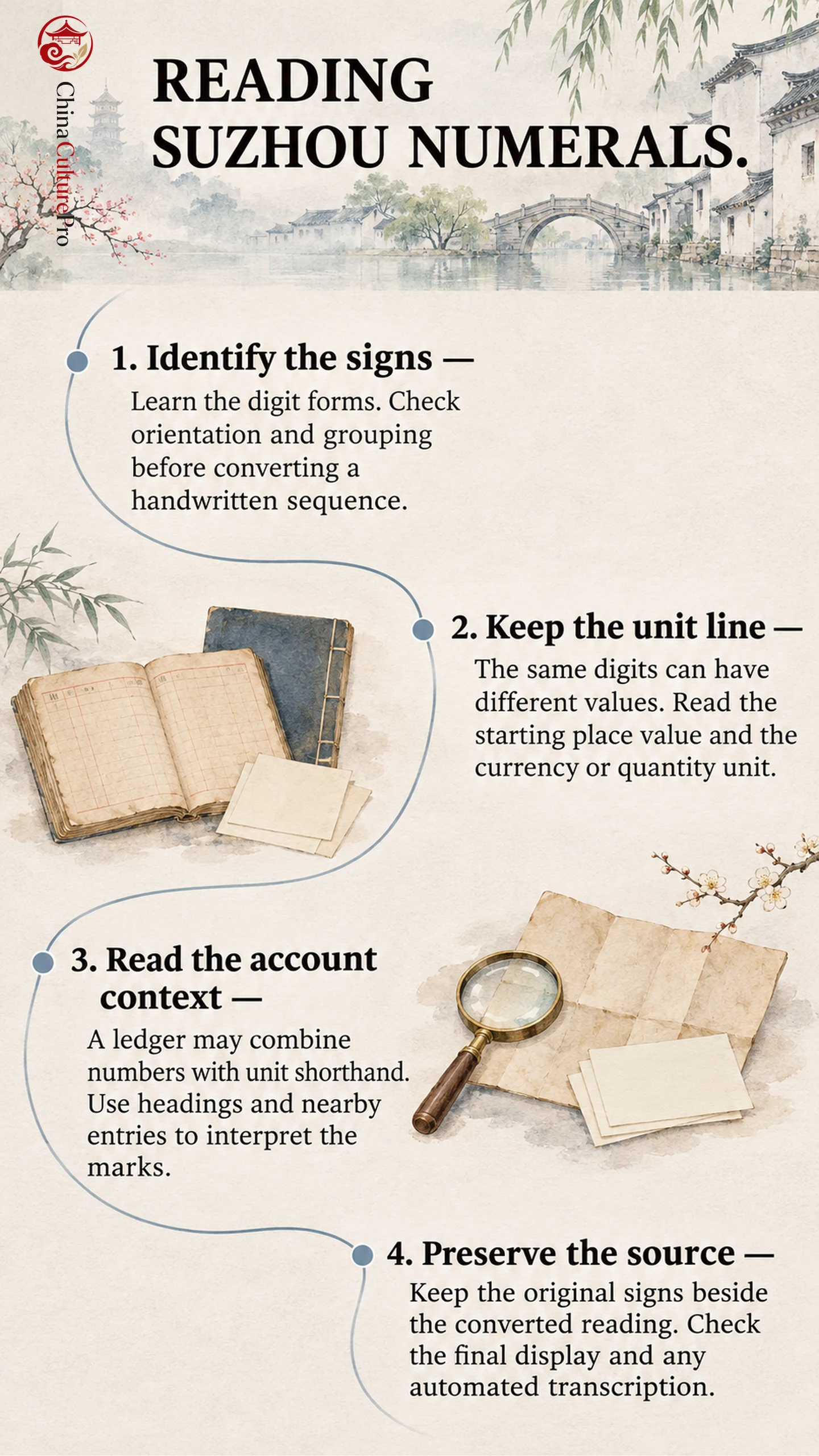
A handwritten price board may contain familiar Chinese words beside unfamiliar strokes. Those marks can be numerals rather than an obscure alphabet. Learning their values helps, but the smaller unit line is just as important: the same sequence can describe different amounts when its starting place value changes.
Recognize the Digits and Their Variants
Start with this reference set. The circular zero is 〇; the nine special forms run from 〡 through 〩. The alternatives shown for the first three values occur in descriptions of the system.[1][2]
| Value | Numeral forms |
|---|---|
| 0 | 〇 |
| 1 | 〡 or 一 |
| 2 | 〢 or 二 |
| 3 | 〣 or 三 |
| 4 | 〤 |
| 5 | 〥 |
| 6 | 〦 |
| 7 | 〧 |
| 8 | 〨 |
| 9 | 〩 |
One, two and three have both upright and horizontal forms. Thomas Emerson’s investigation of the notation documents those variants.[3] When several short stroke signs stand together, inspect their orientation and grouping before counting individual lines. Three adjacent strokes might need to be understood as grouped digits, not automatically as one numeral three.
Use the printed chart to begin identifying handwritten signs. Preserve visible gaps and compare repeated signs on the same page. Do not turn every cross, dot or circle in an account into a digit without checking its position and surrounding notation. A blot, punctuation mark or unit abbreviation can occupy the same small area of a photograph.
Read the Unit Before Assigning a Price
In the common two-line price layout, the lower line identifies the place value assigned to the leftmost numeral.[2] A 2016 Hong Kong report illustrates the consequence with 〡〤〨, the digits 1, 4 and 8:[4]
- With 百元 below: The first digit occupies the hundreds place, giving 148 dollars in the report’s Hong Kong setting.
- With 十元 below: The first digit occupies the tens place, giving 14.8 dollars in the same setting.
These are notation examples, not current menu prices. The written 元 must be read in its currency context, rather than automatically treated as renminbi. The digit row is unchanged; the unit line changes the scale. A cropped image that preserves only 〡〤〨 has lost information needed for the amount.
Use this reading procedure:
- Capture the complete label. Keep both lines and any adjacent currency, weight or product description in the photograph or transcription.
- Identify the digit sequence. Match the marks to their values, keeping their left-to-right order and any visible zero.
- Find the starting place value. Read the unit information before placing a decimal point or assigning a currency amount.
- Record the interpretation separately. Preserve the original notation beside your normalized reading. If a unit is missing or uncertain, mark that uncertainty instead of silently filling it in.
A label may describe a quantity rather than a price. Reading a number correctly does not by itself identify the commodity, currency or unit of sale.
A Commercial Notation With Wider Archival Uses
The notation belongs to a history of practical number writing connected with counting-rod forms. It was not confined to restaurant menus. Qiu Jianli and Li Xuechang’s archival study examines handwritten rent records from the Suzhou and Shanghai region and distinguishes the numeral signs from additional shorthand for units.[5]
Their subject, huashu(花數,huāshù), includes both numbers and abbreviated forms for land area, grain capacity and money. Reading such a page therefore requires more than replacing each mark with a digit. A compact sign can belong to the measurement system or be joined to the preceding writing. The authors treat this as bookkeeping shorthand, rather than an inherently secret code.[5]
Keep that distinction when approaching an old ledger. First identify the column’s function. A rent amount, a date and a land measurement may use nearby marks for different purposes. Compare the headings, repeated entries and totals before deciding what a single sign represents.
The link with older calculation traditions also does not make every counting-rod symbol interchangeable with a Suzhou numeral. For the broader background, see Chinese mathematics history. This page teaches a practical reading route, rather than assigning one inventor or one exact year to a notation that developed through transmission and use.
Unicode Names, Fonts and Digital Transcription
Unicode encodes these signs, but its character names can mislead a search. For example, 〡 is U+3021, named HANGZHOU NUMERAL ONE; the current names list explicitly calls “Hangzhou” a misnomer. The standard also distinguishes these commercial forms from the more elaborate Chinese accounting characters used to deter alteration.[1]
Emerson’s 2000 report investigated that naming problem and found references to Suzhou, while reporting no documentary basis for the Hangzhou designation.[3] The encoded name is not evidence that the system originated in Hangzhou.
Handwritten recognition remains a separate problem from having encoded characters. A 2025 study by Ting-Lin Wu and colleagues introduced 773 expert-annotated samples from late Qing trade ledgers and tested a handwriting-recognition baseline.[6] That specific dataset does not establish perfect automatic reading of an unfamiliar account.
When making a digital transcript, retain the source image and check the displayed glyphs in the final document. Keep the original signs separate from converted amounts so a later reader can review both the digit identification and the unit interpretation. The Chinese characters guide gives the wider writing-system context.
FAQs About Suzhou Numerals
Are Suzhou numerals the same as financial Chinese numbers?
No. They are commercial number signs. Formal accounting characters such as 壹 and 貳 are a different way of writing numbers.
Why do one, two and three have different orientations?
Horizontal alternatives accompany the upright stroke forms. Pay attention to grouping when reading neighbouring signs.
Can I determine a price from the digit row alone?
Not reliably when the layout relies on a separate place-value or unit line. Preserve the complete label.
Why does Unicode call them Hangzhou numerals?
“Hangzhou” remains in encoded character names, but the standard identifies it as a misnomer. It is not proof of the notation’s origin.
資料來源
[1] Unicode Consortium. The Unicode Standard 18.0, chapter 22: CJK Numerals
[2] Words.hk. 花碼
[3] Thomas Emerson. On the “Hangzhou-style” Numerals in ISO/IEC 10646-1
[4] on.cc original reporting. 搜查線:〡〤〨傳統花碼字 你又識幾多?
[5] Qiu Jianli and Li Xuechang. 并不神秘的民间速记文字——“花数”
[6] Ting-Lin Wu and colleagues. Bringing Suzhou Numerals into the Digital Age: A Dataset and Recognition Study on Ancient Chinese Trade Records