


Quick Answer: What Does Inscription on the Wall at Xilin Mean?
Inscription on the Wall at Xilin (題西林壁, Tí Xīlín Bì), by Su Shi (蘇軾, Sū Shì), connects changing views of Mount Lu (廬山, Lúshān) with the difficulty of grasping a whole from within it.[1]
- Scene: Ridges and peaks appear different as the observer changes position.
- Limit: Even many views do not give the speaker an unquestioned understanding of the mountain’s entire form.
- Reflection: The final line locates that limit in the observer’s own situation.
The poem invites awareness of perspective. It does not establish that an outsider automatically knows everything an insider cannot see.
A mountain can look like a long ridge from one direction and a steep peak from another. This poem begins with that ordinary experience, then turns the observer into part of the problem: the person trying to understand the mountain is standing within it.
The Complete Poem and an English Sense Translation
This seven-character quatrain (七言絕句, qīyán juéjù) contains four lines and 28 Chinese characters. The following original English rendering follows the sense without reproducing the rhyme.[1]
| Chinese text | 大意 |
|---|---|
| 橫看成嶺側成峰, | Seen broadside, a ridge; from the side, a peak. |
| 遠近高低各不同。 | Far or near, high or low, each view differs. |
| 不識廬山真面目, | I do not grasp Mount Lu’s full face— |
| 只緣身在此山中。 | precisely because I am here within this mountain. |
The work belongs to the poet’s 1084 visit to the mountain in Jiangxi. Its title refers to writing on a wall at Xilin Temple (西林寺, Xīlín Sì), on the mountain’s northwestern slopes.[2] The Su Shi profile offers the wider author context.
One Mountain, Several Ways of Seeing
The first line contrasts two visible forms. A ridge extends across the view; a peak stands out more sharply. The mountain has not transformed into a different object. Its appearance changes in relation to the person looking.
The second line adds distance and height. Nearness may reveal detail while hiding extent; distance may reveal an outline while losing detail. A higher position and a lower one provide further differences. Read as a sequence, the opening expands the number of possible encounters with the same place.
This matters because the first couplet is more than scenery before a philosophical quotation. It supplies the experience that makes the final couplet persuasive. Without those changes of view, the ending would lose its concrete mountain and become a general saying detached from observation.
Why Being inside the Mountain Limits the View
The third line creates a surprise. After so much looking, the speaker admits not knowing the mountain’s full face. The fourth line explains why: the observer is situated within the very thing being observed.
“Face” gives the landscape a recognizable whole without saying that the mountain is literally a person. The difficulty is relating partial appearances to that whole. A close view can be vivid and accurate while remaining incomplete.
The ending does not describe a final ascent to a position from which everything becomes visible. Nor does it provide instructions to leave the mountain and declare the problem solved. Its achievement is self-recognition: the speaker understands something about the limits of his own seeing.
Applied beyond landscape, that distinction encourages a useful question: what does my position let me notice, and what might it hide? The poem supports that reflection without claiming that all judgments are equally well founded.
The Visit to Xilin and the Question of Buddhist Meaning
In his own note about visiting the mountain, the poet recalls initially intending not to write verse because the scenery overwhelmed him. He nevertheless composed poems and places the Xilin quatrain at the end of his account.[3] The reflection thus belongs to an extended encounter with the landscape.
The temple setting also invites comparison with Chan (禪, Chán) Buddhism. One scholarly reading by Wu Xiaoman argues that the closing admission expresses the poet’s recognition of his own way of engaging with life, rather than a straightforward certification of Buddhist enlightenment.[4]
That is an interpretation, not the only permissible meaning. The Chan Buddhism guide provides context for the tradition, while the poem itself remains readable through its plainly stated relation between landscape and observer.
How to Read from Changing Views to Self-Recognition
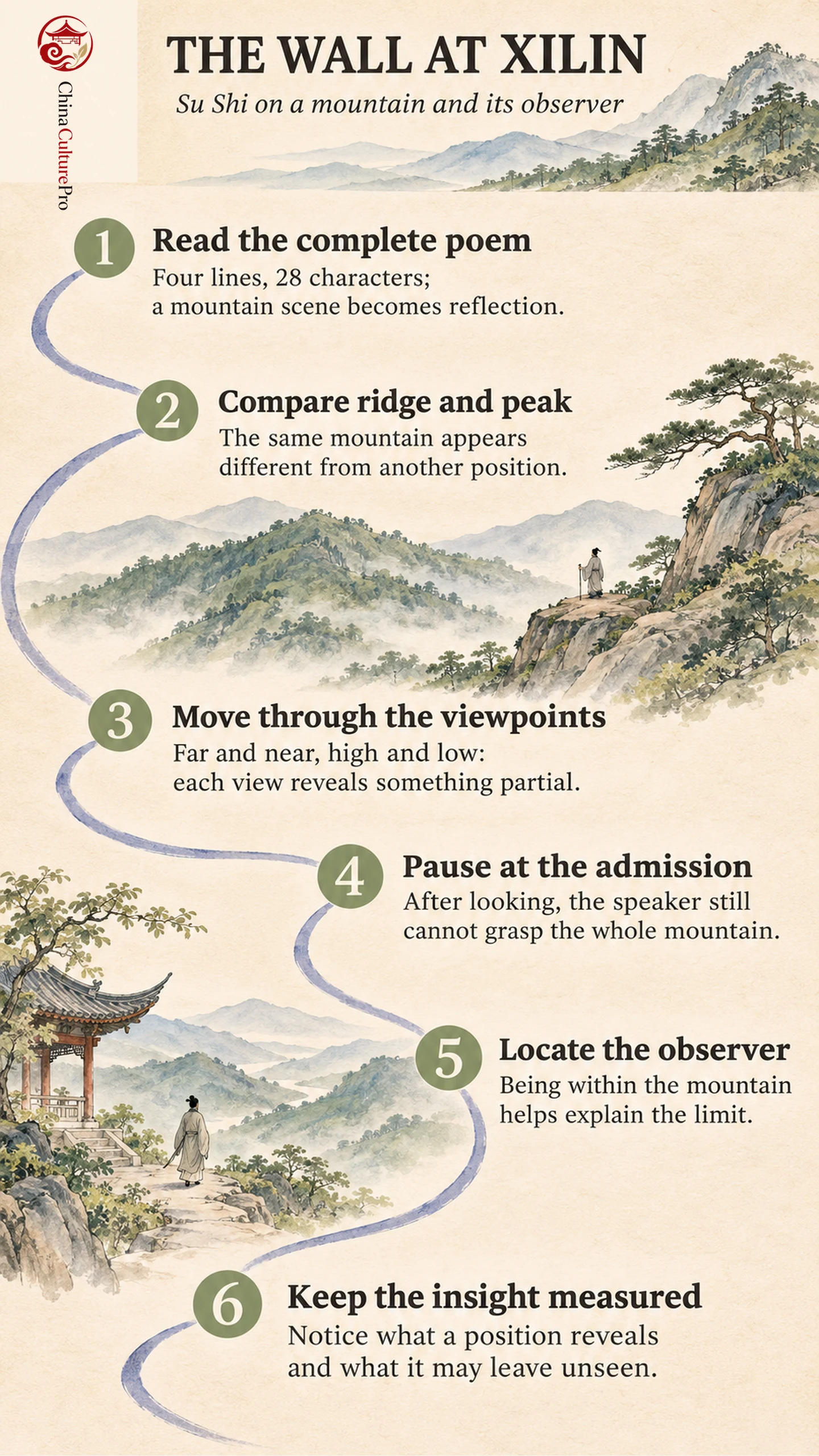
- Picture ridge and peak separately: Notice how two positions organize the same mountain differently.
- Vary distance and height: Follow the opening’s movement instead of settling on one imagined viewpoint.
- Pause at the admission: Let the third line unsettle the expectation that extensive looking guarantees complete knowledge.
- Return to the observer’s position: Ask how the final explanation changes the act of looking described at the beginning.
The Chinese poetry collection offers other poems in which a change of scene becomes a change of understanding.
FAQs About Inscription on the Wall at Xilin
What does Xilin mean in the title?
It refers to Xilin Temple, often rendered in English as West Forest Temple or West Grove Temple. “Inscription” identifies the act of writing a poem on its wall.[2]
Is this a Tang dynasty poem?
No. Its author was a Northern Song writer, and the mountain visit associated with the work took place in 1084. A four-line classical form does not make a poem automatically Tang.[2]
Does the poem say that every opinion is equally true?
No. It shows that an observer’s position affects what can be seen and that partial views can fall short of complete understanding. It does not claim that every interpretation has equal evidence.[1]
資料來源
[1] Su Shi. Inscription on the Wall at Xilin: classical text
[2] Hong Kong Education Bureau. 題西林壁: text, setting and lexical notes
[3] Su Shi. Note on Visiting Mount Lu: classical prose account
[4] Wu Xiaoman. Su Shi’s Journey to Mount Lu and His Non-Enlightenment: research article and abstract