
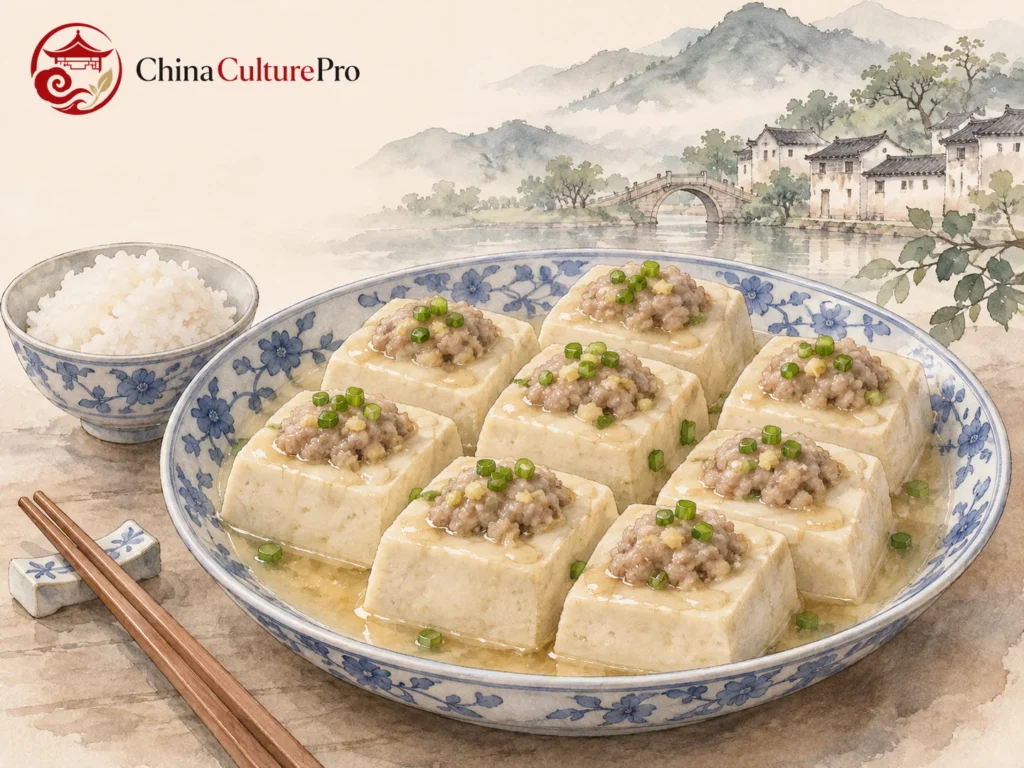

Quick Answer: What Is Hakka Stuffed Tofu?
Hakka stuffed tofu (客家酿豆腐, Kèjiā niàng dòufu), often written yong tau foo, fills tofu (豆腐, dòufu) with a savoury meat mixture. Pork, sometimes combined with seafood, is common in Hakka preparations.[3][4]
- Firm tofu is a practical choice for a first attempt; soft tofu takes more delicate handling.[5]
- Steaming, pan-frying followed by braising, and cooking in broth are all established approaches.[3]
- This recipe steams pork-filled tofu, then adds gravy.[1]
This is one home version, with a comparison of methods and regional variations rather than a claim that every family cooks it alike.

The aim is to keep the tofu intact while cooking its filling through. Choose your tofu and cooking route together: the measured recipe below does not require a frying stage before steaming.
Hakka Roots and Regional Variations
In Hakka cuisine, the culinary verb niang (酿, niàng) describes stuffing one ingredient with another. Tofu is one example; bitter melon, chilies, mushrooms and eggplant can also hold savoury fillings.[3]
A familiar origin story links stuffed tofu to migrants replacing northern dumpling wrappers when wheat flour was scarce. Treat this as a traditional explanation, without assigning an invention date or a named inventor.[4]
In Singapore, the name covers a broader hawker selection: vegetables such as bitter gourd and eggplant often join tofu, and fish paste frequently replaces pork. These are variations within a continuing food tradition, not evidence that pork-filled versions are incorrect.[4]
Choose a Cooking Method
The following cooking methods give different serving styles:
- Steamed: Filled tofu cooks on a plate above simmering water; a separate gravy can finish it.[1]
- Pan-fried and braised: Brown the filled pieces, then simmer them in sauce. Mushroom and dried-seafood fillings are one variation.[2]
- Broth pot: Pan-fried stuffed tofu can finish over Chinese cabbage in broth, producing a soupy shared dish.[5]
Choose one route. The browning step belongs to the latter two examples, not to the steamed recipe below.
Ingredients for Steamed Stuffed Tofu
Serves two with rice.[1]
- Tofu and filling: 450 g firm tofu; 85 g ground pork; 28 g salted fish (咸鱼, xiányú), optional; 1 teaspoon minced ginger; 2 teaspoons Shaoxing wine (绍兴酒, Shàoxīng jiǔ); ⅛ teaspoon white pepper; ¼ teaspoon salt.[1]
- Gravy and garnish: 1 tablespoon oyster sauce (蚝油, háoyóu); 1 teaspoon dark soy sauce (老抽, lǎochōu); 1 scallion; 60 ml steaming juices, topped up with water as needed.[1]
- Separate slurry: 1 tablespoon cornstarch plus 1 tablespoon cold water; use as needed.[1][2]
How to Stuff, Steam and Sauce the Tofu
- Prepare tofu pockets. Cut 5 cm squares, 2 cm thick; scoop 1 teaspoon from each, leaving the base intact.[1]
- Combine the filling. Mince pork, ginger and skinned salted fish, if using; mix with scooped tofu, wine, pepper and salt. Fill pockets.[1]
- Steam the tofu. Set filled pieces on a heatproof plate over simmering water; cover. Start checking at 10 minutes; continue until filling centres reach 165°F/74°C.[1][6]
- Make the gravy. Simmer 60 ml juices with oyster sauce and dark soy. Restir slurry; add gradually until lightly coating. Pour over tofu; garnish with chopped scallion.[1][2]
Use a thin food-thermometer probe in the filling, not just in the surrounding hot tofu. The 165°F/74°C target follows guidance for meat-containing stuffing; the timer is a guide rather than the final check.[6]
FAQs About Hakka Stuffed Tofu
Can I use soft or silken tofu?
Softer tofu is used by experienced cooks, but breaks more easily during hollowing and filling. Begin with firm tofu and a shallow pocket; the tofu types guide helps identify the block you are buying.[5]
Is salted fish necessary?
No. Omit it if preferred; pork and oyster sauce remain.[1]
Why is my gravy too thick?
The prepared slurry is a supply, not an instruction to use it all. Add it gradually and stop when the gravy lightly coats the tofu.[2]
How should I store and reheat leftovers?
Refrigerate in shallow containers within 2 hours, or 1 hour above 90°F/32°C. Keep at 40°F/4°C or colder for 3–4 days; reheat to 165°F/74°C.[7]
資料來源
[1] Bill Leung. Hakka Style Chinese Stuffed Tofu
[2] School of Wok. Hakka Stuffed Tofu (Yong Tau Foo)
[3] Linda Lau Anusasananan. Hakka Classic: Stuffed Tofu
[4] The Nutgraf Editorial Team. Hakka Food in Singapore
[5] Ying Chen. Yong Tau Foo (Hakka Stuffed Tofu)
[6] U.S. Food and Drug Administration. Food Code 2022, Section 3-401.11(A)(3)
[7] U.S. Department of Agriculture. How Do I Handle Leftovers Safely?