


Quick Answer: Who Was Haizi?
Haizi (海子, Hǎi Zǐ; 1964–1989), also written Hai Zi, was a Chinese poet from rural Anhui. He wrote short lyrics, long poems and verse dramas, repeatedly returning to rural life and human connection. [1]
- Begin with the sea-facing poem to notice how wishes and blessings change their addressee.
- Read the Delingha poem beside the wheat-field poem for different relationships between solitude and imagined company.
- Try a translated poem built around a sunlight refrain to hear repetition at work.
These poems offer different entries into a career whose ambitions extended well beyond one famous closing image.
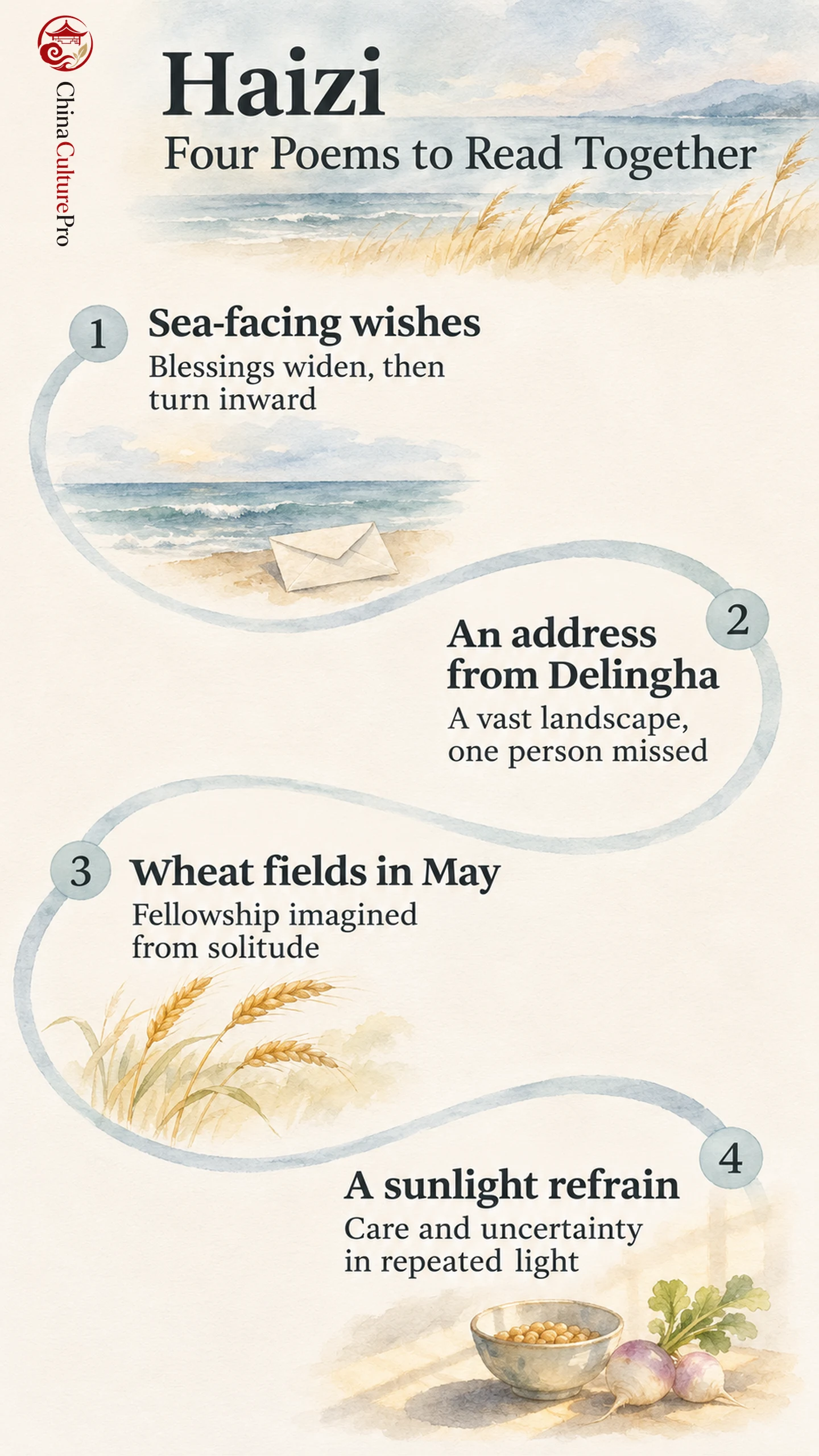
A field can hold an imagined gathering, while a vast landscape can sharpen an address to one absent person. Haizi repeatedly joins ordinary things with large desires: food and shelter, belonging and distance, the individual and a human community. Reading complete poems makes those relationships more visible than an isolated inspirational line can.
Rural Origins and an Ambitious Poetic Career
After studying law at Peking University, Haizi began work at China University of Political Science and Law in 1983, editing and later teaching philosophy and art theory. Rural memory and intensive reading shaped his background. [1]
His ambitions in modern Chinese literature extended to long, mythic works alongside the lyrics. He died by suicide in 1989. [1]
Four Poems to Read Together
- Facing the Sea, with Spring Blossoms: This poem (面朝大海,春暖花开, Miàn Cháo Dàhǎi, Chūn Nuǎn Huā Kāi) begins with a desired future of happiness, practical tasks and attention to food. Its address widens through letters to loved ones and blessings for strangers. At the end, the speaker returns to a personal wish for the sea-facing scene. Notice the difference between the happiness wished for others and the final wish retained by the speaker. [2]
- Diary: This poem (日记, Rìjì), often identified by its opening address from Delingha, repeatedly turns toward a person called sister. The Gobi landscape, empty hands and a sense of isolation surround that address. Its ending moves from a concern with humanity at large to the particular person missed. Read how the repeated address gives the broad landscape an intimate centre. [3]
- Wheat Fields in May: This poem (五月的麦地, Wǔyuè de Màidì) imagines brothers from different directions embracing in the fields and reciting poetry. Against that gathering stands a solitary speaker who dreams of the brothers and recites for them. The field holds a desire for fellowship as well as the fact of being alone. Keep both positions in view when reading the poem’s collective language. [4]
- Song: Light Strikes the Ground: In Ye Chun’s English translation of this poem (歌:阳光打在地上, Gē: Yángguāng Dǎ Zài Dìshàng), a repeated sunlight refrain surrounds questions of bodily pain, traces of past activity and an imagined scene of feeding daughters. Vegetables and simple utensils make care tangible, while the speaker’s conditional language keeps happiness uncertain. Follow what accumulates between returns of the refrain. [5]
Who Is Being Addressed, and What Does the Image Do?
The sea-facing poem changes its circle of address. A proposed personal life expands toward relatives and strangers, then narrows again at the end. Its generous blessings and its separate closing wish can be held together without making them say exactly the same thing. [2]
Compare the scale of the addressee: the Delingha poem concentrates a vast landscape on one person; the wheat-field poem imagines a wider fellowship from solitude. In each, place shapes a relationship. [3][4]
In the translated sunlight poem, the refrain returns around memories, questions and imagined care. The repeated words hold the poem together while the material between them changes. Reading it aloud makes that pattern easier to hear. [5]
For an introduction to Chinese poetry, ask two connected questions: who receives the words, and how does a recurring object change the relationship? A wheat field may carry fellowship in one poem; light may bring warmth and discomfort into the same scene. The particular poem determines the image’s work.
English Selections and Free Reading
Over Autumn Rooftops, translated by Dan Murphy and published by Host Publications, offers an English selection of Haizi’s work. [6]
Ripened Wheat: Selected Poems of Hai Zi is Ye Chun’s bilingual selection, published by The Bitter Oleander Press in 2015. It was shortlisted for ALTA’s 2016 Lucien Stryk Asian Translation Award. [1][7]
For a free sample, Cerise Press publishes the complete English sunlight poem with Ye Chun’s translator credit. Read its repeated phrase and its changes of scene before looking for a single summary of its meaning. [5]
A selection provides a route through the poet’s work. It does not stand for all the long poems, verse dramas and prose he wrote. Use an edition’s contents and introduction to see which part of that range it represents.
FAQs About Haizi
Does the sea-facing poem describe a house he owned?
The house belongs to a poem organised around wishes and a future life. The text alone does not establish that Haizi owned such a house. Its closing scene should first be read within that poetic structure. [2]
Is the Delingha poem a factual travel diary?
Its title invites a personal frame, but its repeated address and compressed landscape form a crafted lyric. Those words alone cannot settle the addressee’s real identity or make every image a documentary record. [3]
Was Haizi only a poet of rural scenery?
He also wrote long poems and verse dramas. His rural images can carry concerns about belonging, human connection and poetic ambition. [1]
資料來源
[1] Ye Chun. Ripened Wheat: Publication Details and Translator’s Introduction
[2] Haizi, Chinese text hosted by Shanghai Ocean University. Facing the Sea, with Spring Blossoms
[3] Haizi, Chinese text in the Beichen Literary Society annual, Daqing Normal University. Diary: Complete Poem
[4] Haizi, Chinese text published by Asymptote. Four Poems: Wheat Fields in May
[5] Haizi, translated by Ye Chun, Cerise Press. Song: Light Strikes the Ground
[6] Host Publications. Over Autumn Rooftops: Dan Murphy Translation
[7] American Literary Translators Association. 2016 Lucien Stryk Shortlist: Ripened Wheat