


Quick Answer: Where Should You Start with Yuan Haowen?
Yuan Haowen (元好问, Yuán Hàowèn; 1190–1257) is a major poet of the Jin–Mongol transition. Start with his lyric about geese, then compare poems of wartime suffering, verse criticism and his work preserving other writers.
- For emotion: Follow the movement from paired flight to solitary loss and remembrance.
- For history: Notice hunger, interrupted communication and the speaker’s sense of responsibility.
- For literary judgment: Compare what he praises in a poem with what he chooses to preserve.
He wrote across a dynasty’s collapse and its aftermath. Neither one love quotation nor one political label explains the whole body of work.
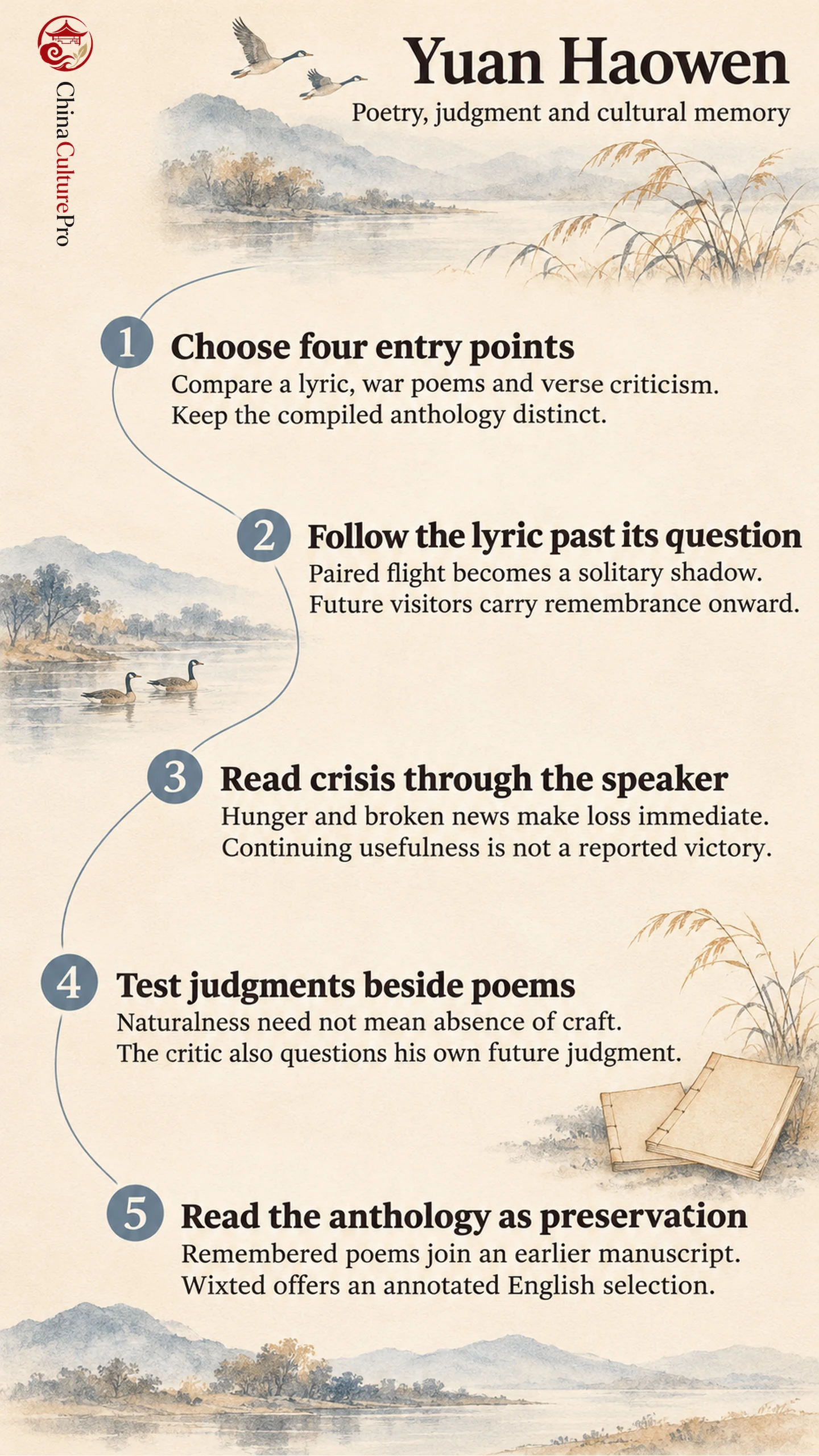
Yuan’s writing asks what can survive when familiar relationships, institutions and cultural records become vulnerable. Sometimes the answer takes the form of a remembered pair of birds; elsewhere it is an anguished poem or an anthology assembled against loss.
Place Yuan Haowen and Choose Four Entry Points
His historical setting is the Jurchen Jin dynasty of northern China, which ended in 1234 during the Mongol conquest. His life continued into the period of Mongol rule. Poems of disorder and the preservation of cultural memory are central to his reputation. [1] The Chinese history guide offers a broader timeline without confusing this Jin with the much earlier dynasty of the same English name.
He wrote both verse poems and ci (词, cí), lyrics composed to established tune patterns. These entry points introduce different literary jobs.
| Work | Kind of writing | First reading question |
|---|---|---|
| Goose Mound Lyric (雁丘词, Yàn Qiū Cí), to Moyu Er (摸鱼儿, Mō Yú Ér) | Tune-pattern lyric | How does loss become an occasion for remembrance? [2] |
| Poems after the Imperial Carriage Went East (壬辰十二月车驾东狩后即事五首, Rén Chén Shí Èr Yuè Chē Jià Dōng Shòu Hòu Jí Shì Wǔ Shǒu) | Five wartime poems | What remains possible for a powerless witness? [3] |
| Thirty Poems on Poetry (论诗三十首, Lùn Shī Sān Shí Shǒu) | Critical quatrains | What makes inherited language feel alive? [4] |
| Zhongzhou Ji (中州集, Zhōng Zhōu Jí) | Anthology he compiled | Whose writing is being saved? [6] |
Read the Goose Mound Lyric beyond Its Opening Question
The preface recounts meeting a hunter who described one goose dying after its companion was killed. Yuan says he bought and buried the birds; he also explains that the lyric revises an earlier version. Read this as the work’s narrated occasion, rather than an independently established law of animal behaviour. [2]
The famous question about love opens a larger progression. Shared flight through changing seasons gives way to an isolated shadow facing immense cloud and mountain landscapes. Later, vanished music and weather-darkened mourning expand the scene beyond the pair. The ending imagines future poets visiting the mound. [2]
The lyric therefore turns a private loss into a place that future poets are imagined visiting. Read through to that future audience instead of stopping at its opening line. The Song ci guide explains the tune-based form also used beyond the Song dynasty.
Hear Public Crisis in the Poems of Imperial Flight
In the five-poem sequence, siege, hunger and broken correspondence bring political collapse close to the body. The third poem joins starvation with the failure of distant news. Its waiting gaze matters as much as the military background: the speaker cannot repair the situation simply by describing it. [3]
The fourth moves from a war-torn landscape and thorns outside the capital toward an uneasy declaration that the speaker is still needed. The change matters: grief does not end in a reported victory. It produces a claim to continuing usefulness amid destruction. [3]
Read these as crafted responses to events, with compressed images and inherited references, rather than unmediated newspaper reports. For the images that carry earlier political and literary meanings, the literary allusions guide provides a useful method: establish the immediate scene, then ask what the borrowed reference adds.
Read Thirty Poems on Poetry as Criticism in Verse
These thirty quatrains evaluate earlier poets through memorable comparisons and judgments. The fourth praises the lasting freshness of apparently natural language in Tao Yuanming’s poetry. The eleventh connects sight and inward response, contrasting that encounter with blind imitation; its painting comparison questions how a convincing landscape can emerge without real knowledge of place. [4]
The closing quatrain turns judgment back upon the critic: who will later assess his own poems? That self-question prevents the sequence from functioning only as a list of winners and losers. [4]
Try reading one critical quatrain beside a poem by the writer it discusses. Ask which feature the judgment highlights and what it leaves out. Yuan’s anthology also preserves writers with diverse styles, so his criticism should not become a blanket claim that all Jin poetry rejects ornament or complexity. [5]
Distinguish the Anthologist from the Author
Zhongzhou Ji gathers earlier and contemporary poets’ work. Its preface recalls a project delayed by siege, poems remembered after dispersal, and the arrival of an earlier manuscript that could be combined with Yuan’s own gathering. Compilation becomes a practical response to the threat of disappearance. [6] Its biographical notices also carry literary judgments. [5]
For Yuan’s own writing, look for his collected works under Yishan Ji (遗山集, Yí Shān Jí); do not assume every poem in the anthology is his. Keep the author, compiler and subject of a biographical notice distinct in your notes.
For an English route, John Timothy Wixted’s The Poetry of Yuan Haowen: Introduced, Interpreted, Explicated presents 150 selections with Chinese text, romanization, translation and commentary. It is a substantial selection rather than the complete corpus. [1] The Chinese classic books guide helps compare such annotated editions. Read one complete poem with its notes, then use the Chinese poetry guide to explore its form and wider connections.
FAQs About Yuan Haowen
Was Yuan Haowen a Yuan-dynasty poet?
He is especially associated with the Jin dynasty and its fall, then lived under Mongol rule. His surname Yuan is not a reason to classify his whole career under the later Yuan dynasty.
Is Zhongzhou Ji a collection of his own poems?
It is an anthology he compiled to preserve earlier and contemporary writers. His collected works and his editorial work are different reading projects.
Does Goose Mound Lyric describe a verified rule about geese?
No. Its preface presents a reported incident that becomes the occasion for a lyric. The poem explores attachment, loss and remembrance rather than establishing animal behaviour.
資料來源
[1] John Timothy Wixted, Chinese University of Hong Kong Press. The Poetry of Yuan Haowen: Introduced, Interpreted, Explicated
[2] Yuan Haowen, via Wikisource. Moyu Er: Goose Mound Lyric
[3] Yuan Haowen, via Wikisource. Five Poems after the Imperial Carriage Went East in the Twelfth Month of the Renchen Year
[4] Yuan Haowen, via Wikisource. Collected Works, Volume Eleven: Thirty Poems on Poetry
[5] Xiuyuan Mi, Sino-Platonic Papers. Naturalness versus Novelty: The Ideal of Poetry in the Late Jin Dynasty
[6] Yuan Haowen, via Shidian Guji. Preface to Zhongzhou Ji