


Quick Answer: What Defines Guizhou Cuisine?
Qian cuisine (黔菜, Qiáncài) is a broad name for Guizhou’s local cooking and community food traditions. Sour flavors and varied chili preparations are important associations, with substantial differences between dishes and places.[1][2]
- Sourness: Fermented grain or vegetable preparations contribute flavors distinct from simply adding vinegar.
- Chili: Different processing methods produce separate ingredients and aromas, rather than one universal chili sauce.
- Meals: Shared fish pots, individual noodle bowls, vegetable wraps and tofu snacks offer different eating formats.
Guizhou is outside the conventional 中國八大菜系 list. Its local traditions are not adequately explained as a variation of one neighboring province’s food.
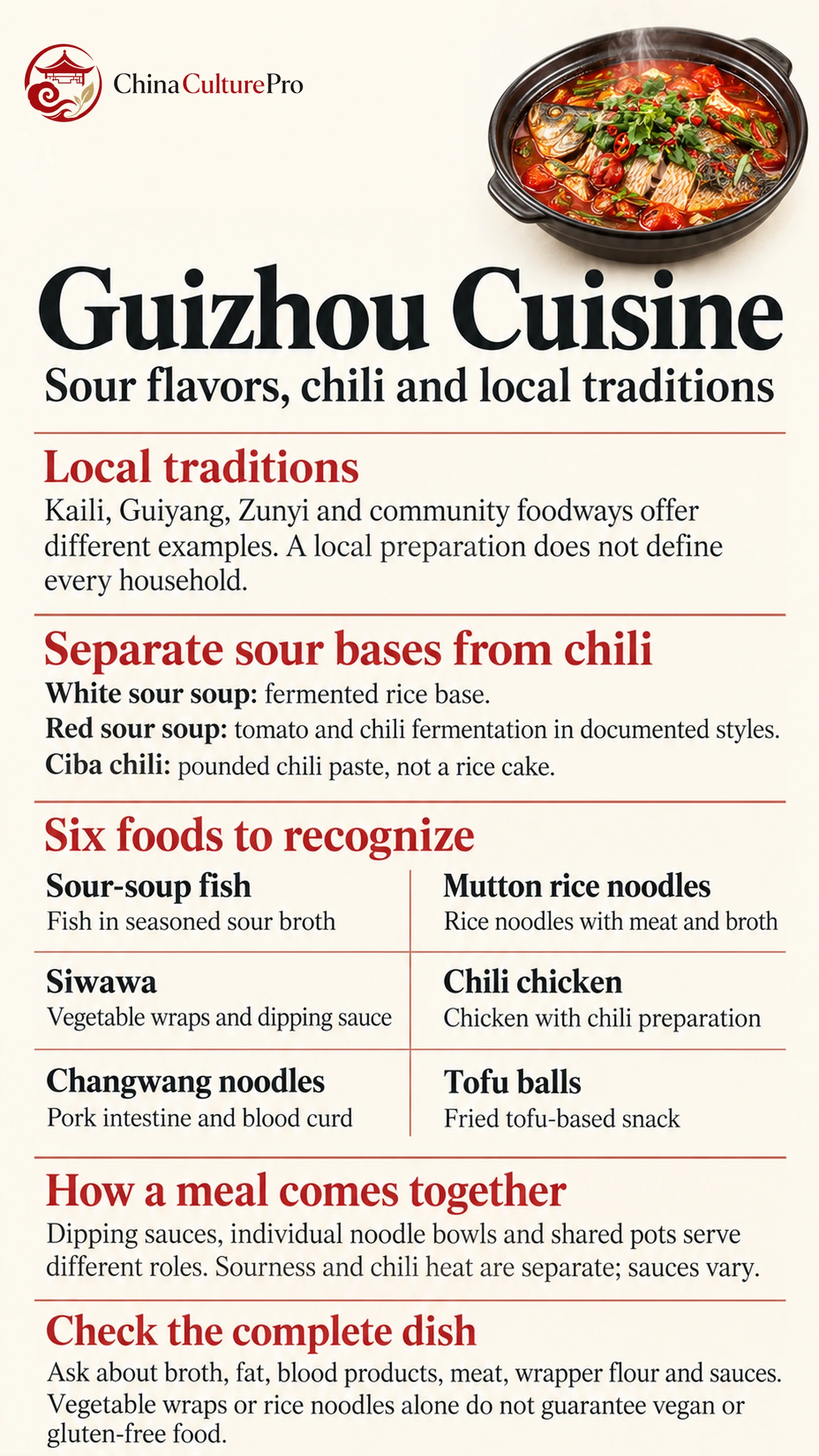
A red sour broth, a pale fermented soup and a bowl of noodles can express different Guizhou flavors. Sourness does not always mean vinegar, and a chili ingredient can be fresh, dried, pounded or preserved. Distinguishing those ingredients helps explain a menu without treating every local dish as one hot-and-sour recipe.
A Province of Local and Community Food Traditions
Guizhou includes Han, Miao, Dong, Bouyei and other community foodways, with differences between cities, counties and households. A recognizable provincial label can introduce those connections, but it should not assign one dish or flavor to every member of a community.
Kaili’s documented fish preparation offers a specific example. The national heritage account locates a living cooking tradition in southeastern Guizhou and describes its regional distribution. That record is more useful than a claim that one modern restaurant represents every village or that one unverified invention story explains the cuisine.[1]
Guiyang’s snack traditions and Zunyi’s noodle foods provide other entry points. Their different structures show why a provincial introduction needs more than a single shared pot. Restaurant menus may collect these examples together, while local everyday meals can be much more specific.[4][5][6][7]
Food traditions also continue to change. A prepared sour base can be used with different ingredients, and a familiar snack can acquire a new sauce or service format. Variation should be described through the actual preparation rather than automatically judged as a failure to follow one provincial rule.
Red and White Sour Soup, Chili and Fermentation
Sour soup (酸汤, suāntāng) is a family of preparations, not one compulsory recipe. In documented Kaili styles, a white base develops from fermented rice liquid, while a red base involves tomato and chili fermentation. Those are ingredient and process differences, not merely food coloring added to the same soup.[1][2]
The distinction also separates sourness from chili heat. A pale sour base can be seasoned further; a red base does not establish an identical heat level at every restaurant. Ask about both the base and the added seasonings. Prepared components may limit how much the kitchen can change them.
Zaolajiao (糟辣椒, zāo làjiāo) is a preserved chili preparation used in regional cooking. It differs from ciba chili (糍粑辣椒, cíbā làjiāo), a pounded preparation of softened dried chilies, commonly with aromatic ingredients. The processing changes the ingredient’s texture and how it contributes flavor.[2][3]
Ciba chili (糍粑辣椒, cíbā làjiāo) is a pounded chili preparation whose name describes its paste-like texture, not a required rice ingredient. The name’s resemblance to a rice food should not make a diner expect pieces of sticky rice in every dish using the condiment.[3]
These explanations identify ingredients. They do not provide home-fermentation instructions, fixed fermentation periods or a guarantee that any improvised sour liquid is equivalent to a documented food product.
Guizhou Foods to Recognize
The examples below separate ingredient, texture and meal format. Confirm the actual recipe where dietary restrictions matter.
| 食物 | What identifies it | What to confirm |
|---|---|---|
| Sour soup fish (酸汤鱼, suāntāng yú) | Fish cooked with a sour base, often as a shared pot | Red or white base, fish species, bones and other stock ingredients |
| Siwawa (丝娃娃, sīwáwa) | Thin wrappers filled with a choice of vegetables and accompanied by sour dipping liquid | Wrapper flour, sauce and additions; a vegetable filling is not the full recipe |
| Changwang noodles (肠旺面, chángwàng miàn) | A noodle bowl with pork intestine, blood curd and other savory toppings | Offal, blood products, noodle ingredients and chili oil |
| Zunyi mutton rice noodles (遵义羊肉粉, Zūnyì yángròu fěn) | Rice noodles served with mutton and a meat broth | Broth, chili and toppings; rice noodles do not make the dish meat-free |
| Guizhou chili chicken (贵州辣子鸡, Guìzhōu làzǐ jī) | A chicken preparation associated with pounded chili seasoning | Bones, condiment and spice level; the name does not promise the same method as every other chili chicken |
| Tofu balls (豆腐圆子, dòufu yuánzi) | A formed tofu snack, commonly fried to give a contrasting exterior and interior | Mixture, cooking oil and dipping sauce |
Local records document these foods, while individual kitchens determine portions and versions. A direct restaurant example confirms wheat-flour wrappers in its vegetable-wrap preparation, illustrating why a pale wrapper should not simply be assumed to be rice.[1][3][4][5][6][7][8]
Dipping Sauces, Noodle Bowls and Shared Pots
A dipping liquid can carry much of a snack’s flavor while remaining separate from the main ingredient. That means the same vegetable or tofu component can taste different according to the dip. It also means dietary checks must include the sauce, rather than stopping at what is wrapped or fried.
An individual noodle bowl is a different structure. Noodles, broth and toppings each contribute ingredients, and a translated name can omit components unfamiliar to the diner. The intestine-and-blood preparation in the table is a clear example: recognizing only the noodle portion would miss much of the dish.[5]
Shared sour-soup pots offer another format. Confirm what is included and how the restaurant organizes cooking and service. A food guide should not replace the kitchen’s handling of raw fish or impose one universal timing rule. The prepared base and additional ingredients determine the complete dish.[1][2]
These settings can coexist without forming one required meal sequence. A diner may choose a noodle bowl for a meal, a snack on its own or a pot to share with others. Portion and accompaniments need a menu question.
Ordering and Checking Ingredients
Begin with the base and method. Ask whether a soup uses a red or white sour preparation, whether a chili condiment is already mixed in, and whether the dish arrives as a bowl, snack or shared pot. Sourness, chili heat and any numbing seasoning should be discussed separately.
Then confirm ingredients: fish, meat, offal, blood products, stock, cooking fat and dipping sauces. A sour base may be plant-derived while the complete pot contains animal ingredients. Vegetable wraps can also bring wheat, soy or other components through the wrapper and condiments.
For gluten-free requirements, distinguish wheat noodles, rice noodles, flour wrappers and sauces rather than relying on appearance. For vegan requirements, check every component, including oil and stock. Some seasonings or prepared mixtures cannot be altered after the fact.
Chinese Food Names helps decode dish components, while Chinese Vegetarian Food explains hidden animal ingredients. Neither a regional reputation nor a vegetable-centered photograph supplies the complete ingredient list.
FAQs About Guizhou Cuisine
Is Guizhou sour soup made with vinegar?
Not necessarily. Documented styles develop sourness through rice-liquid or tomato-and-chili fermentation. Vinegar may occur in particular recipes, but adding it to soup does not explain the whole regional sour-soup tradition.[1]
Are ciba chili and glutinous rice the same ingredient?
No. The chili preparation is named for its pounded, paste-like character. The name does not require it to contain rice or make it the same food as a rice cake.[3]
Are siwawa vegetable wraps vegan?
Do not assume so. Check wrapper ingredients, dipping sauce, oil and any additions. Vegetable choices alone cannot establish the entire preparation, and wheat wrappers are used in a documented restaurant version.[8]
Is Guizhou food always numbing and hot?
No fixed level applies to every dish. Sourness, chili heat and numbing seasonings are separate. Ask about the actual preparation and whether the kitchen can adjust its prepared components.
資料來源
[1] China Intangible Cultural Heritage Network. 凯里酸汤鱼制作技艺
[2] Guizhou Culture and Tourism / GZSTV. 贵州酸汤尝一次就忘不掉
[3] Guizhou Broadcasting. 贵州才有的特色辣椒制品
[4] People’s Daily Guizhou. 贵阳传统小吃:丝娃娃
[5] Guizhou Broadcasting. 贵阳特色美食肠旺面
[6] Guizhou CPPCC newspaper. 漫谈遵义羊肉粉
[7] Guizhou CPPCC newspaper. 筑城美食荟萃 贵阳味道天作
[8] Silian Restaurant. 特色菜式