


Quick Answer: What Is Fortress Besieged About?
*Fortress Besieged* (围城, Wéichéng) is a satirical novel by Qian Zhongshu (钱锺书, Qián Zhōngshū). Fang Hongjian (方鸿渐, Fāng Hóngjiàn) returns from studying in Europe with a false degree. His efforts to find a place in professional life and in marriage give the novel two ways to ask why people want to enter arrangements they later wish to escape.[1][2][3]
- The setting: The novel begins around the outbreak of the Second Sino-Japanese War and follows Fang from a ship to Shanghai and an inland university.
- The academic story: A teaching job exposes the gap between learning and the way people display it.
- The marriage story: Marriage brings family obligations that courtship did not prepare him for.
The title gives a name to the change in how Fang sees a situation after he gets into it.[3]
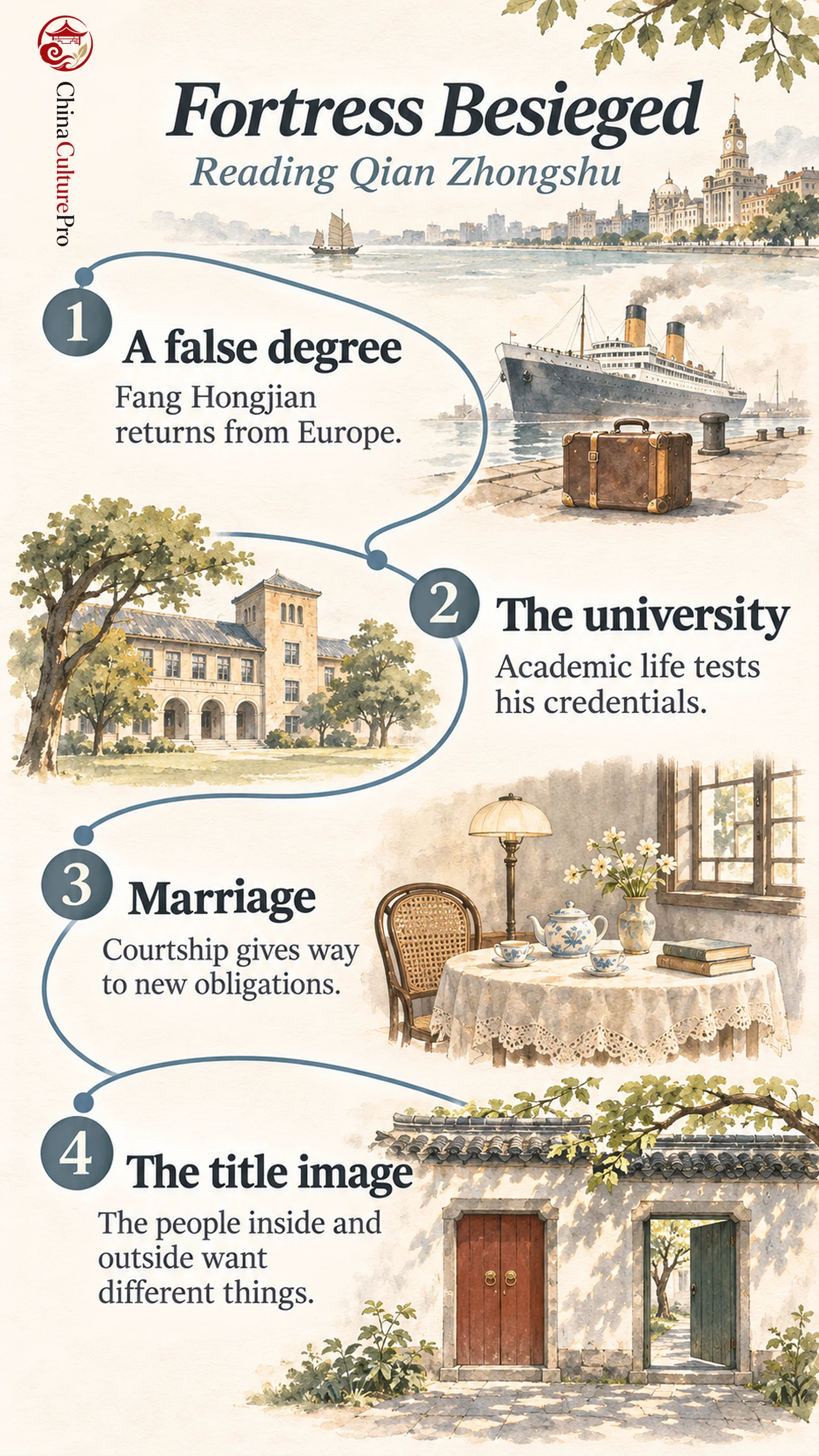
Fang keeps arriving in places that seem to offer him a way forward. Qian takes time to show how each looks once he has to live there.
Why Fang Hongjian Buys a Degree
Fang spends years studying in Europe and fails to obtain the qualification his family expects. He buys a doctorate from a fictitious American university. The degree is useful because the people he will meet may give a credential more weight than what he actually learned. It also leaves him carrying a credential he cannot honestly explain.[1][2]
The trip back puts Fang in another situation where a person’s standing depends on what others think they know. On the ship, his attention goes to Miss Pao and Miss Su in different ways. In Shanghai, his feelings for Tang Xiaofu complicate his relation to Miss Su. As one connection influences another, Fang has to live with consequences he was slow to imagine.[1][2]
What Changes at Sanlü University
Fang goes inland to teach at the newly established Sanlü University. Zhao Xinmei (赵辛楣, Zhào Xīnméi), whom he first meets as a rival in love, becomes an important companion. The journey to the university moves the novel out of the Shanghai social circle. It also brings several people who want a place in the institution together before they arrive.[2][4][5]
Once there, much of the friction concerns rank, appointments and who has the ear of the people in charge. Fang’s false degree has already raised the question of how one gets admitted to professional society. The university scenes ask what people do with a title after they have one. Lu Xun’s Kong Yiji also sets learned standing against the way a community values a person, in a much shorter form and an earlier social setting.
How Marriage Becomes a Besieged Fortress
The image comes up at a dinner where people who have studied abroad use their learning to impress one another. A guest brings up an English comparison between marriage and a gilded cage. Miss Su replies with the image of a besieged fortress, which she presents as a French saying. She can display her knowledge and take part in an exchange that matters personally to the people at the table.[5]
The military image gives their polite conversation an edge. A marriage resembles a fortress whose outsiders want in and whose inhabitants want out. Its force comes from the change of viewpoint. A person outside sees what membership might promise. A person inside has to face the obligations that come with it.[3][5]
Fang meets Sun Roujia (孙柔嘉, Sūn Róujiā) through the group traveling to the university, and they later marry. After they return to Shanghai, each has relatives nearby. An argument between spouses can therefore become an argument about whose family can help, and what that help will require. Living together makes small questions about money, work and relatives consequential. Their arguments give the title a domestic setting, but they also recall the academic story. A position a person wanted can become one they spend much of their time defending or trying to leave.[1][4][5]
How to Read Qian Zhongshu’s Satire
Watch the differences between the status a character wants, the explanation they give for wanting it and the way another person hears that explanation. Fang is often close enough to see through other people’s pretensions. That does little to stop him from depending on the same measures of success. The narrator’s comparisons are often the quickest way to see the difference.[1][4]
Qian moves among romance, work and marriage so that no one setting accounts for all of Fang’s problems. Eileen Chang’s Half a Lifelong Romance likewise lets work and family shape relationships in modern China, with less emphasis on the comedy of institutional rank.
FAQs About Fortress Besieged
When was Fortress Besieged first published?
The first Chinese book edition came out in 1947 from Shanghai’s Chenguang Publishing Company. The novel starts around a decade earlier, as the Second Sino-Japanese War approaches.[1][2]
Why does the English translation call him Fang Hung-chien?
Fang Hung-chien and Fang Hongjian refer to the same character. The English translation by Jeanne Kelly and Nathan K. Mao uses the older spelling. Fang Hongjian is the modern pinyin form.[1][2]
資料來源
[1] New Directions. Fortress Besieged, publisher synopsis and translator credits
[2] Nanjing University of Information Science and Technology Library. Fortress Besieged, Chinese publication and synopsis
[3] Xi Shi. Wei Cheng, from an elite novel to a popular metaphor
[4] Brill. The Institutional Mindset, on Qian Zhongshu’s fiction
[5] World Literature Studies. A study of metaphor and the narrative of Fortress Besieged