

Quick Answer: What Is Evening Song of the Drunken Fisherman?
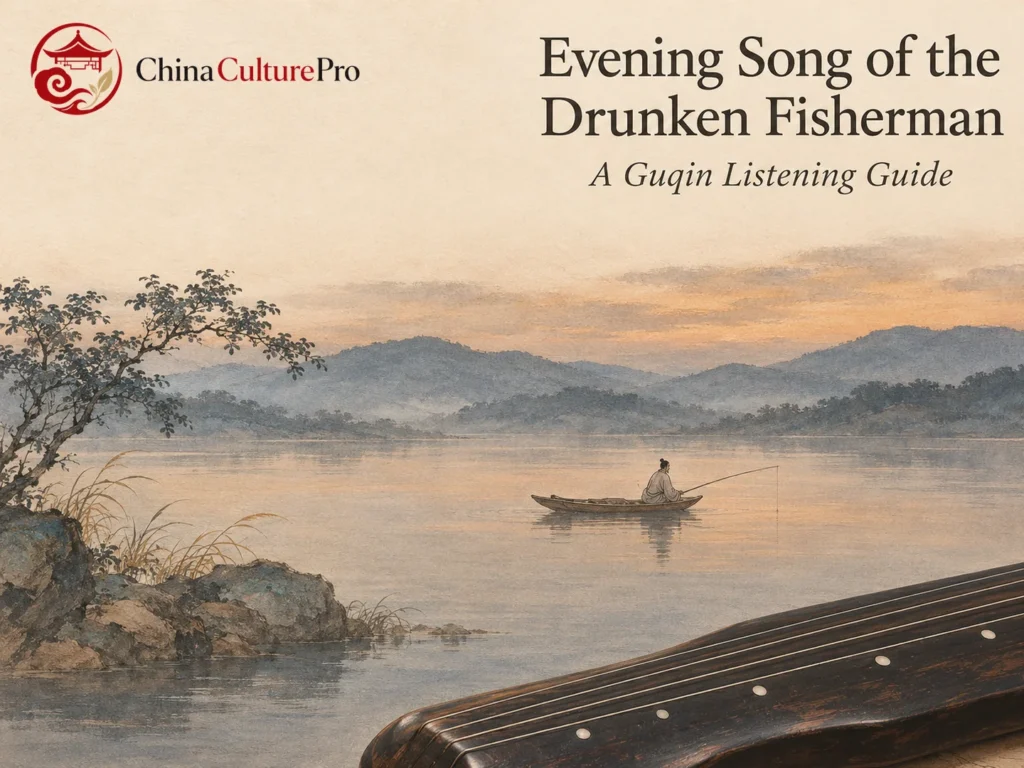
Evening Song of the Drunken Fisherman (Zuiyu Changwan, 醉渔唱晚, Zuìyú Chàngwǎn) is a title in the guqin (古琴, gǔqín) repertory. The musician shapes an instrumental scene of a fisherman singing from his boat.[2]
- Early evidence: The title is recorded in a qin handbook dated 1549.[2]
- Listening cue: Tempo shifts and uneven phrase lengths suggest an unsteady voice.[1]
- Recording: Bell Yung’s performance begins at 19:33 in the Smithsonian program.[1]
Check the collection and teacher credited for the version you hear.

A slow opening gives you one expectation about the pace. The music can then pull away from it suddenly. Hear the effect on the length of each phrase before trying to place it in a fixed count.
Early Sources and Later Guqin Versions
The Chinese Music Archive identifies a version in the 1549 Xilutang Qintong. Its preface tells of Tang poets seeing a fisherman singing from a boat. This is a traditional account attached to the score, with the surviving written evidence dating to the Ming collection.[2]
The archive distinguishes the Ming score from the later music transmitted under the same name. A modern bibliographic record also identifies two entries in the Tianwenge Qinpu, one in six sections and another in twelve. A familiar title can therefore lead to noticeably different scores.[2][3]
Hear the Pace Change in Bell Yung’s Solo
The Smithsonian lists Yung’s music at 19:33–23:38. He learned the piece from Tsar Teh-yun and plays a version linked to the Tianwenge Qinpu. Notice how the pauses and the space between attacks change when he moves into a quicker phrase.[1]
A Hong Kong recital program for Sou Si-tai describes a leisurely opening, a more animated middle and a sudden stop. It also credits the same teacher for the transmitted version. When comparing performances, listen for how quickly the last gesture comes to a stop.[4]
Read the Player and Transmission Credits
A credit can name the person playing, the person who passed on the version and a source collection. In Tsinghua University’s catalog, the player is Gong Yi and the version is credited to Wei Zhongle. Compare those credits with Yung’s program before treating the two recordings as the same rendition.[1][5]
Use the guqin guide to recognize the instrument. Yung’s program places the fisherman piece beside Flowing Water and a work on the Xiao and Xiang rivers, part of a wider set of landscape images in music.[1]
Distinguish Similar Titles
The similarly titled Fisherman’s Song at Dusk is listed for zheng in a Smithsonian recital. Drunken Ecstasy 及 Dialogue Between Fisherman and Woodcutter are separate guqin pieces. When a search returns a shortened English title, check the Chinese name before choosing a recording.[4][6]
FAQs About Evening Song of the Drunken Fisherman
Is Evening Song of the Drunken Fisherman sung?
In the credited solo performances discussed here, the guqin suggests the singing through its phrasing.[1][4]
Is the 1549 piece the exact version heard today?
The 1549 source records a piece with the title. Later versions have their own score histories and may differ in structure and music.[2][3]
Where does Bell Yung’s performance begin?
The music starts at 19:33 in the Smithsonian’s Painting with Music program, after the spoken introduction.[1]
資料來源
[1] Smithsonian National Museum of Asian Art. Painting with Music: Bell Yung, Qin
[2] Chinese Music Archive. Guqin Notes: Evening Song of the Drunken Fisherman
[3] Tianfu College of SWUFE Library. Evening Song of the Drunken Fisherman, Bibliographic Record
[4] Hong Kong Leisure and Cultural Services Department. Guqin Recital with Sou Si-tai
[5] Tsinghua University Library. Mist and Cloud over Xiao and Xiang, CD
[6] 史密森尼國立亞洲藝術博物館。 Chinese Music of the Seasons: Bing Xia, Zheng