
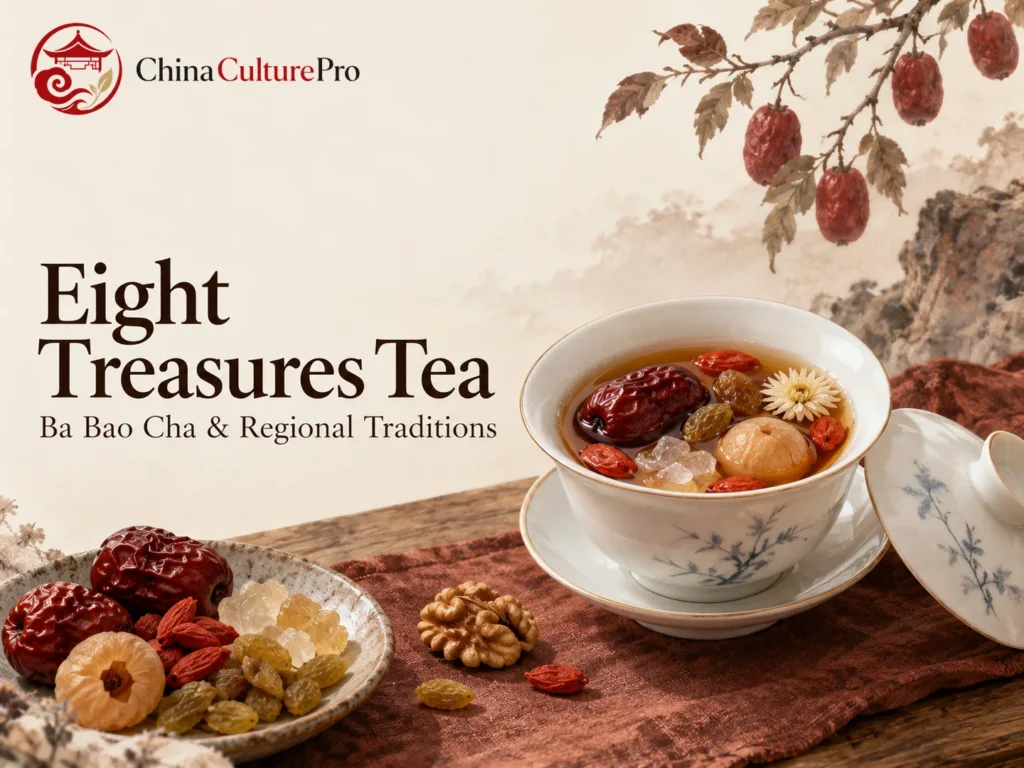

Quick Answer: What Is Eight Treasures Tea?
Eight Treasures Tea (八宝茶, bābǎo chá) is a variable blended drink associated especially with northwest Chinese tea traditions. Tea leaves, dried fruits, flowers, sugar and other additions can share one covered bowl; there is no single compulsory combination.
- Flavor: Often sweet and aromatic, with the result determined by the actual ingredients.
- Setting: A familiar drink for guests and daily social life in places such as Ningxia and parts of Gansu.
- Variation: The name does not require every version to contain exactly eight ingredients.
It is a cultural drink category, not a standardized herbal prescription or a guarantee of being caffeine-free.
A covered bowl filled with red dates, berries and floating leaves offers a different tea experience from tasting one unblended leaf. The interest lies partly in the changing infusion and partly in the welcome expressed by preparing it for someone.
Eight Treasures Does Not Mean One Fixed Recipe
Despite the name, ingredient counts can vary. A local account from Wuzhong in Ningxia explicitly allows combinations with more than eight ingredients or only a few, selected according to preference.[1] The name is therefore a useful cultural label, not a reliable inventory of the bowl.
The distinction matters when comparing a family version, a restaurant serving and a packaged blend. One may use rose jam and walnuts, another flowers and dried fruit, while a seller may choose a more narrowly defined commercial mixture. Those differences do not, by themselves, show that one is pretending to be the drink.
Within Chinese tea culture, Ba Bao Cha belongs to a broad world of social drinking and adaptation. It should not be described as one of the leaf-processing categories in the same way as green tea or oolong. A tea leaf can be an ingredient in the blend without defining every other component.
Ingredients and the Flavors They Contribute
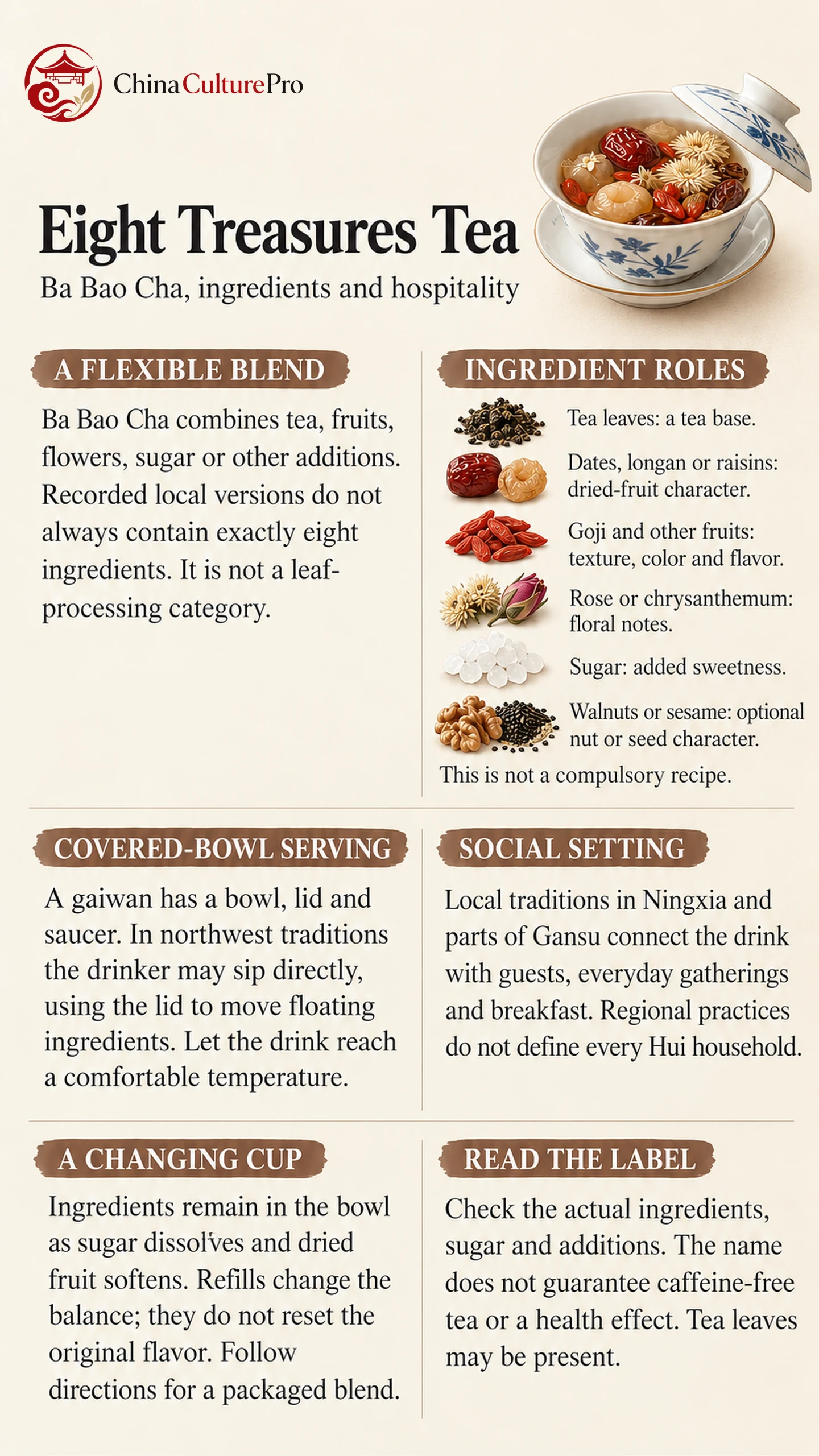
Commonly recorded additions include red dates, dried longan, raisins, goji berries, sugar, rose preparations, sesame and walnuts. Local lists also include other dried fruits and different flowers.[1][2]
| 材料類別 | What it can bring to the bowl |
|---|---|
| Tea leaves | A tea base whose flavor depends on the leaf selected. |
| Red dates, longan or raisins | Dried-fruit character and varying degrees of sweetness. |
| Goji berries and other fruits | Additional fruit texture, color and flavor as they infuse. |
| Rose or chrysanthemum | A floral component when included in that version. |
| Rock sugar or other sugar | Added sweetness that dissolves into the water. |
| Walnuts or sesame | A different nutty or seed-like element in versions that use them. |
This is an ingredient-role guide, not a recipe requiring every row. The wider subject of Chinese flower infusions also helps distinguish a flower ingredient from the tea leaf itself.
The sweetness of a particular bowl cannot be inferred from the name alone. Added sugar, fruit selection, their proportions and the amount of water all affect it. Nor should the visible presence of a familiar plant be treated as evidence of a specific health effect.
Covered-Bowl Tea and Northwest Hospitality
The gaiwan (盖碗, gàiwǎn) consists of a bowl, lid and saucer. In this setting it can be a vessel from which the drinker sips directly, rather than solely a brewer emptied into small tasting cups. That differs from many modern gaiwan and teapot comparisons centered on small-vessel infusion.
Local descriptions from Linxia in Gansu connect the prepared covered bowl with receiving relatives, friends and guests. They also describe using the lid to move floating ingredients and leaving it slightly angled while sipping.[2] The lid is a practical part of drinking, not merely an ornamental cover to remove permanently.
Ba Bao Cha is also associated with Hui communities and other northwest settings. Hui culture supplies a wider context, but regional and household differences should remain visible. One local method does not define every Hui person’s practice.
In Wuzhong, the drink also belongs to everyday breakfast and early-tea settings, alongside breads, fried snacks or other foods.[1] This gives it a place within Chinese breakfast traditions as well as guest hospitality. It is not reserved only for ceremonial occasions.
How the Drink Changes While You Sip
Unlike an infusion that is completely drained from its leaves, a covered bowl can keep ingredients in contact with the water. Sugar dissolves, dried fruits soften and the balance changes while the drink is consumed or topped up. The first sip and a later refill may therefore taste different without anyone changing the ingredient list.
Let the drink reach a comfortable temperature and use the lid carefully to hold back floating material if following a covered-bowl method. A narrow opening should not become an invitation to sip a drink that is still too hot. Hosts and venues may serve the blend differently, so observe the actual arrangement rather than imposing one technique.
A refill dilutes what remains while extracting more from the ingredients. Adding water does not automatically restore the original balance. If you are preparing a packaged blend, its directions provide a more relevant starting point than a universal steeping time for all Ba Bao Cha.
The visible ingredients are part of the experience, but the purpose is not to count them repeatedly or judge whether the bowl looks sufficiently crowded. A smaller mixture can still have a coherent flavor.
Reading a Modern Eight Treasures Tea Label
Modern tourism and product descriptions continue to present Ba Bao Cha through variable mixtures and local identity.[3] A specific commercial blend may list tea leaves along with fruits, flowers and sugar; that is evidence about that product, not every version bearing the name.[4]
Read the full ingredients, serving directions and date information. The name does not reveal whether tea leaf is present, how much sugar was added or whether the blend includes nuts, seeds or other additions you want to avoid.
For the same reason, do not assume the drink is caffeine-free. The presence and identity of tea leaves matter, and tea caffeine cannot be estimated simply from a colorful bowl or an “herbal” impression. A seller’s specific ingredient and product information is more useful than a broad category name.
Ba Bao Cha belongs among Chinese drinks as a flexible example of flavor, hospitality and daily practice. Enjoying that cultural role does not require adopting the medicinal promises sometimes attached to plant mixtures.
FAQs About Eight Treasures Tea
Does Eight Treasures Tea always contain eight ingredients?
No. Recorded local versions allow different ingredient counts and substitutions. The actual blend matters more than the number in its name.
Is Eight Treasures Tea caffeine-free?
Not necessarily. Some versions contain tea leaves. Check the ingredients and product information rather than assuming that a fruit-and-flower appearance means no caffeine.
Is it the same as plain Chinese tea?
No. It is a mixed drink whose added fruits, flowers, sugar or other ingredients contribute to the result. It is not one single leaf-processing category.
資料來源
[1] Ningxia Department of Culture and Tourism. Eight Treasures Tea
[2] Linxia Municipal Culture and Tourism Bureau. A Covered Bowl of Tea and Hezhou Hospitality
[3] China National Tourist Office in Singapore. Ningxia Eight Treasures Tea
[4] Herb Forest. Eight Treasures Tea: Ba Bao Cha