
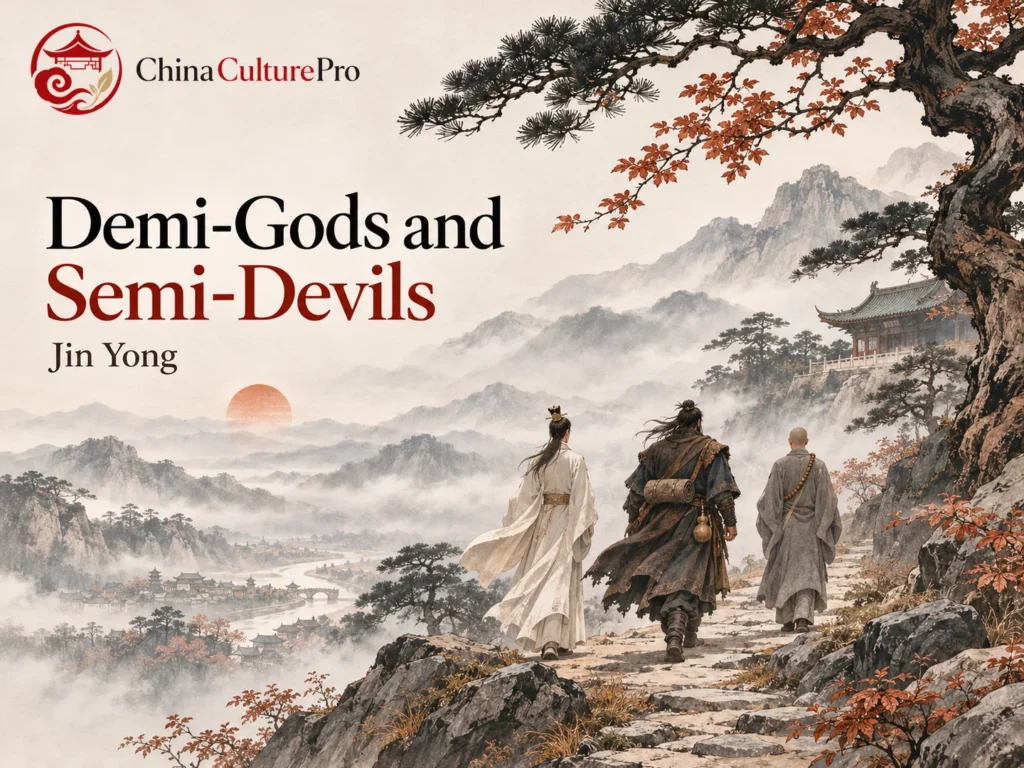

Quick Answer: What Is Demi-Gods and Semi-Devils About?
*Demi-Gods and Semi-Devils* (天龙八部, Tiānlóng Bābù) is a wuxia (武侠, wǔxiá) novel by Jin Yong (金庸, Jīn Yōng), set around the turn of the twelfth century. It follows a prince, a martial leader and a monk whose separate journeys meet. The people they come to trust make demands that their families, schools and political loyalties may not allow them to meet.[1][3][4][5]
- The setting: The story moves through a martial world that crosses political boundaries around the Northern Song.
- The structure: Three main lives come together in a much larger cast.
- The title: Its Buddhist reference connects the characters’ choices to suffering and attachment.
Start with the three leads. Each has a different reason for becoming involved in the martial world.[3][5]

A prince, a leader and a monk come to know one another after very different starts. Their bond matters because the institutions around them claim different kinds of loyalty.
The Three Main Characters
| 人物 | Where to start |
|---|---|
| Duan Yu (段誉, Duàn Yù) | A prince of Dali whose distaste for fighting does little to keep him out of a world that prizes martial skill. |
| Qiao Feng (乔峰, Qiáo Fēng) | A respected leader of the Beggars’ Sect whose origins come under scrutiny. What others learn about him changes how they read the same actions. |
| Xuzhu (虚竹, Xūzhú) | A Shaolin monk whose encounters bring him unusual skills and responsibilities far from the life he expected at the monastery. |
Their arcs are easier to distinguish if you ask what each person wanted before the story began to give him power. Duan Yu and Xuzhu are pulled into responsibilities they did not set out to gain. Qiao Feng begins with standing and has to act when its foundations are called into question.[3][4][5]
The skills readers remember are another way to tell the protagonists apart. Duan Yu is associated with a footwork technique that lets him evade opponents. Qiao Feng is famous for powerful palm strikes. The difference fits the tension at the start of their stories. One man wants to get out of fights and the other is already a fighter whom others look to for leadership.[2]
How the Three Stories Come Together
A limited identity spoiler follows. Qiao Feng learns that he is of Khitan origin and is also known as Xiao Feng (萧峰, Xiāo Fēng). He grew up among people who had come to think of him as one of their own. Once the discovery becomes public, his old relationships take on a new significance. People around him reinterpret the things he did as a leader in light of what they now believe about his ancestry.[4][5]
The three men swear brotherhood. That commitment offers a different basis for belonging from a title, a monastery or an inherited affiliation.[4] A prince of Dali and a monk from Shaolin answer to institutions that make different demands on them. Their choices have consequences across courts, schools and martial groups. That gives a reunion or a promise weight even before you know every faction involved.[3][4]
Where the Buddhist Title Comes From
The Chinese title refers to eight classes of nonhuman beings in Buddhist tradition, among them heavenly beings and dragons. Jin Yong borrows the phrase for a story about human characters. You can read it alongside the book’s interest in attachment and suffering, without assigning each hero a single place in a chart of supernatural beings.[3]
The three lives show how closely power and frustration can follow each other. A person who wants no part in violence may gain great power. A respected man may find that reputation depends on beliefs he cannot control. A monk may gain obligations that put the life he expected further out of reach. Reading the title this way leaves room for the book’s humor as well as its tragedies.
How to Read the Novel and Its Adaptations
The novel began as a newspaper serial and was later revised. The Hong Kong Heritage Museum preserves material from the original run and a later revision. Screen adaptations can arrange storylines and character introductions differently. When accounts disagree on a minor scene, check which edition or adaptation is being discussed. The serial and the collected text are different stages of the novel’s history. Jin Yong also revisited the text decades later, so a modern Chinese edition can differ from the one an older adaptation used.[1][2][1][2]
Readers who want a wider sense of the genre can start with the distinction between wuxia and xuanhuan. Jin Yong’s The Legend of the Condor Heroes follows a different generation and makes a useful second example of what a martial community asks of a hero.
FAQs About Demi-Gods and Semi-Devils
When did Demi-Gods and Semi-Devils first appear?
The novel ran in newspaper installments from 1963 to 1966, including in Hong Kong’s *Ming Pao*. Jin Yong later revised it for collected editions.[1][2][5]
Do I need to read the Condor novels first?
You can start here. Duan Yu, Qiao Feng and Xuzhu lead their own story in an earlier historical setting. Reading another Jin Yong novel can help you recognize the genre’s conventions, but you can follow these three arcs without knowing the Condor books.[3][5]
資料來源
[1] Hong Kong Heritage Museum. Jin Yong Gallery, original installments and revision manuscript
[2] United Daily News. The serialization, revisions and screen versions of Demi-Gods and Semi-Devils
[3] Buddhistdoor. The Buddhist expression behind Tianlong Babu
[4] Hebei Finance University Library. Recommended reading, including Jin Yong’s Demi-Gods and Semi-Devils
[5] Taylor & Francis Online. Othello Meets Water Margin, a study of the novel’s narrative threads